
This Day in Labor History: February 21, 1824
 By
By 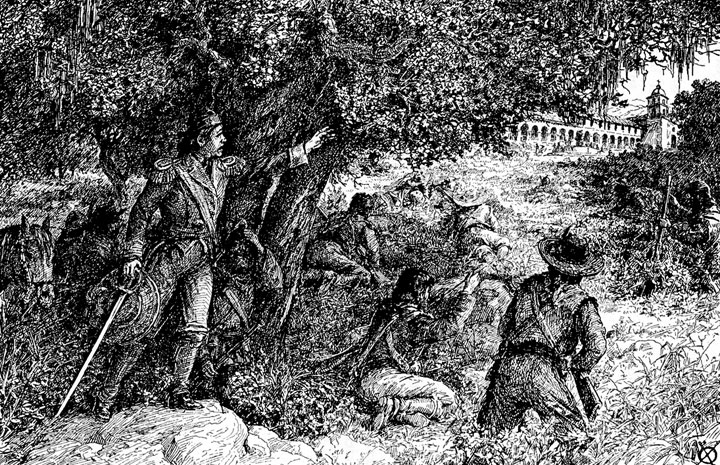
On February 21, 1824, Native Americans at three California missions revolted after a Mexican soldier beat the living heck out of a Native boy with a whip. The Chumash Revolt was already in planning before this, but the incident that was the final straw demonstrates the terrible reality of laboring under Spanish and then Mexican colonialism if you were an indigenous person in Spanish America.
Colonialism existed to extract labor and wealth from conquered lands. God was in there too for the Spanish, but decidedly secondary to wealth. You gained wealth through forced labor. Sometimes that was chattel slavery, as it was for most of the Atlantic world and most certainly the American colonies from New York southward to Argentina. Americans’ entire understanding of the colonial period has been severely distorted by the focus on New England, the one place where slavery was less important because the economy did not really reward chattel slavery since there were no minerals and you couldn’t grow anything. Of course, New England wealth was built on the slave trade. But our vision of colonization is still too driven by religious people in funny hats and Thanksgiving and all that stuff. Even in New England though, forced labor was a thing and it was much more a thing in the rest of the Americas.
In Spanish America, this happened in many ways, often through the encomienda. These were estates given to colonizers that demanded tribute from those unfortunate enough to live on them. A 1549 law outlawed forcing people to serve as personal servants or slaves, but that was routinely ignored on the frontier. The standard tribute was either money, a cotton shirt, or a hide and a certain amount of corn per year. But Native people became peasants bound to the land for generations. When more effort was made to enforce encomienda law, the Spanish created the repartimiento. This was a system of contract labor that in New Mexico, for example, meant that Puebloan peoples had to leave their homes to serve as ranch hands on Spanish estates or to labor as domestic servants. This drastically undermined the ability of the Pueblos to survive, as their own subsistence economy required pretty constant labor for food production. Moreover, the repartimiento also applied to the missions, getting the church in on the semi-forced labor game. Governors created workshops for forced Native labor.
The Spanish expanded their colonial presence into coastal California beginning in the 1760s, building Franciscan missions up the coast. Most of the tribes of California were fairly sedentary, which made sense since that place’s ecological richness meant relatively easy access to food and shelter. This also meant they did not have the military cultures that could easily resist the Spanish. When they arrived, led by their Franciscan priests, they wrought catastrophic changes on these communities, both in terms of the disease they brought and the forced labor that began to define Native lives. Much of that was growing food near the missions so the Spanish could be fed and the indigenous people controlled and monitored. But it also meant all sorts of forced labor, from skilled labor to personal servants to sex slaves. Populations plummeted. Almost immediately, tribes revolted. Soon after Junipero Serra established Mission San Diego in 1769, resistance developed. In 1775, the Kumeyaay revolted there, organizing 800 people from nine different tribes to try and push out the Spanish. They did manage to burn down the mission, though it was soon rebuilt.
The Chumash planned their revolt for later in 1824, but after a Spanish soldier beat up a kid while visiting an imprisoned relative, they weren’t going to wait any longer. The neophytes in the mission started shooting arrows at soldiers and setting buildings on fire. The revolt spread outside mission walls and the Chumash immediately struck Santa Inés and burned it to the ground. Soldiers showed up before they were quite through and the Chumash weren’t prepared for an actual battle, so they withdrew and moved on Mission La Purisima. There was a fight, at least one soldier died, and about 19 Chumash died. They took it over when no one there knew what was happening yet, captured everyone inside, and let them all leave peacefully. The next day they captured Mission Santa Barbara for a bit.
Now, there wasn’t exactly a major plan on what to do with the Mexicans kicked out of the missions. So when the military showed up several weeks later, on March 16, they had little choice but to surrender. Many Chumash had fled to the hills. This was a common form of resistance as well. Not only was it safer, if farther away from food, but it would be another way that California tribes resisted Spanish domination. At other points in these years, the Native Americans would just disappear over night, leaving the Spanish shocked. An initial attempt by the military to find the Chumash failed, but a second expedition in June did and they were convinced/forced to return to the missions, where the Spanish had reestablished control.
The aftermath of this is interesting. You’d think there would be massive reprisals and bloodshed. But that caused a problem. See, the only way the missions could survive was through the labor required of the Native populations. So what really mattered at a moment when there was no substitute labor force and the Mexican military presence in the region wasn’t really that strong anyway was simply getting them back to work. So a Friar Ripoll of Mission Santa Barbara wrote to the governor of California. He stated that you can’t blame the Indians for this. See, they are children and they are acting as such. This is why they need that fine, fine guidance from the Franciscans. He asked the governor to let it go. Now, technically, the Mexican government had a clause in its constitution banning forced labor and stating that all people were equal. Of course, no one really believed this or certainly no Spanish operating in California at this time. But this is where the whole “Indians are children” formulation came into it. You can’t really punish these people, they aren’t equal to us and they just don’t know any better. Similarly they can’t possibly be equal to us, for the same reasons. So let’s just keep them under our control at the missions and no one has to ask too many questions.
The forced labor system in California would continue until the Americans took the place over in the 1840s. After that, a new forced labor system would develop, as whites would simply kidnap indigenous people, especially children, and force them to work as servants. This would continue until after the Civil War, with full-fledged slave raiding parties to northern California tribes by people who nominally opposed Black slavery in the South, until the federal government had to inform California that all slavery was illegal now.
This is the 591st post in this series. Previous posts are archived here.