
Trump agonistes
 By
By 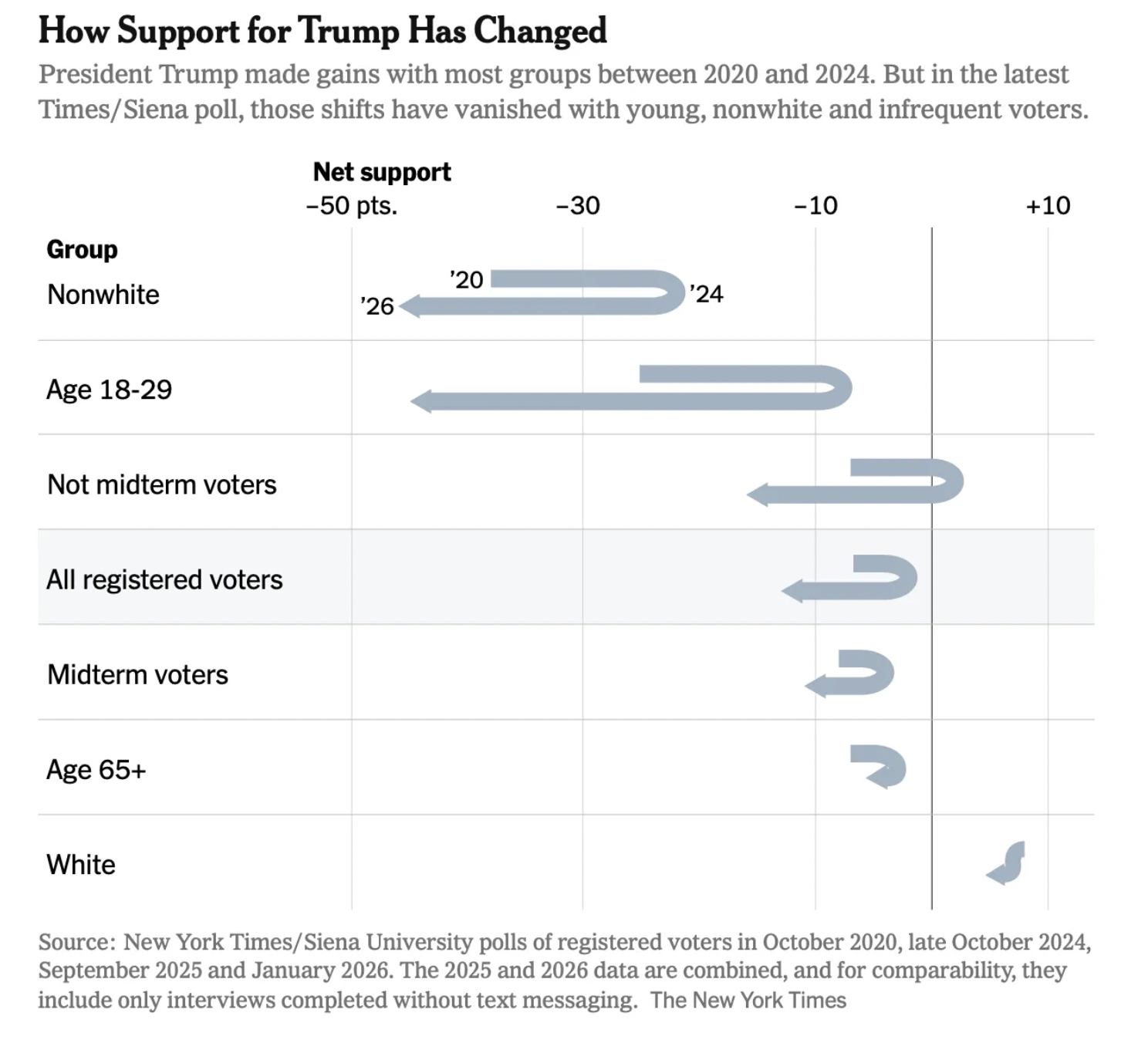
You would have to go back to Nixon — a partisan context in which it was possible for a presidential candidate to win 49 states, a Supreme Court justice resign to hand his seat to an opposition president for receiving a payment Clarence Thomas would consider an insult, and a party’s leading senators would tell a president of their own party they should resign ahead of conviction — to find a president whose approval collapsed as quickly and badly as Trump’s:
One year ago this week, Donald Trump was sworn in as the 47th President of the United States. He entered office with a net approval rating of +5 in the FiftyPlusOne.news approval rating aggregate. Despite a tumultuous first term — which ended with the president posting his worst-ever numbers after the January 6 insurrection — voters, it seemed, were willing to give him another shot.
They are no longer willing to give him that chance. Trump sits at an -16 net job approval on average today, down from +5 on his first day in office. His 21-point drop is the worst first-year performance, in the eyes of public opinion, of any president’s first term going back to at least 1948. If you compare the last year to other second-term presidencies, Trump’s is still the worst first-year performance of any president in the modern polling, with one exception: Richard Nixon (who was consumed by Watergate and other national crises at this point in his term).
Either way, Trump is in historically bad company.
As The New York Times reported this week, Trump’s support among key groups he persuaded to vote for him in 2024 — notably, young, Black, and Latino voters — has now sunk below levels measured in the run-up to the 2020 election (which Trump lost to Joe Biden by 4.5 points in the national popular vote).
Again, persuading a lot of swing voters and a lot of the press that a second Trump administration would be a caretaker presidency that for all the bluster would just bring 2018 back was a very effective campaign strategy, but the 2025 Project Presidency has therefore been disastrous as a governing strategy.
This is a good time to revisit the kind of stuff Patrick Healy — having driven Krugman from the New York Times — was writing while convening “why is Trump so overwhelmingly popular?” panels when things were starting to turn:
I want to bear down on the idea that more Americans think the country is on the right track with Trump. I have three theories to stress-test with you — or else I want to hear your own.
One: Authoritarians are popular, until they aren’t — that’s how it works.
Two: The enthusiasm is a honeymoon stemming from the November election, where Democrats got a big comeuppance from Trump.
Three: A lot of Americans think Trump is generally right in both his diagnosis and Rx of government — that nothing terribly bad is going to happen, that the State Department can run foreign aid and the Treasury and the states can run Education Department programs, that tariffs will be a net positive in the long run, and that for all the sound and fury (and illegality), Trump 2.0 is trying to help America avoid becoming like societies struggling with long-term decline, weak national identities and sclerotic economies.
“Nothing terribly bad is going to happen” — the song of 2024, and it’s regrettable so many voters didn’t figure out they were being bullshitted by cynics until it was too late.