
This Day in Labor History: December 22, 1945
 By
By 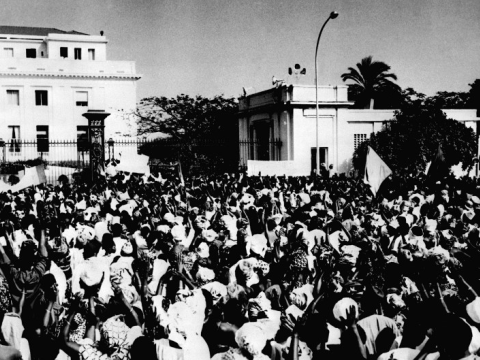
On December 22, 1945, port workers at Dakar, Senegal, in French West Africa, went on strike for higher wages. This led to a general strike that forced the French government to cave on many key issues. It also laid the groundwork for greater labor protests in the coming years that would pave the path to a broader anti-colonial resistance and eventual independence for Senegal and the rest of Africa.
World War II was not easy on the French colonies and those who lived in them. It wasn’t even like the English colonies, where at least you still had a clear government. There were competing pressures among the French colonies. Vichy was by no means strong. And as France was invaded by the Allies and freed from Nazi and Vichy control, attention to the colonies was not great. What this meant for the workers in places such as Dakar was that wages were low and conditions hard and there wasn’t much interest in improving them by the employers. By 1944, things were not great. They didn’t improve in 1945 either. Inflation was an enormous problem and wages didn’t even come close to keeping up. The lives of these workers were getting a lot worse. Some coal workers struck in late 1944, a precursor of the labor militancy to come.
Finally, on December 22, 1945, the port workers in Dakar walked off the job. This quickly spread. There were already small strikes all over the place, so this was just one of many actions we could choose here. The printing workers in Dakar and electrical workers in nearby St. Louis joined the strike. Soon it became a general strike. A lot of oppressed, colonized workers were really unhappy with their lives and determined to do something about it, which was to strike until they got more money. The next day, about 1,000 rail workers met to consider joining the strike.
French government in Senegal was weak at this time. The war had just ended of course. The colony’s governor-general quickly wired back to Paris that he was in way over his head. The French labor movement showed up to help, which was very much about helping the French state keep control over its workers as much as it was about helping the workers in Senegal. A few representatives of the General Confederation of Labor showed up. The idea here was to negotiate through this so that the workers would get something and the general feeling of anti-Frenchness would hopefully subside. Of course the labor movement was imperialist too. This reminds me of one of my favorite bits in The Battle of Algiers, when the colonel crushing the revolt in Algiers reminds the media that the French Communist Party also supported the French occupation of Algeria. Workers of the World Unite Unless They Serve Our Nationalist Agenda! So the French labor representatives really had very little to offer.
But this strike also just blew the minds of the French. They could not conceive of Africans as workers. They understood Marxism well enough, even those who hated it. But as French colonial officials had stated in 1944 at a conference in Brazzaville to create the postwar agenda for the colonies, they saw the Africans as peasants without the proletarian mindset that would cause labor problems. That was, uh, not the case. Moreover, the French were unsurprisingly racist toward Africans. In 1937, the French had passed a law legalizing trade unions in the African colonies. In 1944, planning for the postwar, they repealed that law.
The strike spread. The workers had some good ideas. The main leader, Papa Jean Ka, struck on the idea of connecting the African workers demands to the French wage scales, saying that the minimum wage could not be different for Africans and Europeans. This was outrageous to the French and the arguments with Ka drove them nuts. But he had the moral high ground and had the workers behind him. By January 14, it was more or less a general strike against the French. Colonial officials knew they could not actually win this strike. It was a matter of how to retreat in a tactical manner that kept control over the colony.
Unsurprisingly, there was dissent from different groups of workers. Some workers wanted to stay on strike, others wanted to go back. Some labor leaders were accused of accepting bribes when the urged workers to return to the job. But Papa Jean Ka really was a leader here, urging calm and discipline and noting the importance of continued striking by metal workers and commercial workers, critical sectors here if the movement was to stay together. Even when the final deal was struck, several unions remained out on strike for more. But in the end, this was a pretty united strike that held a lot of different sectors under very difficult circumstances.
The strike ended on February 7, 1946, when the French and Ka came to a deal. It was pretty good for the workers. They got some pretty serious wage gains. Government workers–many of whom were Senegalese–received family allowances that higher ranking, read French, imperial employees received. Seniority was recognized and bonuses for that were created. Wage rates were made much clearer. Unions were recognized. Moreover, once it was officially recognized that Africans would receive some of the same benefits as the French, what was the difference between them in all other aspects of society? Once the French sat down with an African trade union leader, it also legitimized the entire labor movement throughout its colonies. The French just kicked that ominous can down the road.
This was all in the French interest because they were freaked out that the end of the war could mean the end of the empire. And of course that’s exactly what happened, just not in 1946. But movements such as what happened in Dakar at the end of 1945 laid critical groundwork for the anti-colonialism that would solidify into independence movements over the next 15 years. Working together, you could stand up to the colonial power. There were a ton of lessons to be learned from that. Soon, in 1947, a railroad strike would sweep through west Africa that was directly influenced by what happened in Dakar and would move this entire movement forward significantly.
I borrowed from Frederick Cooper, “The Senegalese General Strike of 1946 and the Labor Question in Post-War French Africa,” published in Canadian Journal of African Studies in 1990 to write this post.
This is the 585th post in this series. Previous posts are archived here.