
Erik Visits an American Grave, Part 2,044
 By
By This is the grave of Len Ford.
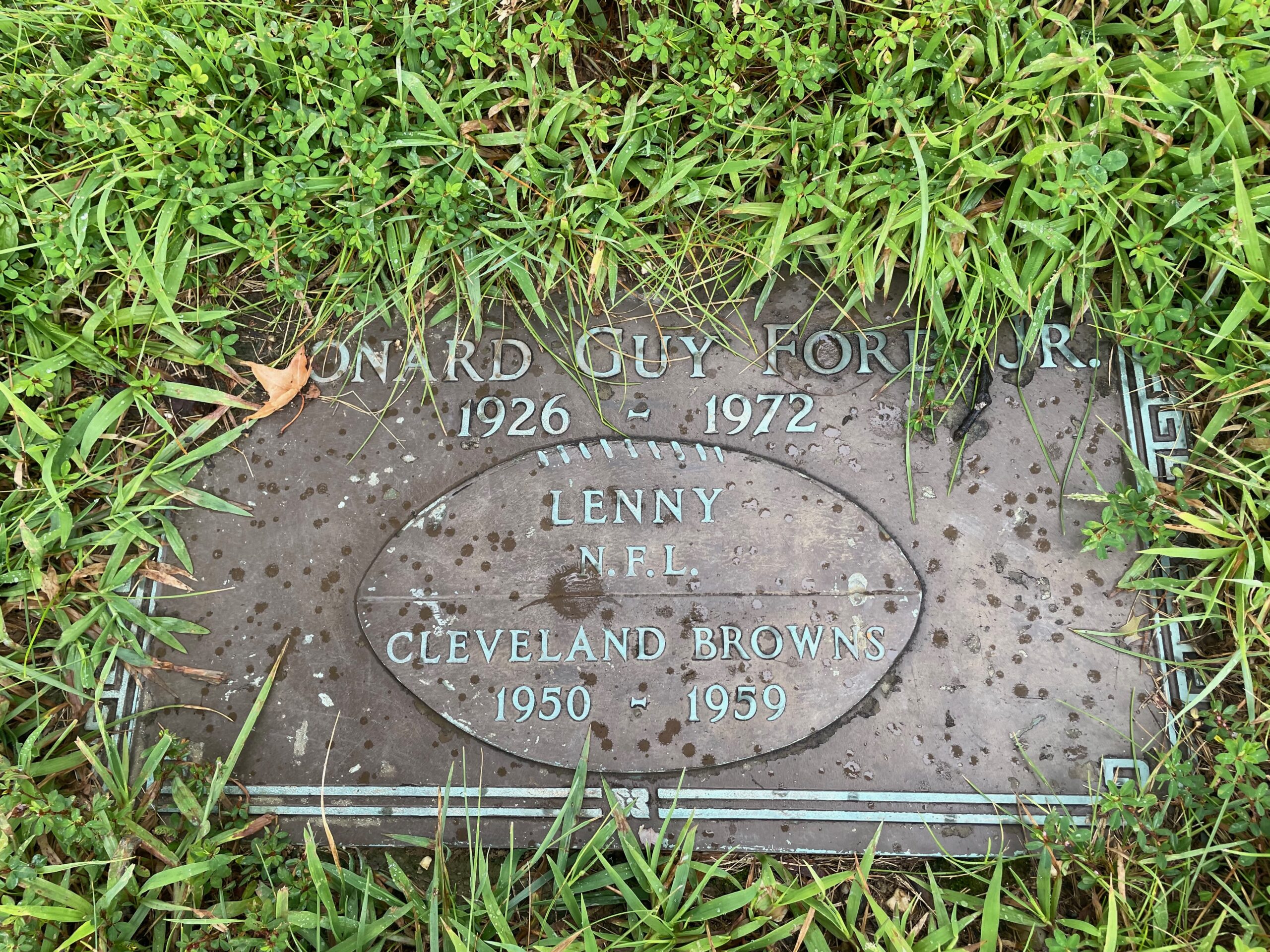
Born in 1926 in Washington, D.C., Ford grew up in the stable Black families that the federal government provided. In short, the federal government was the most important employer of Black Americans in the country for a long time and while conditions certainly weren’t equal, they were stable. Ford’s father was a skilled laborer who worked for the Government Printing Office. The family also had reformist backgrounds. His mother had worked in the settlement houses. That movement is usually associated with immigrants, but there were plenty of Black settlements too, the idea being generally to provide assistance and space for the poor in the city to improve their lives.
Their son Len was a good athlete who played multiple sports in high school and ended up choosing football. He went to Morgan State to play in college. That only lasted a year though because Ford joined the Navy in 1945. That in itself didn’t last long as it was the end of the war and he was soon mustered out. He had already proven he was too good of an athlete to compete at the Morgan State level. So he was able to attend the University of Michigan, which had an integrated team. He was a huge guy for the era, at 6’5″, which is the size of a player today. He was perfect as a tight end and played pretty good defense too. He was part of the undefeated 1947 Michigan team, one of the best of that era.
So Ford should have been a top pick in the NFL draft, right? Nope. That’s because the NFL was still almost entirely segregated. A couple of teams had integrated in 1946, but most were still segregated. Meanwhile, the All-America Football Conference had formed to challenge the NFL and did so in part by allowing Black players. It only lasted until 1949, when the NFL stole a couple of teams (the 49ers, the Browns, and the first iteration of the Colts). But it was obvious that the NFL could not keep up its segregationist policies either. Ford played for the Los Angeles Dons.
Ford was drafted by the Browns in the 2nd round of the AAFC dispersal draft. Browns coach Paul Brown decided to make Ford strictly a defensive end. It worked out well. Ford became a stalwart of the Browns defense for years. Ford helped lead the team to the 1950 Championship, defeating the Los Angeles Rams. This happened despite that fact that Ford took an elbow to the face during that season by St. Louis Cardinals Pat Harder that effectively destroyed his face, breaking several bones and requiring reconstructive surgery. That almost led to Ford missing the title game but he begged to be activated and so he did play. In 1951, Ford was first team All Pro and required constant double teaming to keep him away from the quarterback, freeing up other Browns blitzers. He was named to first team All Pro again in 1952, 1953, and 1954. The Browns were good in all of these years and won the title again in 1954 and 1955. Ford was merely second team All Pro in that latter year.
Things began slipping in 1956. The Browns weren’t very good and Ford wasn’t what he once was. His body was beginning to age and it seems his attention to the game had begun to wane as well. He showed up to camp in 1957 well above his playing weight. He got his ass in shape and, now over 30, he became a mentor to the team’s young players, including its legendary running back Jim Brown. Ford had some injuries in that season, though the Browns made it to the title game, losing to the Lions. I love the idea of a Browns-Lions title. May it happen in the Super Bowl someday. Someone would have to win!
After the 57 season, the Browns traded to the Green Bay Packers. This did not go well. The Packers were horrible. They won one game. Late in the season, Ford broke some fingers on his hand and couldn’t play. So the Packers just decided not to pay him the rest of his contract and then released him! Unsurprisingly, Ford sued. He won too, in 1961. He got the rest of his contract, plus $10,000 in other damages, though I’m sure much of that ended up with the lawyers.
At the time, Ford was seen as a real superstar. He was first in NFL history in recovered fumbles when he retired. Now, that’s something of a luck stat, but you don’t get to first without being pretty great. He and Gino Marchetti were the defensive ends on the 1950s All Decade Team and in 1969, Ford was voted the second greatest defensive end of all time, only behind Marchetti.
Unfortunately, Ford’s post-football career did not go well. He was quite well off as player. He married a woman who became the first Black woman judge in the state of Michigan. He worked real estate in the offseason, since you really did have to work as a NFL player the rest of the year. After retirement, he attended law school briefly but dropped out. He ended up working at a Detroit rec center, but his last years were dominated by an addiction to booze. His friend, the pitcher Don Newcombe, later told a reporter, “He became a wino, stumbling around in alleys. He gave up his life for alcohol.” Yucky.
In 1972, Ford had a heart attack and died, at the ripe old age of 46. Sad stuff. Four years later, he was inducted into the Pro Football Hall of Fame.
And hey, Merry NFL Christmas! I suppose I should be opposed to the NFL bigfooting the NBA’s traditional coming out day. On the other hand, football! Not exactly the most inspiring life story to celebrate it, but hey, such is the way of the world sometimes.
Len Ford is buried in Lincoln Memorial Cemetery, Suitland, Maryland.
If you would like this series to visit other members of the NFL 1950s All Decade Team, you can donate to cover the required expenses here. Gino Marchetti is in Springfield, Pennsylvania and Jack Christiansen is in Fort Collins, Colorado. Previous posts in this series are archived here and here.