
Erik Visits an American Grave, Part 2,043
 By
By This is the grave of Michael Musmanno.
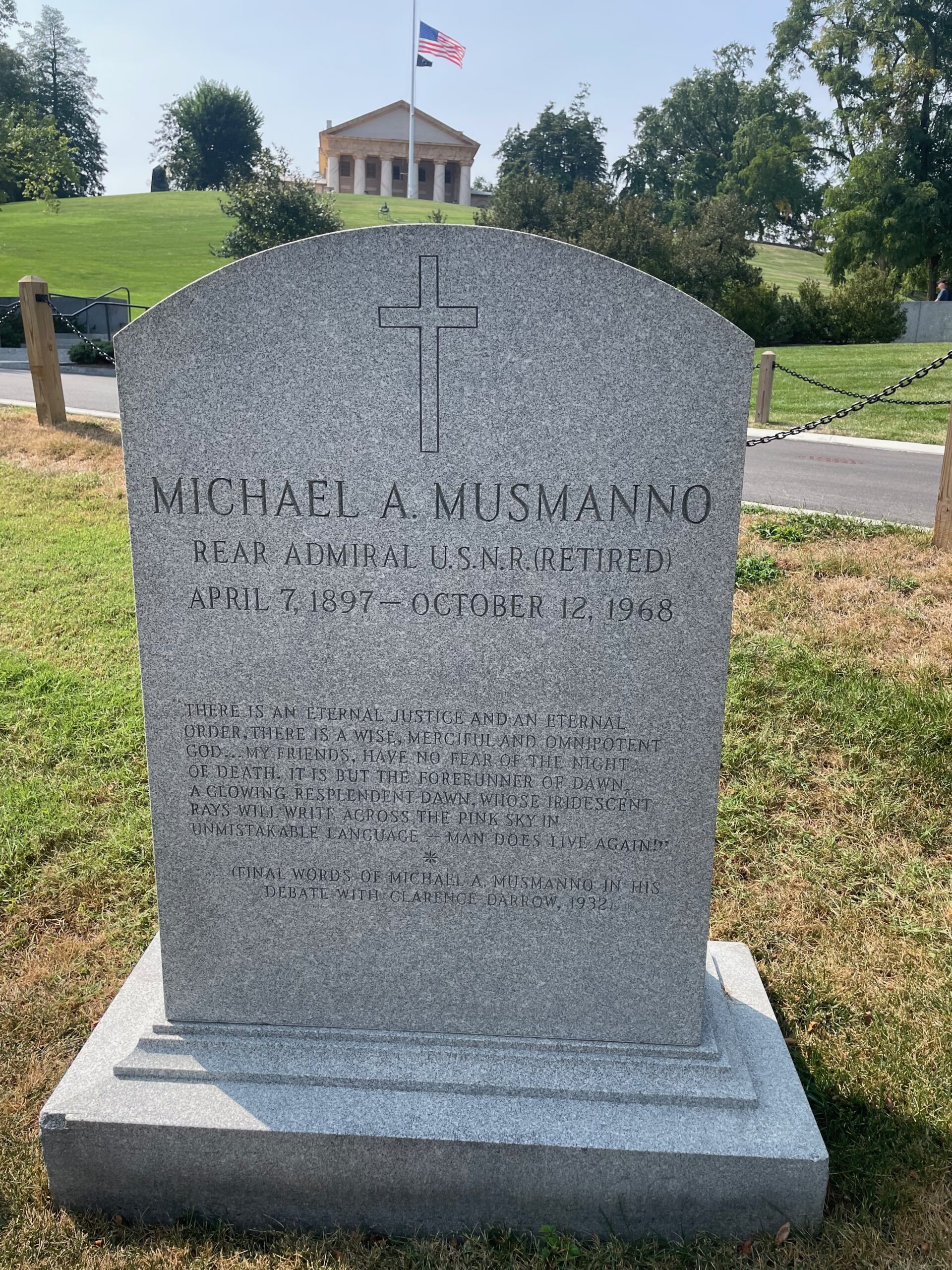

Born in 1897 in Stowe Township, Pennsylvania, Musmanno grew up in the Italian coal mining immigrant world. Lots of Italians came to Pennsylvania and worked in the coal mines. Not too many got out of there to go on and become what Musmanno became. He worked in the mines too as a kid, but he was smart and found a way into studying the law at Georgetown in 1915. I don’t know the details here of how he managed to get from point A to point B but it’s impressive. He dropped out for a bit to serve in World War I when the U.S. joined the war, but then returned and graduated in 1918. He then did a second undergraduate degree at George Washington and stayed there for a master’s and then did a graduate law degree at George Washington as well. He became a labor lawyer, the type of guy who remembered where he came from and wanted to use the tools of the bosses to help the workers.
Musmanno went back to Stowe and started a law practice. He was smart and ambitious, a young Republican. In the 1920s, it was not really anathema to be a Republican labor person. Both parties were basically anti-worker and so it didn’t really matter much yet, not until the Great Depression and the cataclysmic changes to American party politics that would result. So he ran as a Republican for the state legislature in 1926, and lost. But at the same time, he was getting involved in the defense for Sacco & Vanzetti after their unjust conviction and execution for a murder that was really an excuse to kill some Italian anarchists (Sacco did the crime, but there is no way Vanzetti was involved). This miscarriage of justice haunted Musmanno his whole life and he later wrote about it extensively.
Musmanno finally bailed on the Republican Party because he learned the lesson of what that party was. See, in 1928, he ran for office again and this time was elected to the state legislature. The next year, there was a strike in the bituminous coal fields outside of Pittsburgh. A worker named John Barkoksi was beaten to death by the state’s notorious Coal & Iron Police, which had been created in 1865 as a state supported privatized police force to do whatever the state’s industrial captains wanted. In 1930, shortly after his reelection, Musmanno wrote a bill that would ban the CIP. It passed the legislature, but the state’s Republican governor vetoed it. Musmanno was so disgusted that he resigned from his seat.
In response, Musmanno became a Democrat and ran for Allegheny County judge. He became a big supporter of Franklin Delano Roosevelt in 1932. He also wrote a short story about the death of Barkoksi that was adapted into Black Fury by Michael Curtiz in 1935 and which starred Paul Muni. That’s one way to get the attention out. He was a locally important Democratic judge. He served in the military courts during World War II and returned to Pennsylvania in 1948.
But it’s for his time during and just after the war that we remember Musmanno today. He joined the Navy in 1943 and was assigned as a military attorney. He eventually became a rear admiral. He became the Allied Military Governor of the Sorrentine Peninsula in Italy after the Allies liberated it. He did not immediately leave the military after the war. Rather, he was assigned to deal with the displaced persons issue, which is even bigger after World War II than we remember. For not only was there the aftermath of the Holocaust, there were people being shuffled around for political reasons and a massive ethnic cleansing of eastern Europe to center people of the same nationality in the same nations to eliminate that nasty and hated diversity of peoples that had defined Europe for hundreds of years before that horrible war. This was a lot to deal with. Musmanno was named head of the Board of Soviet Repatriation of Displaced Persons. That’s some nasty stuff and he seems to have hated it. For one, no one wanted to go back to the Soviet lands. It was a question of freedom for a lot of people. I assume everyone here has seen The Third Man and the role that this plays in that wondrous movie and the level of resignation that officials had when it came to that issue. If you haven’t seen The Third Man, you need to stop paying attention to politics and starting spending time on what’s important in the world, which is seeing this movie. Musmanno did what he could to help people stay on the western side of the soon-to-be Iron Curtain but of course he couldn’t save anyone and some of those who he could not ended up in the gulags. But what could he do? He sure learned to hate the Soviets though.
A respected jurist with a lot of military experience made Musmanno a prime candidate for another critically important job. This was the Nuremberg Trials. Specifcally, Musmanno was presiding judge at the Einsatzgruppen trial, charging twenty-four SS leaders with the murder of millions on the Eastern Front. Fourteen of these SS scum were sentenced to death, although only four would in fact be executed in the end. Musmanno later explained how he came to figure out the sentences. Basically, he went with the death penalty when it was obvious that the defendant had directly participated in murder and/or gave the orders for the killing. But he would make exceptions if there was any reason to do so. Frankly, he was too generous. For example, an SS officer named Erwin Schulz had led the execution of about 100 Jews in Ukraine. But because he had protested an order killing all Jewish women and children and resigned instead of killing them too, he only got 20 years instead of death. I dunno……But then it would have been hard to preside over those trials, I am sure.
After Nuremberg, Musmanno went back to Pennsylvania and was a judge on the state Supreme Court between 1951 and 1968. He was noted for his dissents, which he wrote with a flourish and in volume. In fact, he holds the record for dissents on that court. But he had his limitations. He was deeply anti-Communist, and not just in the passive way. He wanted to use the power of the courts to eliminate all commies, who he clearly saw as another version of the Nazis he dealt with in Germany. It was bad enough that the U.S. Supreme Court overruled one of his most famous acts, a 20 year prison sentence given out to a local communist leader. He also thought Henry Miller’s Tropic of Cancer was something beyond obscenity, the most disgusting thing he ever read, which he thought he should be banned from America. He issued this dissent in moderate terms:
“Cancer” is not a book. It is a cesspool, an open sewer, a pit of putrefaction, a slimy gathering of all that is rotten in the debris of human depravity. And in the center of all this waste and stench, besmearing himself with its foulest defilement, splashes, leaps, cavorts and wallows a bifurcated specimen that responds to the name of Henry Miller. One wonders how the human species could have produced so lecherous, disgusting and amoral a human being as Henry Miller. One wonders why he is received in polite society.”
He also wrote quite a bit about the problems of the poor and Italian-American history. Some of this was pretty dumb. When evidence came out about the Norse discovery of America, Musmanno wrote a book saying it could only have been Columbus, one of these weird Italian-American obsessions. I get this politically, in the sense that this was a group once oppressed trying to make a claim on America. On the other hand, it’s nonsense and at this point at least, who cares. But he did have a strong civil rights record and pro-worker record, so long as they weren’t too far to the left. But he was clearly a self-promoting blowhard and all the other justices on the court hated him.
Musmanno died in 1968, at the age of 71.
Michael Musmanno is buried on the confiscated lands of the traitor Lee, Arlington National Cemetery, Arlington, Virginia. You even get a view of Lee’s mansion in the background. Quality real estate there.
If you would like this series to visit other Americans associated with Nuremberg, you can donate to cover the required expenses here. Walter Beals is in Seattle and James Brand is in Coos Bay, Oregon. Previous posts in this series are archived here and here.