
Erik Visits an American Grave, Part 2,041
 By
By This is the grave of James Willis Patterson.
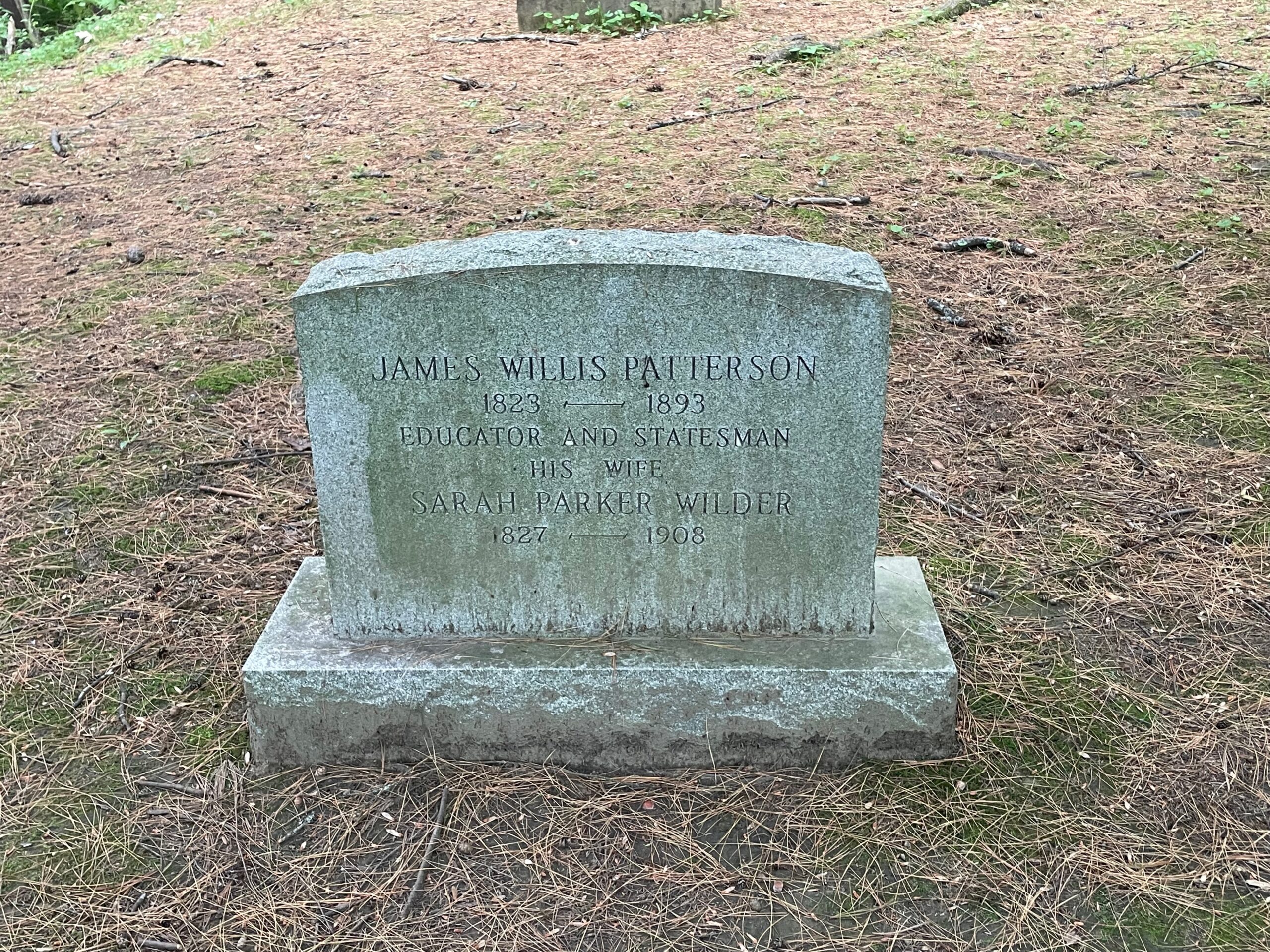
Born in 1823 in Merrimack County, New Hampshire, Patterson grew up pretty well off, went to good schools, and was on to Dartmouth. He graduated from there in 1848 and became principal of an academy in New Hampshire. He then studied law in New Haven, Connecticut for a couple of years before returning to Dartmouth to teach math and astronomy. It was an era where one could still do this many different things.
Well, Patterson became a Republican, like most of New Hampshire, and began to show interest in politics. He was elected to the state legislature in 1862 and then ran for Congress later that year. He served two terms. In 1866, the New Hampshire legislature decided to send Patterson to the Senate. He didn’t have much of a background really, but he was a locally connected guy and a solid Republican vote.
Patterson wasn’t a very interesting senator except for one thing–corruption. He got caught up in the Credit Mobilier scheme. To review, the directors of the Union Pacific Railroad decided they weren’t making enough money building the Transcontinental Railroad. So they created a fake company to steal the money. Credit Mobilier–even gave it a fancy French name–was the name of the construction company building the railroad. Southern Pacific execs used it as an ATM. It cost $50 million to build the railroad, but the UP charged the fake company $94 million and just pocketed the other $44 million. Some of that money was also used to buy off politicians and judges. And lots of politicians were more than happy to be bought off. One of them was James Patterson. The real organizer of this was Oakes Ames, a member of Congress from Massachusetts who was also a UP man. Patterson gave Ames a bunch of money to “invest” in Credit Mobilier. Ames was happy to ensure that those returns were quite rich.
Now, this all blew up in mid 1872, when the New York Sun reported on it. As it happened, Ulysses S. Grant, who was not being bought off here, was running for reelection. But the thing about Grant is that you didn’t have to buy him off. He was a very happy mark for capitalists. Grant legitimately believed that rich people were smarter than the rest of us and he wanted to be rich too. So he just trusted these guys, to the point that he nearly handed over the entire gold market to a racket that included a member of his own family. He was not personally corrupt but that’s because he was too naive and perhaps stupid to be. Instead, he just surrounded himself with lots of corrupt people. This all helped lead to the challenge from the so-called Liberal Republicans, who combined anti-corruption and anti-Reconstruction politics, into joining with the Democrats to nominate Horace Greeley for president. Grant was still reelected in a landslide.
Patterson’s claim is that he had no idea what was going on with his investment because Ames didn’t give him a written receipt. And without that, how could anything be proven? This was not overly convincing to a lot of people. Patterson also just openly lied about all of this. He lied to the House investigating committee. This was reported publicly. He may well have been tossed out of the Senate. But New Hampshire did that for everyone. It did not give Patterson another term. Instead, it replaced him with Bainbridge Wadleigh, quite a name for a very forgettable senator. Patterson wanted that second term too. But at some point, you could be too corrupt for even the rest of the Gilded Age Republican Party. Patterson managed to meet that bar. Impressive!
Patterson was still well taken care of though. He became a regent for the Smithsonian. He even returned to politics, winning a term back in the state legislature. In 1881, he was named the state superintendent for public education in New Hampshire and that occupied him for the rest of his life. He died in 1893, at the age of 69.
James Willis Patterson is buried in Dartmouth College Cemetery, Hanover, New Hampshire.
If you would like this series to visit other corrupt Republicans involved in Credit Mobilier, you can donate to cover the required expenses here. I can even create some fake stock to make you think you’ve really invested your resources wisely! Oakes Ames is in Easton, Massachusetts and William Allison is in Dubuque, Iowa. Previous posts in this series are archived here and here.