
Erik Visits an American Grave, Part 2,031
 By
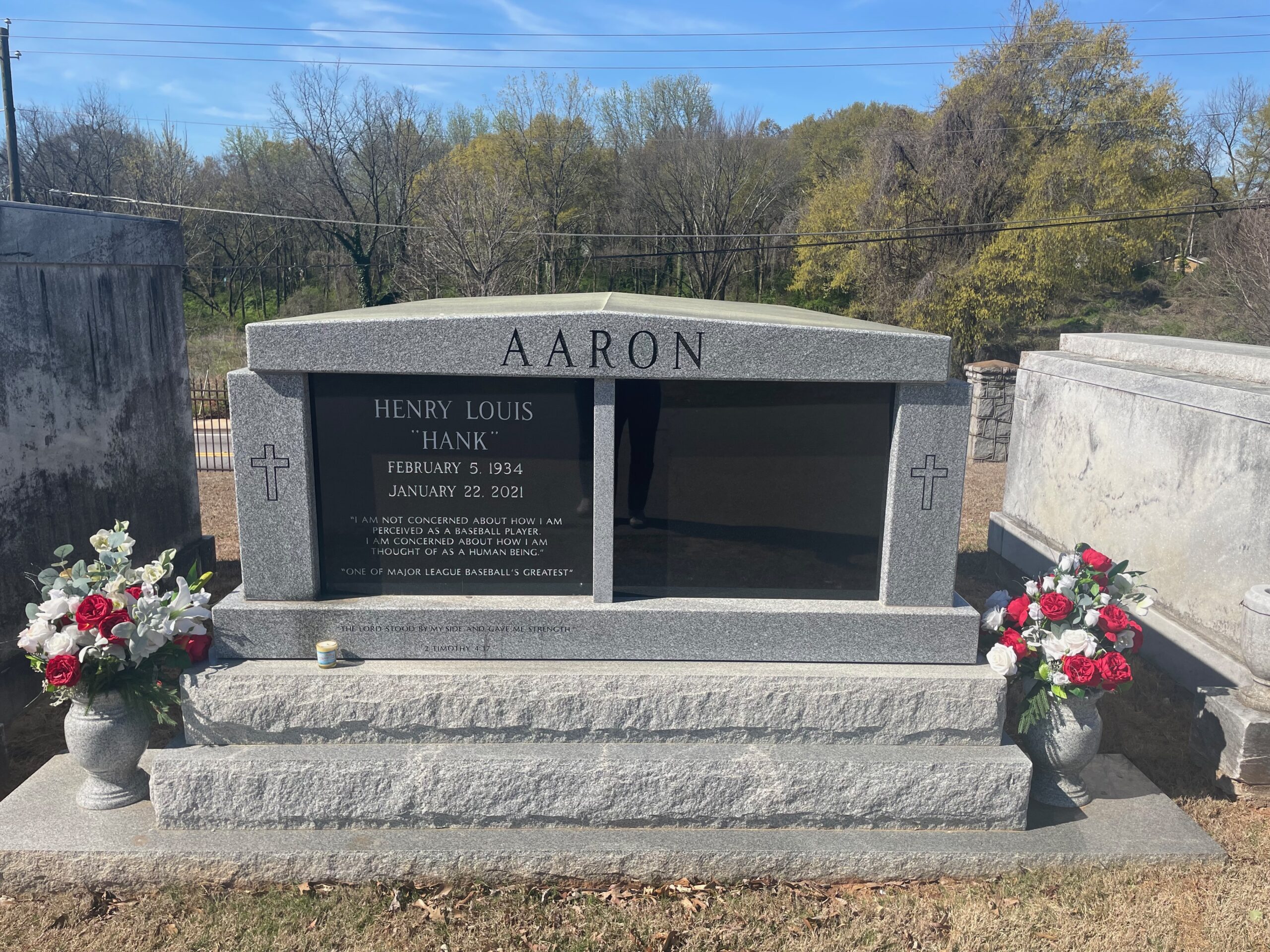
By This is the grave of Hank Aaron.
Born in 1934 in Mobile, Alabama, Aaron grew up in the Black working class. His father was a shipyard welder, when he could find work, but before World War II, there wasn’t much. Aaron grew up spending most of his time on the local sandlots and he became a talented baseball player, to say the least. It took almost no time for him to get attention from the major leagues as he grew up. The Dodgers were checking him out in 1949, which would have been fine him to sign because Jackie Robinson was his hero. That didn’t work out, as he was still awfully young. So he signed with a couple of teams in the now fading Negro Leagues. In 1951, the Indianapolis Clowns signed him to play shortstop. He was great and so two teams sent him offers. The Boston Braves offered him a bit more money than the New York Giants. God, can you imagine if Aaron and Willie Mays had been on the same teams????
Aaron signed with the Braves in 1952 and was assigned to Eau Claire in the Northern League. He then dealt with a ton of discrimination when he was promoted to the South Atlantic League, assigned to Jacksonville. He did have a lot of support from the team though, which knew what they had. They worked with the draft board to get him exempted from the military by claiming they were going to integrate the Southern League with him.
Aaron went to spring training in 1954 and it was immediately clear he would make the team. Aaron had already moved to the outfield, mostly right field. He was a good rookie, finishing 4th in Rookie of the Year voting. But the next year, he exploded onto the scene. He led the league in doubles. By 1956, he was awesome. Baseball Reference’s WAR stat had him worth 7.2 wins that year, the second of a mere 14 years in a row where he would be worth at least 6.8 wins. He was the consummate power hitter. But he was rarely the most dominant player in the game in a single year. He led the league in home runs four times, but never with more than 44. He led the league in hits twice, in runs three times, in doubles and RBIs four times. All that makes a Hall of Fame player or close to it, but what made Aaron unbelievable was him just doing this year after year after year after year. He was such a healthy player. He played at least 145 games a year between 1955 and 1970. He didn’t take a ton of walks, but he didn’t strikeout much either. Every single year, you were going to get about 190 hits, 40 homers, 110 RBIs, 30ish doubles, and then one or two of those categories would spike in that given year. Every single year.
There’s an interesting comp to Aaron that you wouldn’t necessarily expect and that’s Adrian Beltre. Beltre was just a really good player for a long long time and by the end of his career, he was one of the top third basemen to ever play, even though few saw him as the best player in the league ever except that year he went off with the Dodgers before becoming a free agent and signing with Seattle, the low years of his career. Beltre wasn’t Aaron, to be fair. Aaron was always seen as a top league player and he never had a dip like Beltre did in Seattle, but it was the amazing consistency year after year that by the time he was in his mid 30s–and still as good as ever–that he was all of a sudden near the top of almost every career statistical category.
Aaron only won MVP once, in 1957. He was great that year, hitting .322/378/600, while leading the league in runs, homers, and RBIs. That made him worth 8 WAR. MVP quality. But that was one of a mere 8 seasons where he was worth that. For Baseball Reference, his best year was 1961, when he worth an absurd 9.5 WAR, hitting .327/381/594. Now some of that is they rate his defensive metrics unusually high that year and I’ve never been convinced about measuring defensive statistics in the old days because I’ve never heard a convincing explanation of how they make those legit. But however you want to measure it, he had a lot of awesome years. That 1961, he was 8th in MVP voting. In fact, he never finished second in MVP voting either. But he was third 6 different times and top ten 13 different seasons!
This doesn’t even get us to the kind of racist shit Aaron faced when he was ready to break Babe Ruth’s all time home run record in 1974. Evil whites inundated Aaron with hate mail and death threats for daring to take the title from a favored white. It was like Jack Johnson winning the heavyweight title six decades earlier, an assault on the white race. Good thing we’ve moved beyond this racism in 2025…..Aaron handled this–and he handled his whole life this way–with an incredible level of dignity. He had every right to lash out. I can only imagine the internal turmoil and fear. Among those to step in to support him was Charles Schulz, who created a whole bit in Peanuts in the offseason after 1973 of Snoopy about to break the record and how Hank Aaron deserved the homer record more than Snoopy.
Aaron was 40 when he broke the record. He was finally fading. The Braves, at Aaron’s request, trading him to the Milwaukee Brewers. He was happy to be back in the city where he first dominated and had two more years of hitting homers, but the overall quality of play was down and he retired at the right time, at the age of 42, after the 1976 season.
After his career, Aaron became an executive for the Braves, mostly just Being Hank Aaron. He did not attend Barry Bonds’ game breaking his own home run record, not because of the steroid allegations, but because he wanted to Bonds to enjoy the game without the weight of history sitting there. He wrote his autobiography in 1990 and owned a bunch of car dealerships and restaurants. Interestingly, Aaron converted to Catholicism in 1959. While you don’t see a lot of Black Catholics, I have happened to know some because my brother-in-law was for a long time a priest at a Black Catholic church in Macon, Georgia and what was apparent was that a lot of this was a class thing. Most Black Catholics are relatively well off or at least middle class. I’m not saying people are converting to Catholicism for class snobbery, simply that it tends to attract a different kind of audience than other religious choices. In any case, Aaron ended up moving back to the Baptists later.
Later in life, Aaron made a big deal of getting his Covid vaccination in public to encourage older folks to get the life-saving vaccine. He was really old by this time and declining and in fact, he died a couple of weeks later, at the age of 86.
Hank Aaron is buried in South View Cemetery, Atlanta, Georgia.
According to Baseball Reference’s JAWS stat, Aaron is the 2nd greatest right fielder of all time, only behind Babe Ruth. If you would like this series to visit other right fielders, you can donate to cover the required expenses here. Stan Musial, ranked 3rd, is in Creve Coeur, Missouri. Mel Ott is 4th and we said hi to him not too long back. Frank Robinson, Roberto Clemente, and Al Kaline do not have graves. Mookie Betts still plays and that’s the company where he now resides, 8th all time right fielder. Reggie Jackson lives. Harry Heilmann, now the 10th best right fielder of all time, is in Southfield, Michigan. Previous posts in this series are archived here and here.
In conclusion, I’m already getting ready for the baseball season.