
A Former Director of the Los Alamos National Laboratory Speaks Out
 By
By 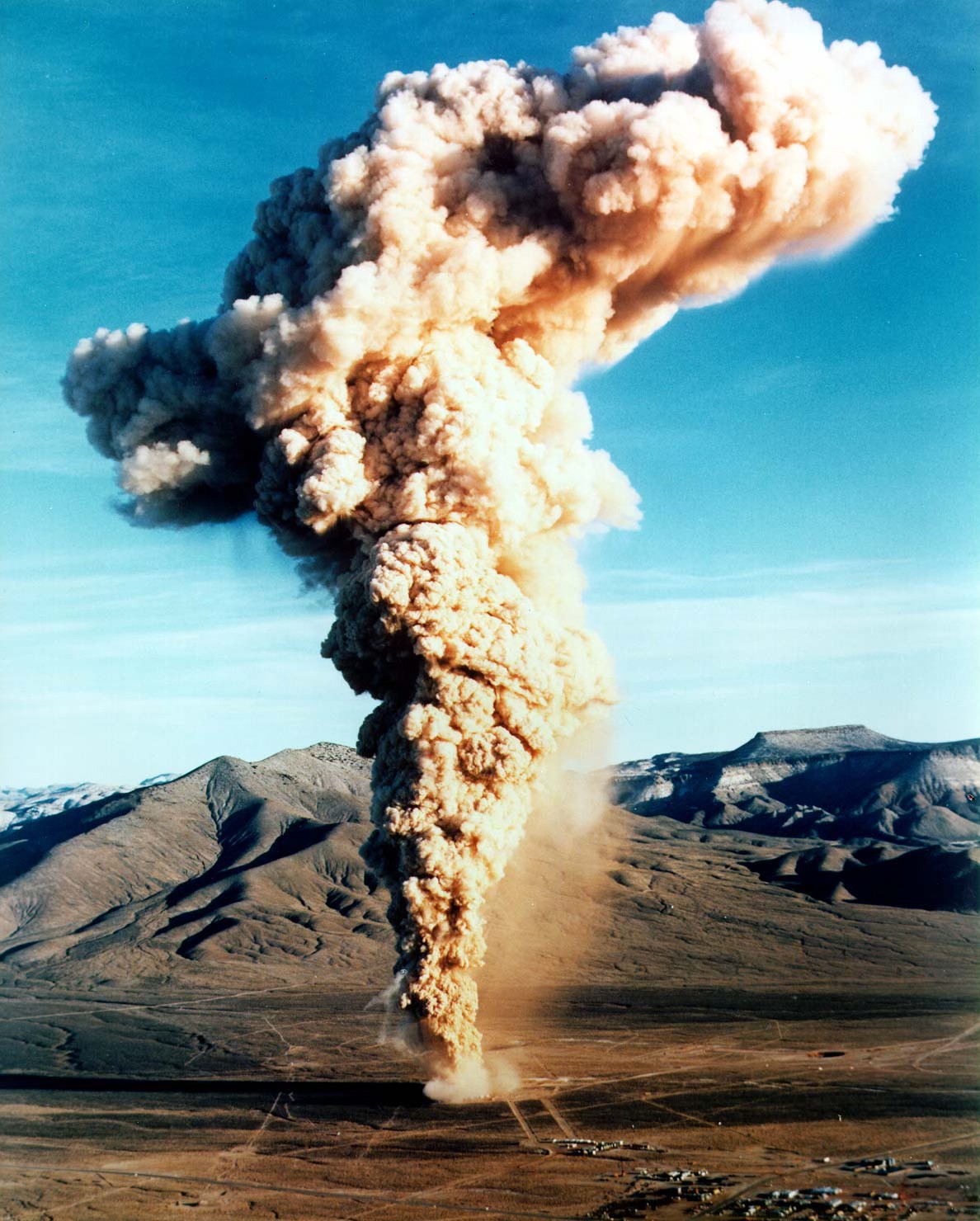
Terry Wallace, 11th director of the Los Alamos Laboratory, posted this on his facebook page:
On December 18, 1970, a nuclear weapons test was conducted in an underground shaft at the Nevada Test Site. The test, code-named Baneberry, was detonated at a depth of about 900 feet. Baneberry was a relatively small weapons test and was conducted at Yucca Flats (a large playa) in alluvial soil derived from surrounding deposits of volcanic tuff. Within the alluvium, there were intermittent seams of montmorillonite clay that were saturated with water. The drill hole was filled with a concrete plug and sorted materials; the procedure for plugging the hole was consistent with previous tests at Yucca Flats, which aimed to fully contain the radioactive products within a cavity produced by the nuclear explosion.
In the case of Baneberry, the detonation seemed normal until about 3 ½ minutes after the “boom,” when a large fissure opened up a few hundred feet from the test shaft, and a boiling cloud of radioactive debris rose above the Nevada desert (Figure 1 is an image of the Baneberry release). The cloud rose about 10,000 feet above the test and was visible in Las Vegas, 100 miles away. The cloud spread radioactive dust across a broad area, contaminating 86 workers at the test site. The total radioactive release was 6.7 megacuries (for comparison, Chernobyl released 200 megacuries), including 80,000 curies of iodine-131. Two of the workers who were contaminated died in 1974 from myeloid leukemia. The accident resulted in a six-month suspension of nuclear weapons testing, and a root cause analysis revealed three geological issues that combined to create the release: an unrecognized fault in the alluvium, a buried escarpment between the alluvium and limestone, and the structural weakness of the water-saturated clay.
The summary conclusion of the root cause analysis indicated that a thorough geological analysis was needed for all future nuclear tests, and it recommended the establishment of a containment evaluation panel (CEP) for the approval of any tests. This panel required that “successful containment means no radioactivity detectable offsite, and no unanticipated release of activity onsite.” Of the 200+ tests that occurred after the creation of the CEP, only four tests had releases—the worst of which was a test called Diagonal Line, detonated about a year after Baneberry, and resulting in a release of 6,000 curies.
I started my career at Los Alamos National Laboratory as an undergraduate student in 1975 employed by the J Division, which was responsible for providing the containment package for LANL nuclear tests. My first project involved modeling the small earthquakes that occurred after an explosion. Once an explosion is detonated, it creates a cavity by vaporizing and compressing the surrounding materials. This cavity is expected to collapse over the following days or weeks to create a porous chimney that traps the gases produced in the explosion. This containment strategy is unique to the geology of the Nevada Test Site and is not applicable to other testing environments, especially crystalline rock (like the North Korean Test Site). Over the three years I worked as a student at LANL, I analyzed data from more than 70 tests, which initiated my career in forensic geophysics and eventually led to my becoming the 11th Director of LANL.
On September 23, 1992, the U.S. conducted its final explosive nuclear test, code-named Divider (a LANL test). Shortly after the test, President Bush announced a test moratorium that was extended indefinitely by President Clinton. This ushered in a new era in which nuclear weapons were evaluated not through explosions but by scientific tools that verified material properties through dynamic testing and advanced computer simulations that encapsulated the complex physics of nuclear reactions and explosions along with the material properties derived from non-explosive experiments.
The Directors of Los Alamos, Livermore, and Sandia are required to write an annual stockpile assessment letter that assures the nuclear stockpile’s reliability; this letter is finalized after a yearlong assessment of the safety, reliability, and performance of both the nuclear and non-nuclear components of all weapon types in the U.S. arsenal. The letters are highly classified and closely held, but no letter has indicated that the U.S. needs to return to nuclear testing. This is hugely significant not only for the U.S. but also for the world—the moratorium on testing represents a small step toward a world that recognizes that nuclear weapons are not weapons of war, but rather instruments of deterrence.
On October 28, President Trump announced that the U.S. would restart nuclear weapons tests: “Because of other countries’ testing programs, I have instructed the Department of War to start testing our nuclear weapons on an equal basis. That process will begin immediately.” Although his statement lacked clarity regarding what “immediate testing” would entail, it was widely assumed he meant explosive testing of weapons, thus breaking the 33-year moratorium. This assumption stemmed from the first Trump administration’s suggestion in 2019 that such testing was necessary. In January 2025, the Heritage Foundation released a paper titled “America Must Prepare to Test Nuclear Weapons” (Figure 2 shows a screenshot of the report cover). It is important to note that the Heritage Foundation is behind Project 2025, which the Trump Administration has followed closely.
The worldwide response to Trump’s announcement was uniform and best described as “outraged.” Moreover, U.S. experts stated that preparing for a safe underground test would require 18 to 36 months. However, this elicited a response from the Heritage Foundation, suggesting, “the President may order the above-ground testing of a nuclear weapon… And while the United States leaving the [Nuclear] Test Ban Treaty may not be optimal and may indeed have negative downstream effects, doing so may be necessary to stave off further adversarial escalation.”
Today, the Secretary of Energy, Chris Wright, attempted to downplay the idea of explosive testing but could not clearly define what “immediate testing” would entail beyond the current activities of the U.S. government. Nevertheless, given that public statements from the Trump administration continue to assert that Project 2025 is not necessarily “their” policy plan while simultaneously carrying out its implementation, there is growing concern about how even statements regarding testing will be perceived by Russia and China.
Above-ground nuclear tests have been outlawed by international treaty since 1963, and even the suggestion of an atmospheric test is exceedingly troubling—such testing is unnecessary and presents a significant risk of radioactive fallout affecting U.S. citizens, not to mention the inevitable tit-for-tat responses from other nuclear nations.
I cannot fathom the extent of harm the Trump administration has inflicted on the environment and science, but nuclear testing is beyond the pale. An atmospheric test of U.S. weapons would produce fallout three to ten times larger than that produced by Baneberry; however, this would not be an accident but an intentional contamination of our country. The implications of coal use, removal of EPA regulations on emissions, and radiation present a dystopian distain for America.
This is the Heritage Foundation report that Wallace references.