
Erik Visits an American Grave, Part 1,997
 By
By This is the grave of Henry Raymond.
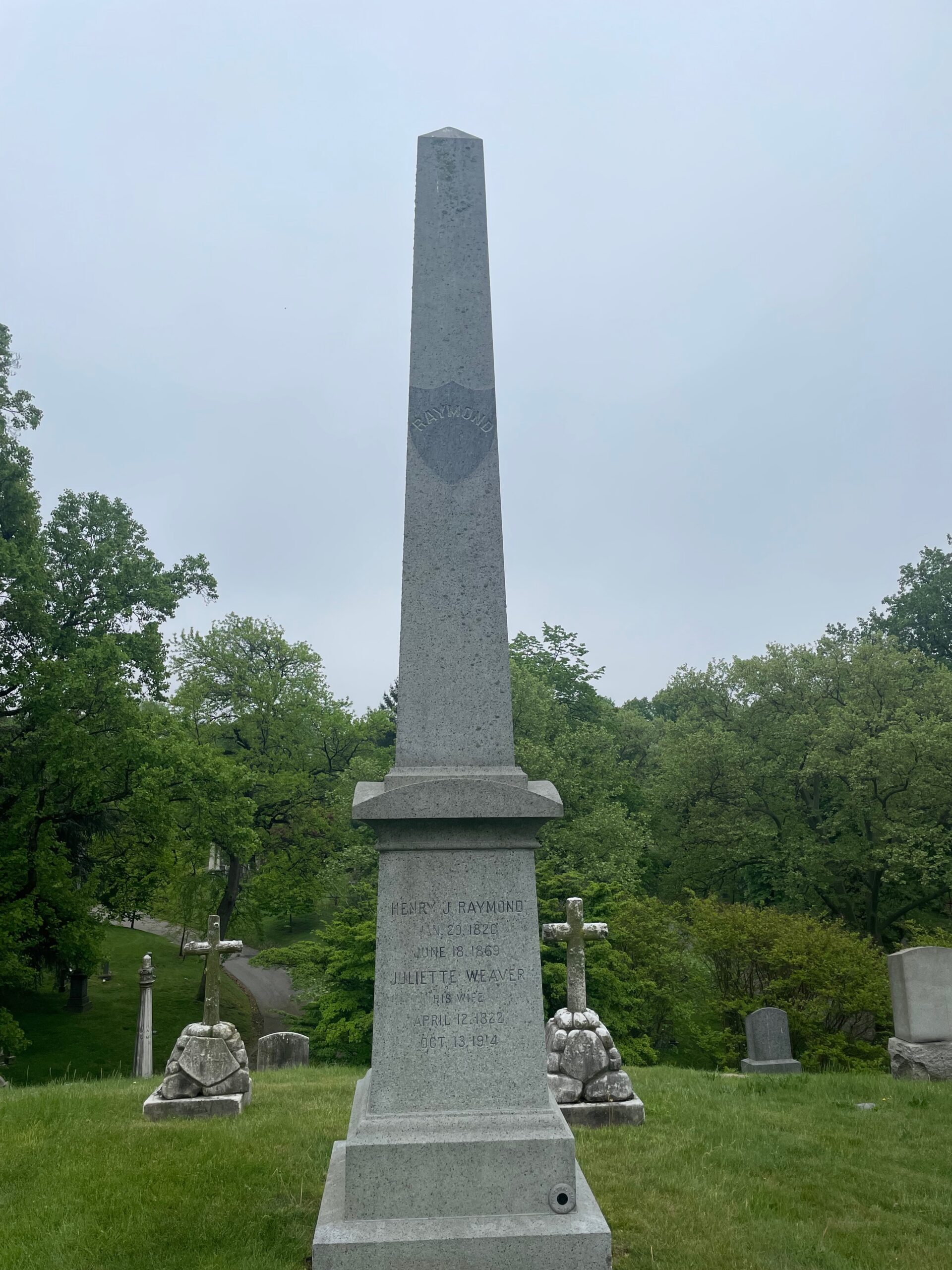
Born in 1820 outside of Lima, New York, Raymond grew up in the educated middle classes of that era, with a family proud to talk about their lineage in this country back to the Puritans and whatnot. Me, I can’t stand those kinds of families and that’s especially true living in Rhode Island all these years, where you can’t throw a stone without hitting someone happy to tell you they are descended from Roger Williams. Who cares? Was he as annoying as you are? It doesn’t make you a better American and it most certainly doesn’t make you a more interesting person!
Anyway, Raymond was a real smart kid and became something of a boy orator. He started at Genesee Wesleyan Seminary in 1832, which is the precursor to the modern Syracuse University. That wasn’t really a college then though and he eventually ended up at the University of Vermont, where he graduated in 1840. He became a newspaperman, working for Horace Greeley among other prominent editors of this time of American newspaper expansion in the age of white male democracy. He became a prominent writer and editor of his own and in 1851, he and a man named George Jones–sadly not the Possum–got together, formed a company, and opened their own rag. It’s called The New York Times.
Raymond made his home at the Times and pushed what he saw a moderate tone. In a sense, he succeeded in this. We can make fun of the paper today–and we should, despite my strongly held beleifs that liberals today talking about the corruption of the mainstream media vastly overstate just how powerful these organs are, including not only the Times and Post, but Fox. The fact of the matter is that the real influential media is off your radar. Rogan is vastly more important to more people who don’t have set opinions about the world than any of these organs. But the Times isn’t good today and in many ways it wasn’t good then. What Raymond thought was moderation was really just being wishy-washy on the moral issues of the day while always, endlessly, perpetually coming down on the side of capital.
Now, it’s not that Raymond had no political opinions of his own. He was certainly one of these types who believe in moderation for moderation’s sake, a type of politics I abhor. I have no problem with being a moderate because you happen to be a moderate on those issues. Even I have some positions with which I don’t agree much with contemporary liberal doctrine (yes, it was almost certainly an error to keep schools closed that long because of Covid, for example, something that seriously damaged the Democratic Party brand in some areas, for example, and at the same time think that you should have to have a Covid vaccination to receive anything like social services or employment in this nation). But that’s because I believe something about a given position. That’s completely different than the type of person–and I know a lot of them and you probably do too–who thinks that whatever the issue here, you have to both sides it because to take a side would be too far for you mentally. And what sums up the Times more than that, then and now?
So Raymond was certainly a Republican. The Times was a Republican rag all the way. In fact, the same year he founded the Times, he was in the New York legislature as a Whig and in fact was Speaker of the House for the state at the time. He had broken with Greeley by this time, uniting with men such as William Seward and Thurlow Weed, leading to him getting the nomination for lieutenant governor of New York in 1854, which led to Greeley’s alienation from his earlier politics that slowly set him on a path to become the disastrous Democratic presidential nominee in 1872. As the Second Party System collapsed due to the rise of the Slave Power and specifically the Kansas-Nebraska Act, Raymond helped lead many Whigs into the new Republican Party and he was a critical player in the creation and stabilization of that party as the second party in the new party system. He would occasionally serve again in the New York legislature after that and was speaker again in 1862.
All this time, Raymond made sure the Times was a solid, middle of the road Republican paper. Abraham Lincoln grew on him–it’s almost important to remember that almost no one really respected Lincoln when he became president and he was a compromise candidate between a bunch of huge egos like Seward and Salmon Chase who thought they should be president–and they eventually became close allies. He wrote a couple of books about Lincoln toward the end of the war. He had already written a biography of Daniel Webster back in the 1850s, so doing good hackwork for his favorite politicians was easy for him.
After the war, even with Lincoln assassinated, Raymond made sure his paper was super moderate. In short, he called for a super liberal reaffiliation with the South. If that meant more or less abandoning the civil rights of the freedpeople, well, he didn’t care much about that. In fact, it was generally the disaffected Democrats who had joined the Republicans who would be more pro-civil rights than the old Whigs who wanted to get down to the real business of making a lot of money. In fact, Raymond got elected to Congress in 1864 and in there, was an active opponent of Thaddeus Stevens. He opposed Stevens’ “dead-state” theory that claimed that with secession, the states were now to be treated as territories until they got their shit together enough to be associated with the United States again. Stevens was completely correct about this and the nation would have been better off if the Republican Party and held to these ideas, but Raymond provided tons of cover for southern racists.
In fact, Raymond became so friendly toward the racists that he destroyed his own standing in the Republican Party. In 1866, Republicans kicked him out as chairman of the Republican National Committee. Andrew Johnson nominated him as the ambassador to the Austro-Hungarian Empire. The Senate rejected the nomination, although Raymond didn’t really want the job anyway.
So Raymond left Congress when his term expired in 1867 and went back to running the Times as it moved farther toward the right in response to the rise of industrial capitalism (yay from him) and the promotion of civil rights (boo from him).
Raymond almost certainly would have gotten worse and worse politically as he aged. But he didn’t age much. He had a heart attack in 1869 and died. He was 49 years old.
Henry Raymond is buried in Green Wood Cemetery, Brooklyn, New York.
If you would like this series to visit other Republican National Committee chairmen, you can donate to cover the required expenses here. They are such a special group in recent years, but those people are all still alive. Edwin Morgan is in Hartford and Marcus Ward is in Newark. Previous posts in this series are archived here and here.