
Erik Visits an American Grave, Part 1,968
 By
By This is the grave of Minnie Miñoso.
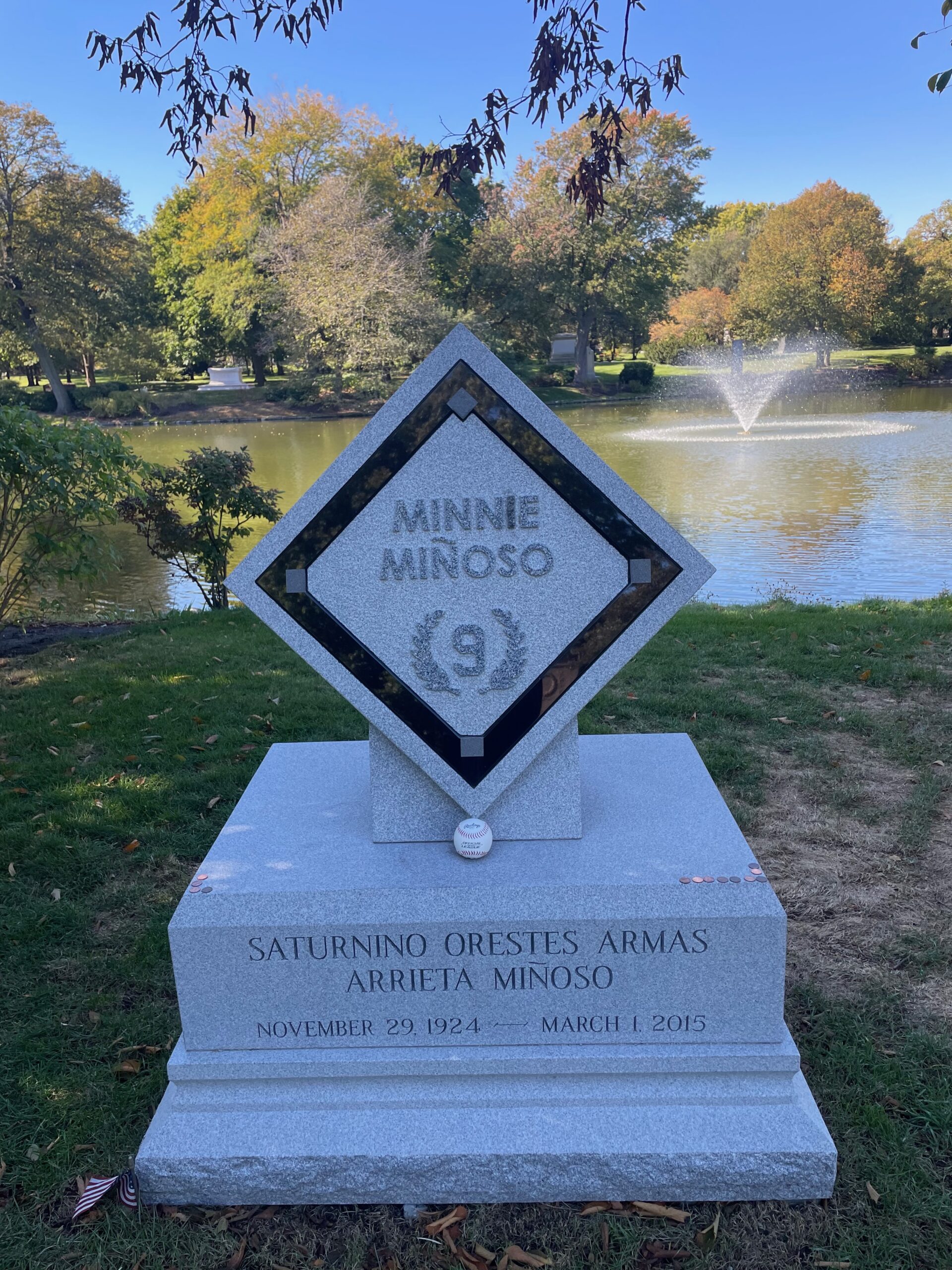
Born in Perico, Cuba, it’s only possible that Miñoso was born in 1924 as it says here. Evidence from Cuba suggests 1923 or 1925. Anyway, he was good at baseball, which is what we are doing here of course. The family had no money. His father cut sugarcane. Minnie organized baseball teams on the plantation and moved to Havana, where his older sister lived, in 1941, to see if he could compete there. He sure could. He played third base for a team in Cuba and then went to the U.S. to play for the New York Cubans in the Negro League. That was good money for the son of a cane cutter.
Of course, the Negro Leagues were declining pretty fast after Jackie Robinson made the majors. Other teams–not the racist Red Sox, but teams that wanted to compete–were looking to sign Black players and the Cleveland Indians targeted Miñoso. He became the first Black Cuban in the major leagues when he made his debut for Cleveland in 1949. He didn’t play much though and they sent him back to the minors, where he stayed until 1951. Shortly after that season started, they traded him to the Chicago White Sox, which he desegregated.
It did not take Miñoso long to establish himself as a rock for Chicago, at first at third but soon moved to left field. He was just incredibly consistent, a clearly above average left fielder, the type of player you need to win, which had little to do with the White Sox, but still, Miñoso deserved better. He played in Chicago until 1961 with a two year exception when he was back in Cleveland and was good to excellent each year. He was a revelation in 1951, hitting .324/419/498 with OK power and good speed, finishing 4th in the MVP voting. In fact, he would finish 4th in the MVP balloting on four separate occasions, never higher than that. He really wasn’t an MVP quality player except in 1954, when he absolutely went off. He hit .320/411/535 that year, leading the league with 18 triples, hitting 19 homers, scoring a career high 119 runs and driving in a career high 116 runs. For all of that, he was worth 8.2 WAR on the Baseball Reference version of the stat. For comparison, his second best season was 6.2 in 1956. Usually he was worth a solid 5 WAR. That is an all-star level player if not an MVP candidate.
Generally, Miñoso was a very solid doubles and triples hitter who would knock a few over the fence too, but with horrifically awful base running instincts. For a guy who usually stole about 20 bases a year, he managed to lead the league in caught stealings on 6 different occasions. Even in an era where managers didn’t care that much about the stolen base percentage, that’s atrocious. He was considered a good defender at third, winning three Gold Gloves, but the advanced states suggest he was basically a average defender, certainly not saving a lot of runs compared to the norm, but not a guy you had to move to first either.
Miñoso was still a good player in 1958 when Chicago sent him back to Cleveland in a trade for Early Wynn. He remained good there too, but he was super bummed that Chicago made the World Series in 1959 without him. Cleveland sent him back to Chicago for Norm Cash after that season. But Chicago wasn’t heading back to the Series anytime soon. But he was aging and started to slip in 1960. He was still OK in 1961 but he was traded to the St. Louis Cardinals after that season. He wasn’t very good there either and missed two months when a pitch him him in the head and fractured his skull. He sort of was asking for this. No one leaned into a pitch like Miñoso. He led the league in hit by pitch an absurd 10 different seasons. Eventually one was going to catch him in the noggin. In fact, he had missed a chunk of 1955 for a fractured skull too. But he was not going to change his ways. So he missed most of that year, was awful with the Senators in 1963, and came back to Chicago for a last cup of coffee in 1964 before retiring.
Or sort of. He actually would not stop playing. He went on for eight more years in the Mexican League. This is man who was going to play the game that got him out of cutting cane for as long as he possibly could. He was actually pretty good there for a long time too. In 1973, in his late 40s, he hit 12 homers and drove in 83 runs. What I remembered Miñoso for is his weird old man comebacks. He started coaching for the White Sox in 1976 and made himself available for pinch hitting. So at the age of 52 (or so), he had 8 at bats for Chicago. Got a hit too. In 1980, seeing a gimmick where a man could play in five decades, the White Sox activated him again and gave him two at-bats. In 1990, he wanted to do this again, now over 60 years old, but Major League Baseball intervened and reminded the White Sox that this was not a variety show, however they wanted to run their franchise. But the Independent League St. Paul Saints brought him in instead and then again 2003, at the age of 77.
Miñoso was basically Mr. White Sox in his later years. There were attempts to get him into the Hall of Fame, but the two times he was a Veterans Committee finalist before his death, it didn’t happen. He was a borderline HOF player anyway, better than some who have gotten in (especially by the Veterans’ Committee dubious standards). He was however elected to the Mexican Baseball Hall of Fame in 1996. Evidently there is a museum too, in Monterrey. I never had any particular desire to visit that part of Mexico, but if I did, I would 100% go to that museum. There was long talk that the late life stunts to get him at bats in each decade hurt his chances, taking away from his accomplishments for a sideshow. Maybe. He died in 2015 of heart disease. He was 90 years old. President Obama released a statement lauding him upon his death.
Miñoso finally was elected to the Hall of Fame in 2022.
Minnie Miñoso is buried in Graceland Cemetery, Chicago, Illinois.
According to Baseball Reference’s JAWS state, Miñoso is the 18th best left fielder of all time. That puts him right at the bottom of where most guys are in the HOF. In fact, 19th is Lance Berkman, who approximately 0 people ever considered a HOF quality player, though he was of course very good. If you would like this series to visit other left fielders, you can donate to cover the required expenses here. Joe Medwick, who was dominant with the Cardinals in the 30s and then stuck around forever as a marginal player after that, is 16th and is in Sunset Hills, Missouri. Ralph Kiner, the Pirates legend who got a late start due to the Korean War but was great for the rest of the 50s and who is ranked 21st, is in Farmington, New Mexico. Previous posts in this series are archived here and here.