
Erik Visits an American Grave, Part 1,955
 By
By This is the grave of Edward Sanford.
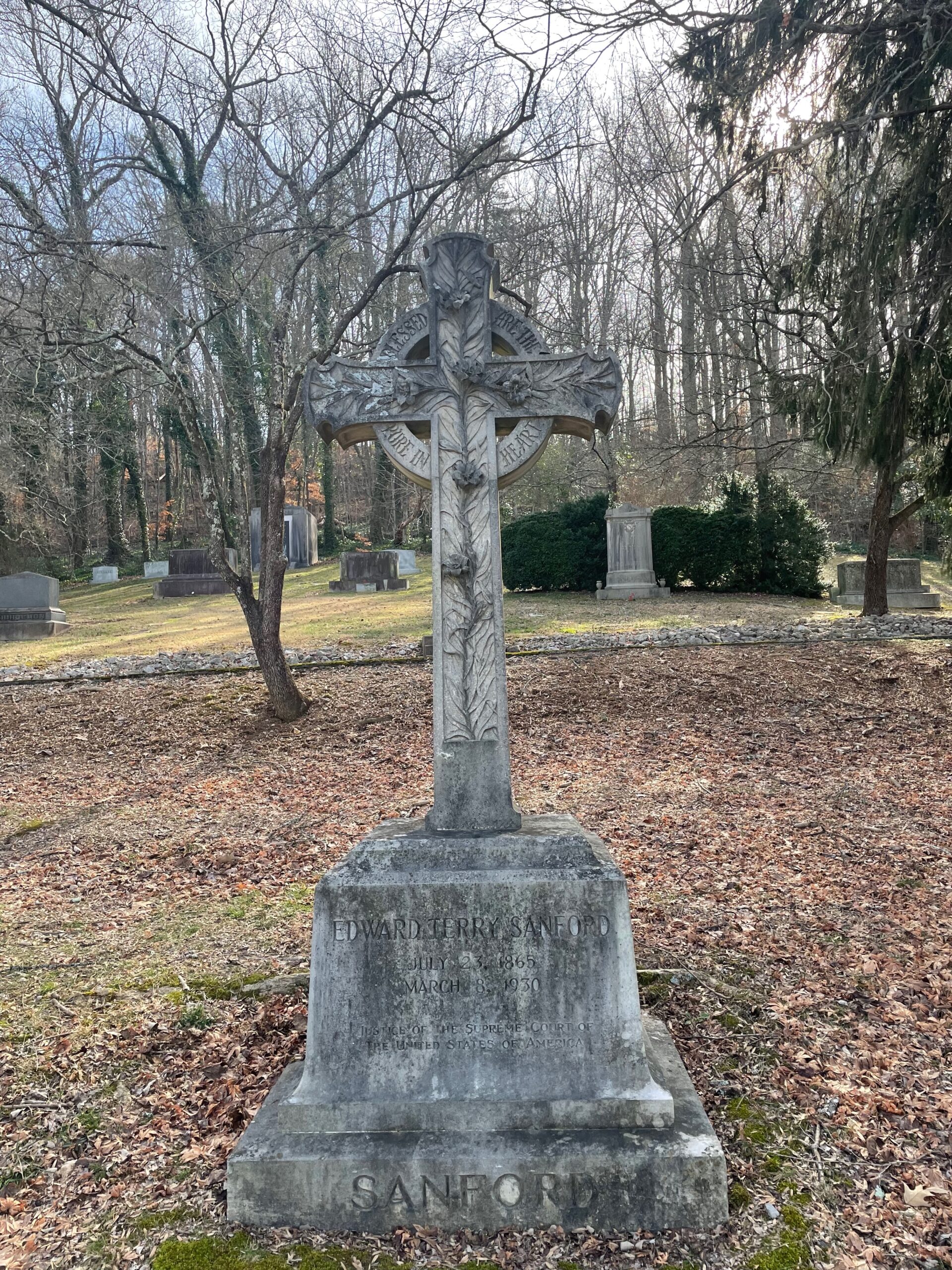
Born in 1865 in Knoxville, Tennessee, Sanford grew up the son of a prominent Tennessee unionist, one who had moved down from Connecticut before the Civil War and stayed during the war. His father became a major industrialist who used prison labor to run his coal mines, which led to the Coal Creek War in Tennessee in 1891, as free labor engaged in violence to protect themselves from competition from prisoners. To be fair, I guess, Sanford pere was a bit removed from the actual decision to make the particular contract with the prison that led to the violence, but he still routinely used prison labor in his operations.
Sanford grew up in the Knoxville Republican elite and went to the University of Tennessee before transferring to Harvard, eventually getting a law degree there in 1889. He then moved back to Knoxville and practiced there. He rose quickly in the law world and soon began arguing in front of the Supreme Court, supporting the company in Knoxville Iron Company v. Harbison, which was a case against company scrip. That he remained a Republican goes without saying, with his background and pro-corporate mentality. So he got hired by the Roosevelt administration in 1905 as a special assistant to the attorney general and then became Assistant Attorney General in 1907. A very capable guy, Roosevelt nominated him to the District Court of the Eastern District of Tennessee and the Middle District of Tennessee in 1908.
Sanford remained in his district court position until 1923, when Warren Harding plucked him out of obscurity to be on the Supreme Court. I’m not sure why Harding picked him. But Sanford proved a willing and able judge, very active in opinion writing. He was confirmed easily. He would write 130 opinions over the years. He wrote the majority opinion in Gitlow v. New York, in which he upheld a state law banning anarchist literature but also laid the groundwork for the Warren Court’s expansion of rights by saying that the Bill of Rights mattered at least as much as state law. This pushing the Bill of Rights as that important basically laid the groundwork for Griswold, among other cases. Legal scholars around here can expand on this and correct the flaws in a field I don’t know well.
Sanford also ruled for the constitutionality of the presidential pocket veto in Okangan Indians v. U.S. Far worse, he wrote the majority opinion in Corrigan v. Buckley, upholding the right of property owners to discriminate on the basis of race. This was a unanimous opinion, demonstrating once again the unanimity of racism among whites at this time. The case itself was about racial covenants and the Court said, yep, more please! To Sanford’s credit, he was not a totally reactionary of everything. For example, he voted with the minority in Adkins v. Children’s Hospital, where the majority threw out the Washington, D.C. minimum wage as unconstitutional. Sanford and William Howard Taft were super close; the ex-president wrote this opinion, but it was still 6-3 for complete and total reaction.
So in the end, Sanford was a mixed bag as a justice, not the best, but also not Sam Alito. He was much better than most of the Republican hacks of the era. But he did not last long. In 1930, he went to the dentist to have a tooth pulled. Not a big deal normally, but something caused him uremic poisoning, his kidneys failed, and he died. He was 64 years old. I’d like to say more about Sanford, but there doesn’t seem to be that much to say in the end.
Edward Sanford is buried in Greenwood Cemetery, Knoxville, Tennessee.
If you would like this series to visit other Supreme Court justices Sanford worked with, you can donate to cover the required expenses here. James McReynolds (what a peach!) is in Elkton, Kentucky and George Sutherland is in Suitland, Maryland. Previous posts in this series are archived here and here.