News from the Northern Front
Be sure to read Dave Noon’s update on our progress in the War Against Christmas.
Courage.
Be sure to read Dave Noon’s update on our progress in the War Against Christmas.
Courage.
It looks as if the Bevilacqua kid (“Cause that sugarless motherfucker, it’s the last fucking drink you’re ever gonna have.”) has some actual legal problems:
An actor who once played an aspiring mobster on ”The Sopranos” faces murder charges along with another man in the death of an off-duty police officer, authorities said Sunday.
Lillo Brancato Jr., 29, was hospitalized in critical condition with gunshot wounds suffered when the officer shot him after catching two men breaking into a home. Brancato’s friend Steven Armento, 48, was also shot and in critical condition.
Prosecutors were in the process Sunday of charging Armento with first- and second-degree murder and Brancato with second-degree murder in the death Saturday of Officer Daniel Enchautegui, 28, said Steven Reed, a spokesman for the district attorney’s office.
Ah. Life imitating art…
I read the Narnia Chronicles immediately before I first read The Lord of the Rings. (My mother, who is wise in such matters, suggested that if I liked those books, I really should take a look at these). I loved both at the time, and I don’t know if I would have pegged LOTR as a favorite. A few years later, of course, Tolkien’s world was still in my mind, and the books were getting a reread; the world of Narnia, on the other hand, was fading fast and was never picked up again. I was rather surprised, when I first heard about the movie and turned my thoughts to Narnia, how little I remembered anything about the books–I’d actually forgotten all about the character of the White Witch.
One particular detail of the Narnia chronicles has always stuck in my head and my craw. Lewis did more to convince me I couldn’t be a Christian–at least not his kind of Christian. His treatment of Susan, the older daughter, in the final book, struck me as outrageous and egregiously unfair. I stand by that judgement, and as Timothy Burke points out it’s got the unhealthy stench of misogyny to it as well. It’s described in a NYT piece today, which contains a delightful tidbit about a Neil Gaiman story:
Then there’s the unfortunate business with Susan, the second-oldest of the Pevensies, who near the end of the last volume is denied salvation merely because of her fondness for nylons and lipstick – because she has reached puberty, in other words, and has become sexualized. This passage in particular has set off Pullman and other critics (and has caused the fantasy writer Neil Gaiman to publish a kind of payback scenario, in which Susan has grown up to be a distinguished professor, not unlike Lewis, and in which for good measure Aslan performs earth-shaking oral sex on the witch).
I’m not the world’s biggest Gaiman fan, and I’m not sure that sounds like the greatest premise I’ve ever heard for a short story, but I must say I want to read it, if only as an act of solidarity with Susan. The nature of Susan’s exclusion–senseless, trivial, petty and random, punished for her humanity–told me all I needed to know about Lewis’ brand of Christianity. A part of the human experience was arbitrarily repackaged as worldliness and condemned for this invented sin, for no discernable reason other than resentment toward her change and growth. Using the fetishization of childhood to excuse a childish cruelty. Perhaps Lewis did me a favor, making it all so clear to this ten year old. Having never bothered to think much more about this, let alone read any commentary on the series, I wasn’t aware this was a common criticism. Today, I’m happy to learn I’m not alone in my outrage.
As for the movie? I’m not intentionally avoiding it, and I wouldn’t mind seeing it, but there’s about a dozen current and upcoming releases that’ll have priority in the next month or two. Not likely.
See also The Rage Diaries.
As always, I was intensely irritated by Matt Bai’s review of Pierson and Hacker’s fine new book. While such events as the failure of Bush’s social security initiative do indeed raise serious questions about the limitations of the thesis, and there are certainly other things one can quibble with, Bai for the most part takes the “shape of the world: views differ” approach he virtually always does. Rather than rebutting their voluminous data about shifts in the Republican caucus that do not reflect shifts in public opinion, he basically declares that since it doesn’t blame both parties equally it must ipso facto be wrong. I see that the authors themselves have critiqued Bai, which saves me the trouble of detailing the obvious problems with this lazy approach. And some of my disagreements with Bai, such as his argument-from-tradition that the Senate’s gross malapportionment must be preferable to a more majoritarian legislature, are just normative. But there is one additional part of the review which should be pointed out:
For all the hype about the so-called religious right, most rural and exurban voters display little ideological zealotry; rather, they seem inclined toward mild conservatism on economics and foreign policy, along with a reverence for individual liberty – a combination which places them firmly in the historical mainstream of American politics.
On foreign policy, I’ll buy it, but he doesn’t let us in on what the evidence is for the alleged economic conservatism and cultural libertarianism of swing voters; I certainly don’t get it out of Hacker and Pierson’s data. Rather, this seems to be the ur-pundit’s fallacy: the idea that swing voters are conservative economically but socially liberal. This is, of course, as Matt recently noted a better description of media elites like Bai than of swing voters. The latter, from the data I’ve seen tend to prefer Democratic positions on economic issues but–with the exception of criminalizing abortion–tend to prefer Republican positions on cultural issues. (This is particularly ironic from someone who applauds the equal representation of California and Wyoming in the Senate because it will frustrate “urban elites.”) Whatever “reverence for individual liberty” rural voters may express in the abstract, they tend to be (for better or worse) more statist in their economic and cultural positions than both political and media elites.
Let me echo Redbeard and Angelica (among many others) on the Cory Maye case; it seems that this guy is getting railroaded. You don’t have to be a Second Amendment purist to believe that someone who shoots an unannounced intruder in the middle of the night in his own home doesn’t deserve to die.
“My Humps” has made me a fatter man. I think it’s fair to attribute 3-4 pounds to the fact that I can’t figure out how to change the radio station in the gym at my apartment complex. If “My Humps” starts playing at the beginning of a workout I can ignore it, but if it starts playing when I’m 23 minutes in on the elliptical, I just can’t muster up the gumption to finish. I think I need an Ipod.
Matt Yglesias: Wrong about “My Humps”, wrong for America.
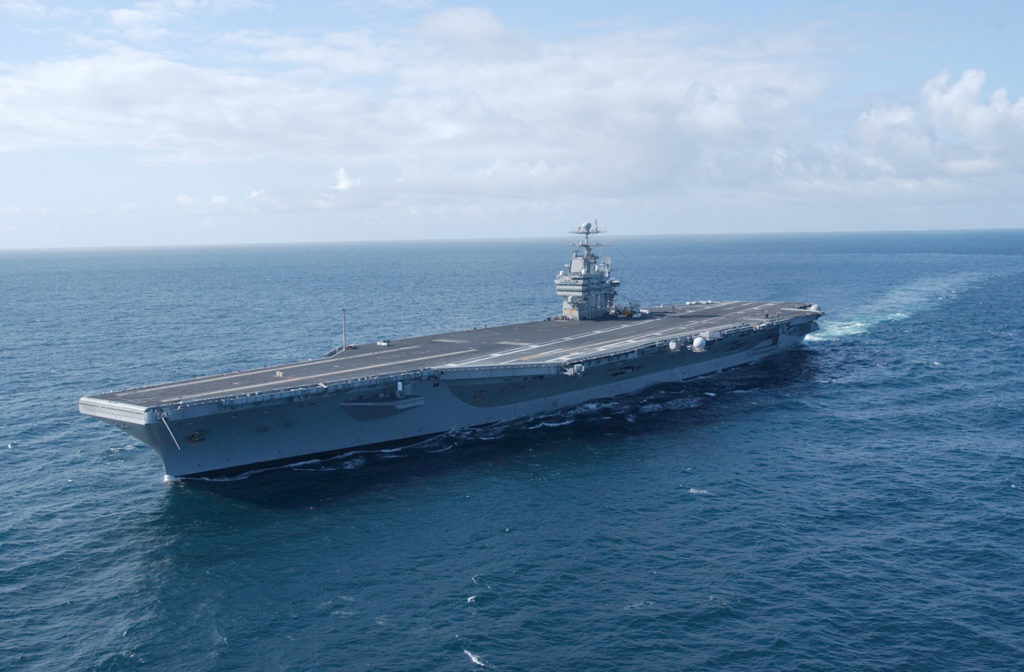
Interesting report from the New York Times on how the Navy is thinking about its procurement future.
I think that Matthew Yglesias evaluation of the DD(X) as a ship that is “cool but useless” is a little bit unfair. The DD(X) has actual mission capabilities beyond combat at sea. The Advanced Gun System is capable of delivering a lot of ordinance to points deep inland in a very short amount of time. As such, it represents a real increase in current naval capabilities. This doesn’t mean that we should buy it; the DD(X) is very expensive, and it doesn’t look as if the Navy will be able to afford more than a small number (although it’s unclear whether the seven destroyers mentioned in the article are the initial buy or the entire production run). But to call it useless is putting the case a little bit too strongly. I’m inclined to think that the Arleigh Burke destroyers have a long, useful life in front of them, but at some point we will have to come up with a replacement. The DD(X) might not be it, but I like the idea of the Navy procuring ships that keep Joint operations in mind, and that you can actually imagine being engaged in the kinds of conflicts that might happen in the next twenty years.
The LCS is the other new ship that the Navy is working on. Whereas the DD(X) is really expensive ($3 billion a ship), the Littoral Combat Ship is relatively inexpensive (about $200 million). LCS is a roughly frigate sized ship that is designed to operate in shallow waters and fulfill a variety of different missions, from amphibious operation support to anti-piracy. Like the DD(X), the LCS design shows that the Navy is at least beginning to think of its missions in a less Mahanian fashion; that is, directed toward ends other than the destruction of an enemy fleet at sea.
Whether the procurement of either the DD(X) or the LCS in any kind of numbers will happen is in serious question. The Navy has been declining in size for quite a while, and Congress is unlikely to be very receptive to calls for a funding increase. See Brad Plumer for a bit more on this. Personally, I am very doubtful that the Navy will ever get a DD(X), but I think the LCS has a much brighter future, if only because the Navy can sell it as a multi-purpose vehicle.
For a very bad analysis of naval procurement, see Ed Morrissey. His post on this topic is a clinic on inept half-thinking on the issue of naval power. For Ed, one “existential threat” is just as good as another; if we needed a huge Navy to prepare to fight the Soviet Union, then we certainly need one for the War on Terrorism. And if we don’t, then we need one to prepare to fight China. That the procurement proposed by the Navy doesn’t seem particularly geared towards the Chinese threat apparently escaped his notice. His most laughable assertion is this:
In a decade, the Chinese fleet may surpass our Pacific fleet in firepower, a dangerous imbalance not only for us but for our Pacific Rim allies such as Japan and South Korea. That shift in power will signal not just Beijing but other regimes and terrorist bands that the US has lost its primacy on the seas — and that will exponentially expand our problems.
Quite. The first part is true; if China goes on a crash naval buidling spree, and the US Navy loses six aircraft carriers in a mysterious boating accident, then the PLAN might approach equality with the USN in a decade. Of course, the JMSDF would still be larger than the PLAN, but in the mind of Ed things like that don’t matter; despite all actual evidence, Japan will bandwagon with Chinese power rather than balance against it. As for South Korea, it has perhaps escaped Ed’s notice that China doesn’t need a single fishing boat to threaten Seoul. To his credit, I will allow that it’s possible that Al Qaeda pays close attention to the relative naval procurement strategies of the US and China, much in the same way that it’s possible flesh eating zombies could crawl from the sea tomorrow and begin attacking US naval assets around the world. This is what happens when a blogger can’t bring himself to analytically distinguish between naval power and his own masculinity…
USS Guam (CB-2) came about through a curious set of circumstances. Early in World War II, the United States received intelligence suggesting that Japan was building a class of 18000 ton heavy cruisers designed to raid deep into the Eastern Pacific. In order to counter this threat, the United States Navy developed plans for a class of ships in between heavy cruisers (ships of roughly 10-12000 tons, carrying 8″ guns), and battleships (of which the most recent were 35000 tons, carrying 16″ guns). Guam and her sister Alaska ended up with 9 12″ guns, a displacement of 27000 tons, and a speed of 32 knots. Oddly enough, the Japanese were neither building nor planning to build any such ships, although they considered the possibility after learning of Alaska and Guam.
The Navy insisted (and still insists) that Alaska and Guam were not battleships, or even battlecruisers, but instead something called a “large cruiser”. The naming protocal for Large Cruisers was unclear. Cruisers were named after cities, and battleships after states. The battlecruisers planned in the early 1920s were named after famous battles, such as Lexington and Saratoga. It was decided that these not-quite-battleships-but-more-than-cruisers should be named after US territories. The four members of the class never completed were listed as Hawaii, Samoa, Philippines, and Puerto Rico. The USN may have been reluctant to call Guam a battlecruiser because of the high casualty rate among battlecruisers in World War II.
The contention that Alaska and Guam were not battlecruisers is indefensible. Guam was more than twice the size of the heaviest heavy cruiser ever built, and carried an armament superior to the contemporary Scharnhorst class. Moreover, they were designed for specifically the mission that the first battlecruisers were created for, which was the pursuit and destruction of enemy heavy cruisers. In action, Guam fulfilled precisely the same missions as the other battleships in the fleet, which primarily meant fleet air defense. Had Guam encountered Yamato or another modern battleship, her characterization as a “Large Cruiser” wouldn’t have made a damn bit of difference.
The US Navy placed Guam and her sister Alaska in reserve shortly after World War II, along with most of the rest of the battleship fleet. A large number of ships were
disposed of in the immediate postwar period, leaving only the Big Five (California, Tennessee, Maryland, West Virginia, and Colorado), the two ships of the North Carolina class, the four of the South Dakota class, the four of the Iowa class, and the two Alaskas. The Navy purged itself of all but the Iowas in 1960. I believe that not retaining Alaska and Guam was a mistake. Their armor and armament were superior to any ships afloat other than the Iowas (and the French Jean Bart). They could perform shore bombardment duties nearly as well as the Iowas, and could be operated at a lower cost and with a smaller crew. They might well have proved an option more palatable than retaining Wisconsin and Iowa on the Navy List until the first DD(X) comes into service.
Trivia: What are the only two dreadnought battleships built in the United States to carry wing turrets?
I decided to turn on the 1 o’clock game while I was doing some writing, only to discover that the only game showing was the monumental Jets/Raiders thriller. With my stereo broken, however, the other options are slim so I left it on, and every once in a while glanced over to see the Raiders QB throwing up one feeble wounded duck after another. “Wow, Kerry Collins’ arm is really shot!” thinks I. But a more careful listening revealed that the Raiders QB was ex-UW not-really-a-star Marques Tuiasosopo, something that has to make one of my co-bloggers doubly unhappy. (And nor can Jets fans be happy, as this decision may remove them from the Reggie Bush sweepstakes.) The scary thing is, though, that Tuiasosopo isn’t even the worst recent Huskie QB to start a game this year; the 49ers had enough contempt for their fans to try to pass off Cody Pickett as an NFL quarterback. I mean, I guess it’s always nice to see alumni get nice paydays, but…
Anyway, I think this is a sign that it’s time to go out for brunch.
I think it’s easy for people of my generation to underrate him because of his generally dreary feature film career, but Richard Pryor was a genius comedian, one of the very greatest. I’ve been listening to his collection of comedy recordings–mostly from his peak in the mid-70s–and it’s just brilliant stuff, a must-own if you’re interested in the genre at all.
The NYT has an extensive obit here.
…nice roundup and tribute from Joe Gandelman. Good stuff from Digby too.
Apparently sick of having to have politicial appointees overrule professional lawyers, the Bush administration has decided to just skip the middleman:
The Justice Department has barred staff attorneys from offering recommendations in major Voting Rights Act cases, marking a significant change in the procedures meant to insulate such decisions from politics, congressional aides and current and former employees familiar with the issue said.
Disclosure of the change comes amid growing public criticism of Justice Department decisions to approve Republican-engineered plans in Texas and Georgia that were found to hurt minority voters by career staff attorneys who analyzed the plans. Political appointees overruled staff findings in both cases.
The policy was implemented in the Georgia case, said a Justice employee who, like others interviewed, spoke on condition of anonymity because of fears of retaliation. A staff memo urged rejecting the state’s plan to require photo identification at the polls because it would harm black voters.
But under the new policy, the recommendation was stripped out of that document and was not forwarded to higher officials in the Civil Rights Division, several sources familiar with the incident said.
Fortunately, in this case the courts have provided the function the Bush DOJ won’t perform: the 11th circuit has unanimously sustained the lower court decision striking down the Georgia poll tax that the Bush DOJ (for obvious reasons) refused to evaluate legally. But every year of Bush appointments make having federal judges who will perform such oversight of the executive branch less likely. Having an executive branch that isn’t strongly committed to gutting voting rights starting in 2008 is critical.