
This Day in Labor History: July 9, 1971
 By
By 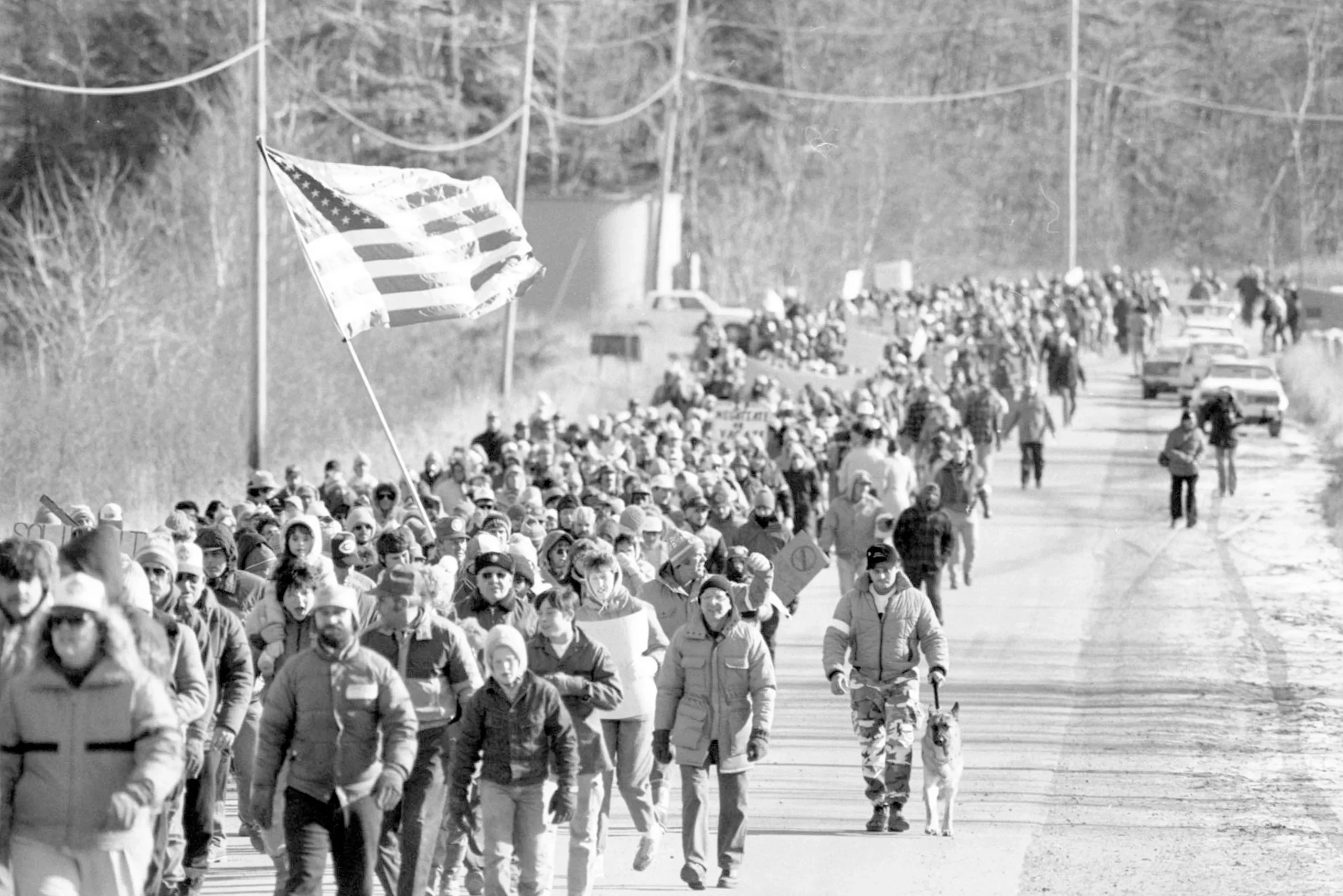
On July 9, 1971, paperworkers at Fraser Paper Company, in Madawaska, Maine went on strike. This dramatic strike, an early moment in the unionbusting that would soon destroy American unions, faced strong resistance from workers, including responding to police tear gassing them by throwing rocks at the cops and destroying their cars. The workers won too, pushing back against the ethnic contempt at these French speakers by their employers and winning on shopfloor power.
Fraser was a family-run company that opened in 1932 and slowly grew into a pretty important local power. By the 60s, the Maine paper industry had structural problems, with competition from elsewhere cutting into profits and leading to closed factories. Fraser was also bringing in outsider managers by this time who threw long traditions in the plant out the window.
Now, some of the background to this strike was ethnic. Most of the workers in this paper mill town were French-Canadian migrants by heritage. Many spoke French as their first language. The plant itself was owned by Canadians as well. Madawaska is at the very top tip of Maine, bordering New Brunswick, but just east of the line with Quebec. But Canada, well, it had a management-style that tended to be a bit friendlier to workers. The owners looked at this with jealousy. So they hired a bunch of Americans to run it. These Americans had two things going for them–they hated unions and they didn’t speak French. In other words, this was an insult to the French speaking works. And the contempt of Anglophone Canada to Francophone Canada was very much in the mix of what was happening here.
These were unionized workers, under four different unions. The new managers went after them hard. In 1968, they threatened a plant closure if the union did not agree to a three-year wage freeze. The union seems to have not expected this and the workers agreed, thrown on their heels. This can happen. But there was also a promise that if the union took lower pay, the company would hire a lot of new workers, making the workers’ jobs easier and likely many of those jobs going to the workers’ family members, though of course that was not contractually stated. But that didn’t happen. The company went all on to make workers’ lives on the shop floor much worse through more intensive management, stopwatches, the whole playbook totally violating the contract. Making it worse, this Catholic workforce now had to work many Sundays.
Workers’ anger grew rapidly. In 1970, workers engaged in a short wildcat strike over changes in the boiler house that forced fewer workers to labor harder. The workers were sick of it. The company fired the leaders and the workers wouldn’t go back until they were rehired, which did eventually happen. It was a very tense situation and a more official strike was almost inevitable after this. That happened the next summer. The company had responded to the wildcat by firing twenty Acadian supervisors, seeing them as not loyal to the English-speaking management. So this was ethnic warfare as well. The four unions voted to go on strike, meeting in the local Knights of Columbus hall to do so, probably the only time in history that organization has ever hosted anything progressive. Solidarity was strong and they mostly shut down the mill, with the managers trying to keep things running, but mostly failing to do so.
On August 9, the one-month anniversary of the strike, tensions boiled over. The company was trying to move scab paper on trains. Over 1,000 workers and their families, along with some other supporters, lined up to resist this. They blocked the track. The cops did what cops do–they teargassed the crowd, even though there were lots of women and children there, who naturally enough also got gassed. That did not endear the cops to the strikers. With the state police effectively helping the company, strikers began throwing rocks, not only at the factory and its officials, but at the cops. They overturned two police cruisers. They also destroyed two locomotives that were trying to haul some of the scab paper. The cops did not fire back. They retreated. A state trooper later remembered, “Oh, my Jesus, you had a moment there . . . it was almost like an eclipse out there, the sky was so full of rocks.” Hope a few struck home at least.
Interestingly, this strategy was something the unions borrowed quite consciously from the Birmingham movement of 1963. I think we often forget just how confrontational this was. Martin Luther King urged families to allow their children to protest precisely because he knew there was a good chance their blood would be shed and thus get good press. The thing about bringing children is that you force the issue–just how violent will the other side be? And in the case of the police, whether under Bull Connor or the corporate masters of Madawaska, beating children was cool, whatever. And like in Birmingham, it got the attention the workers wanted. Anyone who thinks it’s immoral to expose children to such risks, well, go talk to Dr. King about it, don’t get mad at me. He’s right.
However, this was the 1970s, not the 1870s and overt state violence against unions was not going to be in order, at least not in New England. After the confrontation with the police, Governor Kenneth Curtis stepped in, ordering the cops away from the plant. He then moved toward mediation, trying to bring this action that was giving his state bad publicity to a speedy ended. The company stopped trying to move its paper from the mill as well. Right in middle of all this, Richard Nixon issued hids infamous 90-day wage and price control order, which barred unions from negotiating wage increases during that time. The Madawaska workers just decided to ignore Nixon.
Finally, on September 12, the company and union settled the strike. Government officials remembered later that the biggest issue was the unbelievable arrogance of the corporate side and the deeply held hurt and anger among the workers. In truth, it wasn’t any huge victory for the workers in terms of material benefits. Probably the biggest victory was that the plant replaced its whole management team. But in terms of pay, it was whatever. However, they did win back a lot of the shopfloor rights they had lost in the union busting campaign that the company had engaged in the for the previous three years. That was really huge. The new management proceeded to rehire Acadians in lower management roles and was remembered fondly by the workers in future years, especially compared to what they had just faced. Moreover, future contracts led to much higher pay gains among workers. So the workers may have only won a slight victory in 1971, but in the longer term, unlike much of the 70s, they won significant long-term gains.
The Maine paper industry would continue to witness some of the biggest battles in the American labor movement over the next few decades, probably culminating in the epic Jay strike in 1988. But the industry is mostly dead today and the level of bitterness that has engendered in rural Maine and the lack of real attention to their economic and cultural decline of these places explains a lot about why they are now Republican voters.
I borrowed from Michael Hillard, Shredding Paper: The Rise and Fall of Maine’s Mighty Paper Industry to write this post.
This is the 608th post in this series. Previous posts are archived here.