
Erik Visits an American Grave, Part 2,193
 By
By This is the grave of Maurice Tobin.
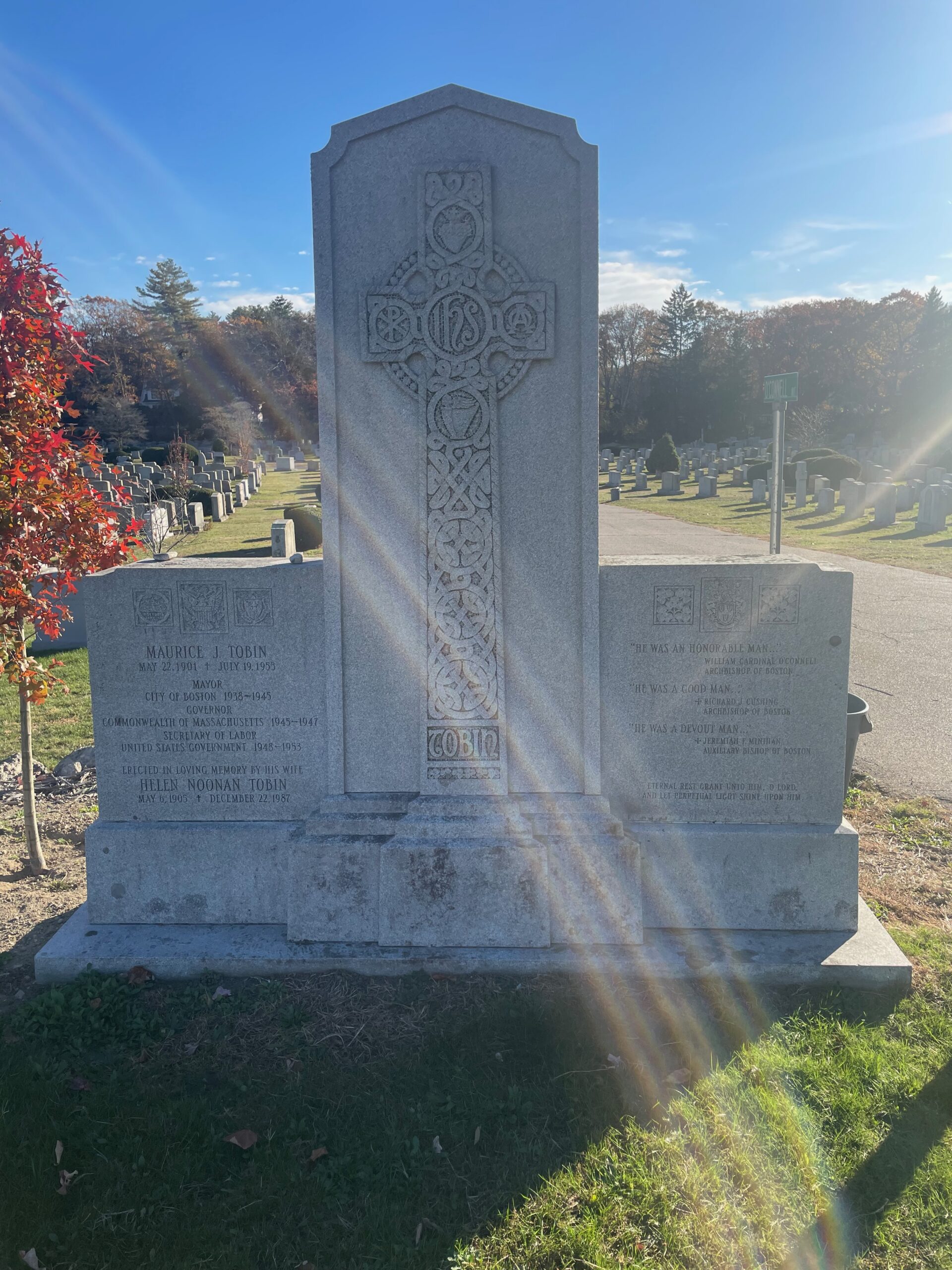
Born in 1901 in Boston, Tobin grew up in Irish Catholic politics land, which was a rich and fertile soil for a young man with political interests, as Tobin would have. It was a working class family, as one would expect. His father was a carpenter. They didn’t have much money. Tobin put himself through night school at Boston College, working during the day. But he was determined and he had a mentor–James Michael Curley, the king of Boston Irish politics. Tobin wanted electoral office bad. He ran for the state legislature in 1926 and won a seat, only 25 years old.
Tobin only served a term and then in 1929 was on the school committee in Boston. Then, in 1937, he decided to take on his old mentor Curley in the race for mayor of Boston. At this time, Curley was finishing a term as governor after being mayor already and he wanted his old job back. But Curley was just openly corrupt and that gave Tobin an opening. His time as governor had been a disaster. He had run for Senate in 1936 and lost, so then he wanted that job back, as I mentioned. Enough old-time Brahmin types held their noses and voted for one Irish over another to keep Curley out. They would have a rematch in 1941 and Tobin would win again.
Tobin was pretty effective as mayor. He was good at bringing in that New Deal to build up the city’s infrastructure. But unlike Curley, he wasn’t going to put the city into debt for that infrastructure, nor was he going to steal the money. So as a good government liberal, he could appeal to a lot of people. He also built his own form of the New Deal Coalition. He was deeply opposed to discriminatory practices and with Boston’s black population growing, he was sure to include them in his government. He supported anti-discriminatory laws. Curley openly favored the Irish community, Tobin did not.
On the other hand, Tobin was behind the West Broadway Housing Development, which was quite openly a whites-only development. It was built between 1941 and 1949. One thing most people don’t understand about public housing is that it was not intended for the poorest of the poor. It was intended to pay for itself through renters. It was a strategy to deal with both the underhoused working class and the poor state of housing generally at this time. The idea was for working class people to move out of the urban slums into nice new buildings and live in a communal sense. So there weren’t funding mechanisms built into public housing projects when the postwar housing boom and the rise of suburbia sent white families into single-family housing in the 1950s. Most of these public housing projects were seen as white-only, not only by city leaders but very much by the people who chose to live in them. Integration was not what anyone had in mind. We know, for instance, that as early as 1940, newly radicalized United Auto Workers members in Detroit who saw FDR as a hero were beginning to vote Republican locally over the integration of their public housing projects. It didn’t take Donald Trump or even George Wallace to move northern white working class voters to the Republican Party. Note that I am not excusing Tobin here, just saying his support of this is entirely typical for the era.
Tobin was also buddies with Barney Welansky, who owned a nightclub called the Cocoanut Grove. This place seemed really dangerous to people. Welansky bragged that he didn’t need to fix it because he was friends with the mayor. Then it caught fire in 1942 and 492 people died. Tobin had actually planned to be there the night it burned, but he decided not to go. Tobin was damn near indicted for this. Later, when he was governor, he pardoned Welansky, who had been sentenced to 12-15 years in prison.
And yes, as you can see, Tobin did recover from his connections with Welansky. He ran for governor in 1944 and won over the Republican Horace Cahill. But Massachusetts was a deeply divided state at this time. It’s easy to forget just how conservative New England was and how much people there hated the New Deal. Massachusetts and Rhode Island went over the Democratic Party first but that’s because they had waves of immigrants and their children becoming citizens and overwhelming the cranky old yankees who hated everything about the modern activist liberal government. What this meant was that Tobin spent two years fighting with a corporate-dominated conservative legislature and got nothing done. He then lost his reelection bid.
But Tobin was close to Harry Truman and close to organized labor. He was a major campaigner against the unionbusting Taft-Hartley Act. So when Truman won in 1948, he named Tobin Secretary of Labor. Tobin was quite at good at it. Labor was an ever weaker cabinet position than today, with a lot of functions around work scattered through other parts of the government. Tobin worked on Truman to move some of those into the Labor Department, with some success. He also was a major player behind the 1949 expansion to the Fair Labor Standards Act that increased the federal minimum wage to 75 cents and hour and did more to close child labor loopholes. He also publicly attacked Joseph McCarthy at a time when that was dangerous for anyone to do. Moreover, during the 1952 steel strike, when Truman went so far as to nationalize the steel industry in order to support the workers, Tobin was right there supporting him in taking such a radical step. The Supreme Court threw that out, but the fact that the government was on the side of strikers left the steel companies with no real choice but to stop their unionbusting campaign and settle. Tobin deserves his share of credit for how this went down.
Tobin stayed with the administration until the end. I wonder what he would have done next. He was a young man still. Yes, he was controversial in Massachusetts, but he was deeply tied to the rising Democratic Party there. Perhaps he would have become governor again. Maybe senator. But none of that took place because he had a massive heart attack later in 1953 and died. He was 50 years old. There’s been too many graves of people who died young in this series lately for my early 50s comfort.
Maurice Tobin is buried in Holyhood Cemetery, Brookline, Massachusetts. To the extent that anyone remembers Tobin today, it’s the Tobin Bridge in Boston.
If you would like this series to visit other Secretaries of Labor, you can donate to cover the required expenses here. Lewis Schwellenbach is in Seattle and Martin Durkin is in Evergreen Park, Illinois. Previous posts in this series are archived here and here.