
Closing the Frontier
 By
By 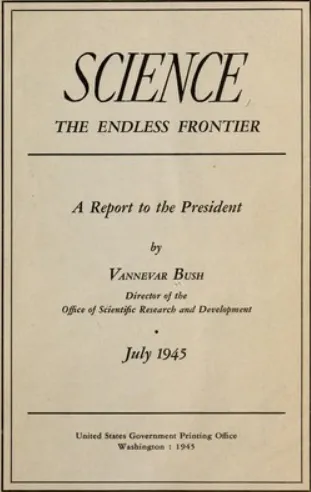

This is a busy week for me, but I would like to put down a marker on Michael Kratsios’s parody (not conscious) of Vannevar Bush’s “Science: The Endless Frontier.” Bush’s report to President Harry S Truman at the end of World War II proposed a system for funding and developing science in the US based on the ways that radar and atomic weapons had been developed during the war.
Now the brain trust of the Donald Trump administration, after attacking the universities and removing all scientific grants that had “diversity” and other forbidden words in their titles, is ready to build that science in their own image.
I haven’t read the parody yet, just comments from people who have and this article from Science magazine. I have long intended to work through Bush’s report and compare it to today’s situation in science. During my career in the national laboratories, I saw changes that seemed to undercut Bush’s vision. But Kratsios’s report is not the corrective.
My reading of Bush’s report a long time ago was that he assigned basic, individually-driven research to the universities, intermediate development and generic development that industry shunned to the national labs, and commercial development to industry. That was more or less the way things worked through the 1970s or 1980s. But industry had always wanted a bigger role and, particularly, more government money.
Basic research, silly things like Gila monster saliva, could be left to the universities. But the intermediate stages were tempting to industry. If they could hold parts of those intermediate stages, they could hold large parts of an industry. When the national labs developed those parts, they were available to all corporations. That was Bush’s point: that some sorts of research would benefit entire industries, but because of that broad usefulness, they were not cost-effective for any one company. Corporate competition could focus on differentiation in end uses or more efficient or otherwise improved applications.
But industry people pressed Congress to let them have the golden goose in various ways. The national labs were unfairly competing with industry. The national labs didn’t know how to cooperate with industry. The national labs were hidebound and stodgy. The government shouldn’t pick winners. Give us that money, dammit!
Congress caved in various ways to industry, although some baseline technologies like fusion, remained in the national labs. Now, suddenly, a gaggle of private companies are trying to commercialize fusion, which may mean that the technology is mature or that companies have decided on a more aggressive strategy to get the money. Silicon Valley in particular is involved in new fusion and fission companies with little expertise, although they are buying up experts. And they’d like government money, dammit!
The national research establishment has always returned more money than has been granted to it. It has its weaknesses, but it has also been the envy of the world. Now it is being disassembled. The government has picked the winners: artificial intelligence, quantum information science, fusion, space, semiconductors, and robotics. I don’t know if there will be another report for biosciences, but they’ve been a big part of the US’s scientific success. The list sounds like the focus of those grown boys who read lots of science fiction and believe they will never need health care.
That weird stuff, like Gila monster saliva, would be cut off from the universities in favor of those sure winners. And why am I talking aboug Gila monster saliva? That’s where the GLP-1 drugs, which treat diabetes, weight loss, and possibly a host of other things, came from. You never know about that silly woke individual research.
I’ll probably write more, but I am immensely angry about this on top of Russell Vought’s desire to insert political officers into the granting process. The two initiatives are different, but they are both of a piece.