
Have Some Recommendations, Give Us Some Money
 By
By 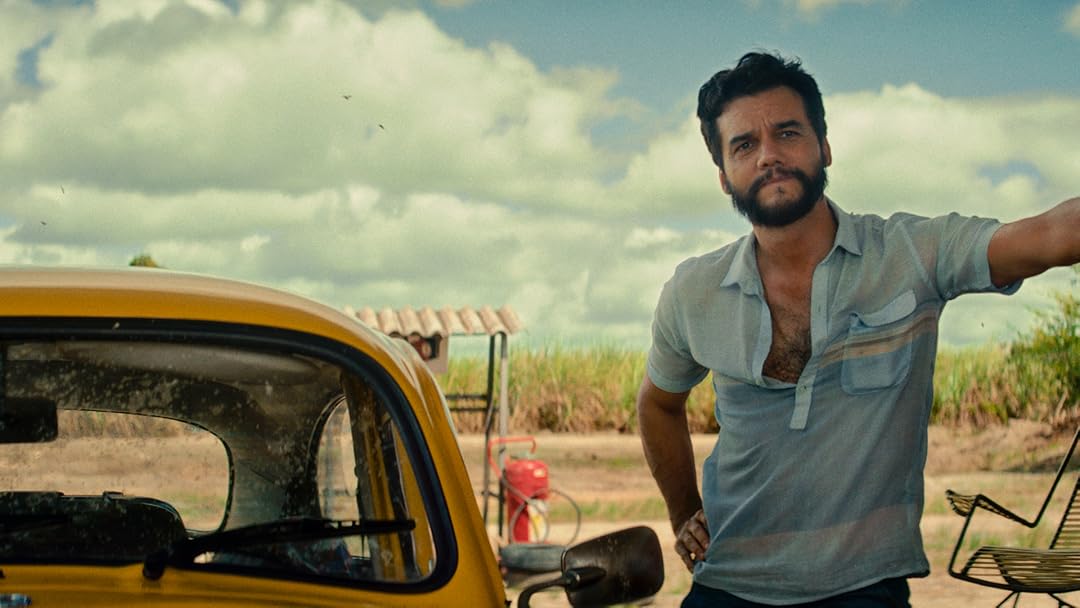
It’s LGM fund drive day! As the blog’s resident “watching stuff on TV” correspondent, here are a few things I watched on TV recently that you might enjoy! If you appreciate this service, please consider giving us money so that I can continue doing something that, in all fairness, I do for free on other parts of the internet, but analytics suggest that you won’t see them in those places.
First up, last week I watched The Secret Agent, a film that was nominated for several major awards at the Oscars a few months ago. Somehow I had managed to miss that the director is Kleber Mendonça Filho, whose earlier film Bacurau is an absolute masterpiece (Erik has also written about it in glowing terms). The Secret Agent is, if possible, even better. Like Bacurau, it starts out in an enigmatic mode, introducing us to a man, Marcelo (Wagner Moura) as he drives to Recife, Brazil, and then through him to a wide cast of characters: the landlady of the building where he rents an apartment (Tânia Maria, who also appeared in Bacurau) and her other tenants, a corrupt cop and his hangers-on, a journalist, a film projectionist, and many others. It is the 1970s, the height of Brazil’s military dictatorship, and many of the people Marcelo meets are in hiding or on the run. But despite its title, The Secret Agent is not about how people respond to direct government oppression, but rather an examination of how violence and corruption breed in a society where autocracy is the order of the day.
It’s a long film, and some might consider it meandering, but its kaleidoscopic plot offers scope for both tragedy and triumph, for a loving exploration of a particular city in a particular point in time (including a delirious scene in which a disembodied leg attacks cruisers at a park, which is apparently a local urban legend), and a clear-eyed examination of the corrosive forces running through it (a subplot about a plutocrat cavalierly shutting down a successful regional public university will hit pretty hard right now for a lot of people, I imagine). The community Marcelo discovers offers him support and moments of joy and camaraderie, but it may not be enough to protect him. And in the film’s extremely moving coda, we see that even though things get better, the weight of the past continues to bear down on its survivors.

Second, earlier this week I finished watching Half Man, Richard Gadd’s follow-up to Baby Reindeer, whose six-episode season was released on HBO. Like Baby Reindeer, this is a difficult watch, and like that show, it is saying things about masculinity and its crises that basically nobody else in pop culture has the courage to say (not to keep harping on this, but I feel like this is the show people kept telling me Adolescence was last year, without the Evil Internet copout). The show stars Gadd and Jamie Bell as Ruben and Niall, who become step-brothers in 1980s Glasgow. The two are polar opposites: Ruben is brash, outgoing, and has a terrifying violent streak; Niall is passive, suffers from bullying, and is deeply closeted. They forge an unexpected and increasingly unhealthy bond, which lasts for decades as they hurt each other, themselves, and innocent bystanders, culminating in a framing story in which Ruben crashes Niall’s wedding, with disastrous results.
It would be accurate to call Half Man a love story. It would be equally accurate to call it a tale of horrific abuse. The relationship between Ruben and Niall is never just one thing, and neither one of them is particularly sympathetic. As in Baby Reindeer, Gadd’s subject here is how abuse rarely produces perfect victims, and how that’s exacerbated by a society that teaches men that they can never talk about the abuse they’ve experienced, or even admit that they’ve been victimized. It’s not a perfect show—six episodes was perhaps not quite enough to tell this story with the nuance it deserved, and Gadd’s background in theater shines through in several scenes that feel overly stagey and unreal. But for all that, this is one of the mostly viscerally thrilling and disquieting things I’ve seen on TV this year, and it deserves the same kind of attention Baby Reindeer got.
That’s it for today! Send in those donations to get more pop culture discussion in the future! The silent auction (which isn’t loading for me right now, but hopefully that will soon be fixed) once again includes the option to request a review from me, which I think worked out really well last year. So anyone who is dying to find out what I think about their favorite (or least favorite) book, movie, etc. should consider bidding on that.