
This Day in Labor History: April 25, 1923
 By
By 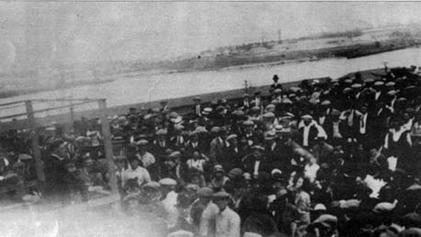
On April 25, 1923, dockworkers in San Pedro, California, organizing under the banner of the Industrial Workers of the World, went on strike over the horrible conditions of their work and lives. The last major American strike organized through the IWW, the longshoremen of San Pedro would lead the fight toward industrial unionism, fight against California’s harsh anti-union establishment, and lay the groundwork for the successful organizing of the 1930s.
Los Angeles and the surrounding area was among the most anti-union places in the country. The Los Angeles Times and its publisher Harrison Gray Otis was so committed to unionbusting that in 1910, the Ironworkers blew up the newspaper’s building. That did not help the union cause. Nothing had changed by the early 20s. Controlling labor and ensuring that unions did not succeed went hand-in-hand. On the docks, the major way to do that was the shape-up. This meant that hiring happened on a daily basis, as men showed up and the boss would pick the ones they wanted. If you showed any signs of resistance or got a reputation as a radical, no work for you.
Meanwhile, longshoremen were among the most radicalized workers of the world, sharing information through their unusual ability to meet people from around the world. That was especially true on the west coast, where the itinerant nature of so much work had created a more politicized working class. It was these people–whether in logging, mining, agriculture, or on the docks, that had made up the true center of the Industrial Workers of the World. The IWW was in terrible shape by the early 20s. Effectively destroyed by the Red Scare of World War I and right-wing violence in the aftermath, what was left was riven by a lack of leadership and horrible infighting. But the spirit of the IWW remained among many western workers.
Dockworkers had won some minimal gains over hiring halls in the 1910s, but in October 1919, the port’s employers announced they would fully implement the open shop through the hiring hall. The IWW and the AFL both in their own way tried to stop this but both totally failed and the typical infighting between the two organizations distracted both. So it was a totally open shop.
Anger mounted and in 1923, there were some small strikes, where workers just got sick of it and then held up ships from being loaded. This should not have been that hard to manage, but LA was so anti-union and hated anything associated with radicalism so much that it enacted its criminal syndicalism law to bust these small strikes. That was stupid. This was the moment in which the Red Scare had abated, Eugene Debs had been freed, and Americans were tired of busting radicals. But not among LA leaders. So they brought these workers on trial. That led to workers starting the much larger strike in April 1923.
Soon, 5,000 men on the east coast joined about 1,500 in Los Angeles to oppose what was happening at San Pedro. The fact that this was through the IWW–though to be clear, it was more than the workers just claimed to be IWW rather than something like a union with a centralized authority at this time–did not help, as other, more conservative unions of dockworkers refused to help. The immediate goal was to secure the release of what they considered class war prisoners, i.e., their fellow longshoremen trying to make everyone’s life slightly less awful.
This led to the last great IWW strike. The Wobblies soon convinced a bunch of construction workers to join them. This scared the employers enough to begin negotiations, but they fell apart immediately based on the core issue–the open shop. The workers wanted their own hiring hall and dock employers simply refused to give that. So the LAPD, always one of the worst institutions in the country, went full on state suppression, escorting in strikebreakers.
The strike went on. After about a month, the LAPD and employers recruited a new ally–the Ku Klux Klan, then at its peak. The KKK became the shock troops of violence in intimidating and beating up strikers, sometimes wearing hoods and sometimes not. As arrests increased, the IWW went to a very comfortable place with that–a free speech fight. Claiming, with plenty of justification, that the speech of organizers was being suppressed, the IWW called for people to come to the docks to demand basic First Amendment rights. This brought in the American Civil Liberties Union, who showed up to counter the Klan. When the writers and socialist Upton Sinclair joined them to give a speech, he was immediately arrested.
Mostly, the mass arrest of IWW activists and rank-and-file workers for speech worked. This wasn’t a decade earlier, when these free speech fight would attract itinerant Wobblies from around the nation to flood the jails. LA could handle anyone who came. On May 18, the strike effectively ended. The employers reopened the ports with thousands of strikebreakers. In fact, because of the number of backed up ships waiting, it was the busiest day in the port’s history to that point.
The police then allowed the workers to come back to work peacefully, so long as they joined the same kind of open shop hiring hall that created the strike in the first place. The ACLU held a last meeting on May 23 that the police protected and allowed to take place. Sinclair addressed the workers, among many others. The next day, the longshoremen chose to move the dispute back to the job. By this time, all the committed IWW longshoremen were blacklisted anyway.
The strike was a defeat. But a decade later, former IWW member Harry Bridges would lead the west coast longshoremen on a second epic strike, this time based in San Francisco. It was a very different time and place in 1934. San Francisco had a much stronger union culture than Los Angeles and the Great Depression and New Deal had transformed the nation’s political conditions anyway. That strike was also violently suppressed locally, but federal mediators in the Roosevelt administration basically gave the longshoremen everything they demanded anyway. But Los Angeles would remain a redoubt of extreme violent anti-unionism until World War II.
This is the 599th post in this series. Previous posts are archived here.