
John Roberts out of the shadows
 By
By 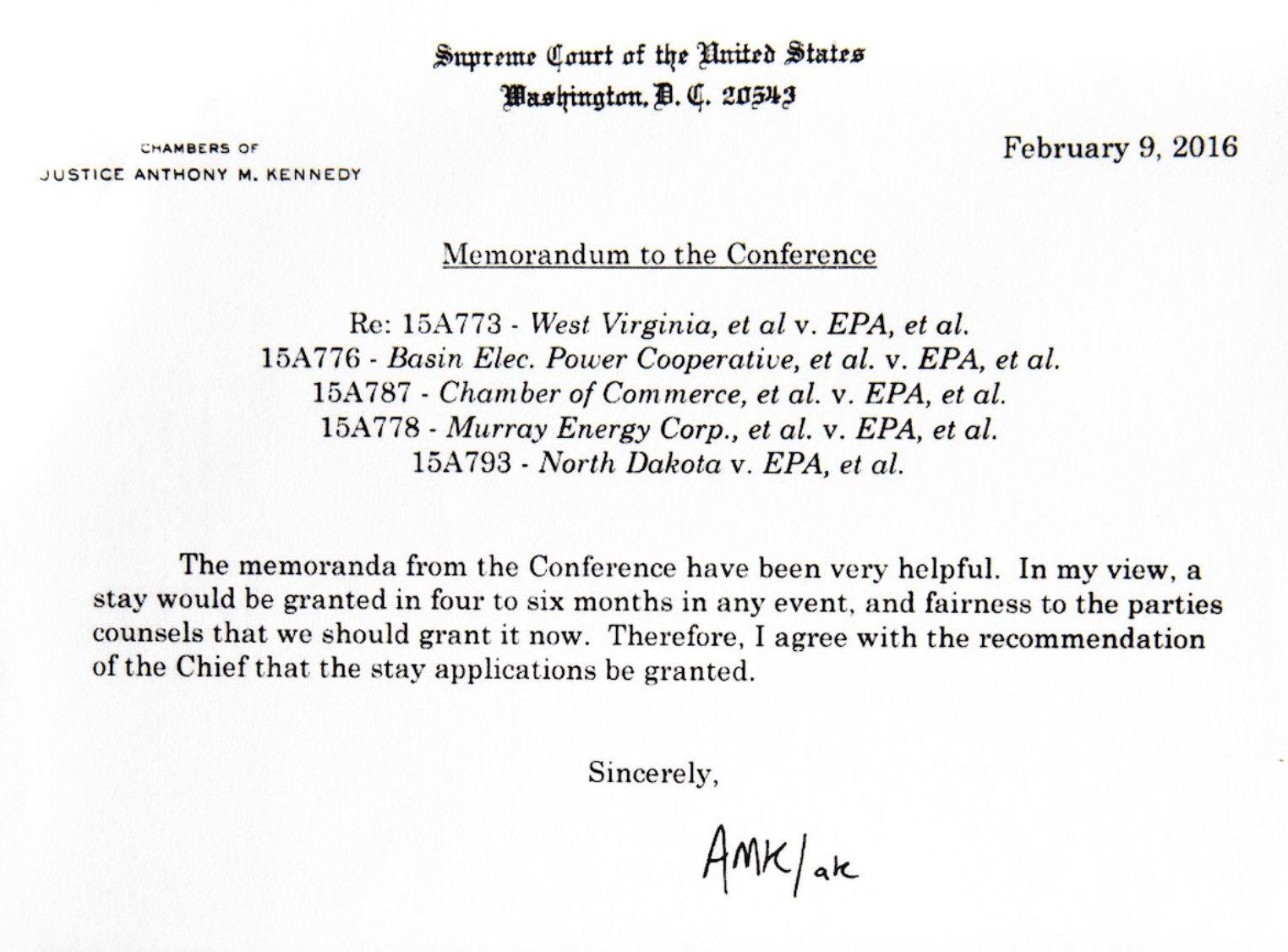
Jodi Kantor and Adam Liptak have a story [gift link] based on the internal memos that circulated before the Court issued the order that marked the beginning of the contemporary shadow docket. As you would expect, it is dominated by John Roberts’s arrogance and impatience about imposing his pro-business policy views on the responsible branches:
Just after 6 p.m. on a February evening in 2016, the Supreme Court issued a cryptic, one paragraph ruling that sent both climate policy and the court itself spinning in new directions.
For two centuries, the court had generally handled major cases at a stately pace that encouraged care and deliberation, relying on written briefs, oral arguments and in-person discussions. The justices composed detailed opinions that explained their thinking to the public and rendered judgment only after other courts had weighed in.
But this time, the justices were sprinting to block a major presidential initiative. By a 5-to-4 vote along partisan lines, the order halted President Barack Obama’s Clean Power Plan, his signature environmental policy. They acted before any other court had addressed the plan’s lawfulness. The decision consisted of only legal boilerplate, without a word of reasoning.
At the time, the ruling seemed like a curious one-off. But that single paragraph turned out to be a sharp and lasting break. That night marks the birth, many legal experts believe, of the court’s modern “shadow docket,” the secretive track that the Supreme Court has since used to make many major decisions, including granting President Trump more than 20 key victories on issues from immigration to agency power.
Since that night a decade ago, the logic behind the Supreme Court’s pivotal 2016 order has remained a mystery. Why did a majority of the justices bypass time-tested procedures and opt for a new way of doing business?
The answer would remain secret for generations, legal experts predicted. “We’ll never know (at least, until our grandkids can read the justices’ internal papers from that time period),” Stephen Vladeck, a law professor at Georgetown, wrote in a newsletter in February marking the anniversary of the order.
The New York Times has obtained those papers and is now publishing them, bringing the origins of the Supreme Court’s shadow docket into the light.
The 16 pages of memos, exchanged in a five-day dash, provide an extraordinarily rare window into the court, showing how the justices talk to one another outside of public view.
You can read the memos at the link in the second-to-last graf above.
When colleagues warned the chief justice that he was proposing an unprecedented move, he was dismissive. “I recognize that the posture of this stay request is not typical,” he wrote. But he argued that the Obama plan, which aimed to regulate coal-fired plants, was “the most expensive regulation ever imposed on the power sector,” and too big, costly and consequential for the court not to act immediately.
In the Trump era, he and the other conservative justices have repeatedly empowered the president through their shadow docket rulings. By contrast, the papers reveal a court wielding those same powers to block Mr. Obama. Justice Samuel A. Alito Jr. warned that if the court failed to stop the president, its own “institutional legitimacy” would be threatened.
The court’s liberals pushed back, but compared with their recent slashing dissents, they were not especially forceful, mostly confining their arguments to procedures and timing.
The papers expose what critics have called the weakness at the heart of the shadow docket: an absence of the kind of rigorous debate that the justices devote to their normal cases.
[…]
On Feb. 5, the internal correspondence obtained by The Times shows, the chief justice circulated a blast of a memo, insisting that the court halt the president’s plan.
His arguments were forceful, quick, and filled with confident predictions. The court was going to give the case a full hearing eventually, he forecast. At that point, the justices would vote to overturn the Obama plan, he said, because it went beyond the boundaries of the Clean Air Act.
For now, the chief justice contended that the court had to act immediately because the energy industry “must make changes to business plans today.”
“Absent a stay, the Clean Power Plan will cause (and is causing) substantial and irreversible reordering of the domestic power sector before this court has an opportunity to review its legality,” he wrote.
In his final paragraph, the chief justice again told colleagues that the E.P.A. had done an end run around the court with the mercury regulation just months before and said the agency had signaled that it was planning to do the same thing again.
The chief justice cited an unusual source for that last point, one that would not ordinarily figure in a Supreme Court opinion: an interview with the BBC in which the E.P.A. administrator at the time, Gina McCarthy, had said “we are baking” the Clean Power Plan “into the system.”
In the memo, he weighed no potential downsides of his proposal and considered no alternatives.
Justice Breyer responded later that day to the chief’s memo but did not address all its points. Such stays were unusual, he wrote, stating his objections mildly.
He skipped over the question of whether the plan was lawful, asking only: Why the rush? The circuit court had already set a date to hear the case in June. The first deadline for power plants to reduce their emissions was six years away; full compliance was not required until 2030. That was plenty of time for the case to play out through the legal system.
The chief wrote right back the next day sounding irritated and blunt.
Speed was vital, he said, because environmental regulation was going to be very expensive for states and the power industry. The sums involved could approach $480 billion, he asserted, and industry groups would have to start preparations immediately.
“Without a stay of the E.P.A.’s rule, both the states and private industry will suffer irreparable harm from a rule that is — in my view — highly unlikely to survive,” he wrote. He was predicting the ultimate outcome of a case that had barely begun to be litigated.
Seeing how little headway Justice Breyer had made, Justice Elena Kagan sounded an alarm. In a memo on Feb. 7, she warned the chief justice that he was departing from the court’s long-established way of doing business.
Court action at this point in the process would be “unprecedented,” she added. She mentioned that she was inclined to find that the Obama plan was lawful, but she said the thin briefing made it difficult for her “to determine with any confidence which side is ultimately likely to prevail.”
Justice Alito issued a salvo on the same day as Justice Kagan, with neither of them addressing the other. Echoing the chief justice’s sense of insult and suspicion about the Obama administration, he wrote that the E.P.A. appeared to be trying to render the court irrelevant.
[…]
As usual, the decision would come down to Justice Kennedy.
On Feb. 9, he dashed off a quick, three-sentence note. He believed that the Supreme Court would ultimately stay the Clean Power Plan soon anyway, and that there was no reason to put off the inevitable. He was voting with the chief justice.
Over just five days, the justices had decided the issue. Even as they debated the Obama plan’s possible burden on the power industry, in the entire chain of correspondence obtained by The Times, not a single justice, conservative or liberal, mentioned the dangers of a warming planet as one of the possible harms the court should consider.
The most striking thing about the memos is indeed nobody citing the dangers of climate change as a factor to even consider. Admittedly, since the Court’s liberals didn’t want to intervene they had less reason to, but it’s striking that none of Roberts, Alito, or Kennedy suggested that the impact of the order on the environment should be given any weight at all, despite the purpose of the legislation being to mitigate the environmental effects of air pollution. The executive action would impose costs on business, and that’s all we need to know. And the beauty of the shadow docket is that nobody needs to even pretend to think rigorously before casually dismissing a major executive order.
And this is the new normal:
Since then, even as the court’s approval ratings dropped, applications like the one it confronted a decade ago have proliferated, swamping the court’s ordinary work.
This is partly a consequence of a gridlocked Congress and presidents willing to push the boundaries of executive power, particularly Mr. Trump.
But it is also the result of the justices’ decision to entertain emergency requests like the one in 2016, warping procedures that had developed over centuries.
In an appearance this month at the University of Alabama, Justice Sonia Sotomayor reflected on the unceasing flood of emergency applications.
“We’ve done it to ourselves,” she said.
Reading the article is also melancholy inducing because of how conigent the future of the Court was at that moment, how evitable this all was:
In the moment, the case looked like an outlier, not a turn toward a new way of operating, according to people involved. Nor did it look like a final decision on climate policy. Hillary Clinton was the strong favorite to win the presidency later that year. With her election, the court would be poised to take a step to the left.
[…]
It was initially hard to tell how the vote would fall, people familiar with the discussions said. The Supreme Court felt less predictable back then, more alive with debate. The court was technically divided 5 to 4 between justices appointed by Republicans and Democrats, but Justice Kennedy, appointed by President Ronald Reagan, was a true swing vote, “a persuadable person,” as one of those people put it. The term before, he had written the majority opinion to establish a constitutional right to same-sex marriage.
The possibility of a liberal median vote on the Supreme Court for the first time since 1970 was sitting there. Coverage of the 2016 election was dominated by a trivial story about Hillary Clinton’s compliance with email server management best practices. And no, I will never get over that.