
This Day in Labor History: March 14, 1952
 By
By 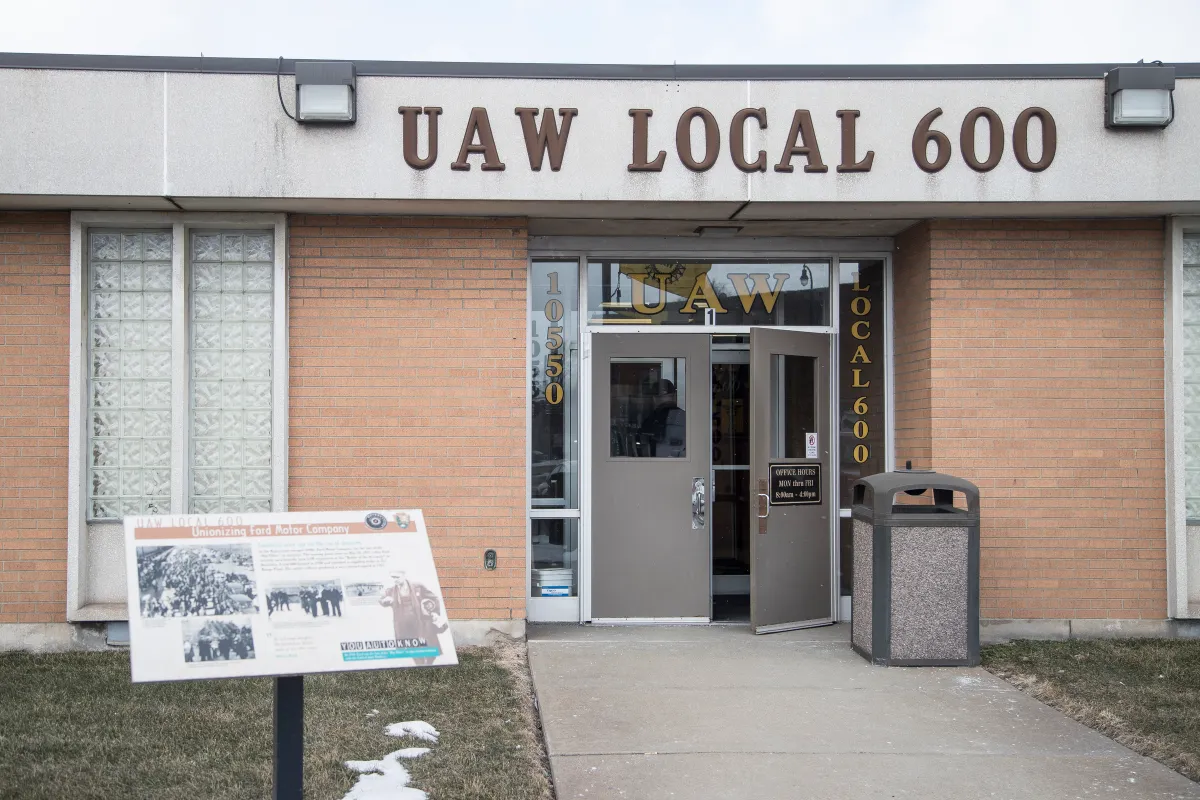
On March 14, 1952, United Auto Workers head Walter Reuther started the process to move Local 600 into receivership. This was a key moment in the postwar transition of the UAW into a liberal but very much not leftist union consolidated under Reuther’s control and his anticommunist ideology. But it was also a moment where a local fighting hard for civil rights was repressed, demonstrating the difficulties of intensive civil rights organizing during the. anti-communist scare.
When John L. Lewis created the Council of Industrial Organizations in 1935 to organize workers on an industrial basis, it was within the American Federation of Labor. When the AFL showed outright hostility to these efforts, he moved renamed it the Congress of Industrial Organizations and created an alternative and very hostile federation that hoped to drive the AFL into the dustbin of history. There were millions of workers who desperately wanted unions. The Great Depression had led so many people into hopelessness and a belief that capitalism had failed and the future with either going to be communism or fascism. Given how many of these workers were either immigrants or the children of immigrants, communism was appealing to a lot of them, though certainly not all. Moreover, the Communist Party was very good at training committed organizations who would do anything to get the job done. Lewis was not only not a communist, he was a staunch Republican who had voted for Herbert Hoover in 1932. But he knew he could employ these organizers to build these new unions and he would seek to control them and rein them in when needed.
Perhaps the most important of these new CIO unions was the United Auto Workers, which exploded in membership and power after defeating General Motors in the Flint Sit-Down Strike in 1937. The UAW, like most of these unions, was divided between communist and anti-communist forces. The UAW actually split early on, with a rightist named Homer Martin withdrawing and starting UAW-AFL, affiliated with the older organization and trying to destroy the CIO version. Didn’t work, but it was a real distraction.
Meanwhile, Walter Reuther was rising within the UAW and became president in 1946. He had spent time in the Soviet Union but was not a communist and he did not trust the Communist Party. On top of this, the nation had turned sharply to the right immediately after World War II. Congress responded to the 1946 strike wave by passing the Taft-Hartley Act the next year, which banned much of what made the CIO work. It also forced communist unions out of the mainstream organized labor movement. By this time, most other CIO leaders were fine with this, as the communists ideological inconsistency (or extreme consistency in doing whatever Stalin told them to do, leading to whiplash position changes overnight) had really made a lot of people mad, including in the rank-and-file. It’s hard for me to imagine how the labor movement would have survived had the CIO not gone along with pushing out the communists. Lots of contemporary leftists say this was the end of the real American labor movement and there’s truth to that, but they ignore the context, which was that a majority of Congress would have gladly ground the CIO to dust otherwise. After all, when Harry Truman vetoed Taft-Hartley, Congress overrode that veto in a landslide the very same day.
This is the context for Reuther dealing with the communists in the UAW. Local 600 was a communist-led part of the union. Its core were the black workers who had moved from the South and become radicalized. Unsurprisingly, communism, with its anti-racist ideology (leaving behind the reality of life in the USSR, but these workers would have no way to know this) had a lot of appeal for black workers, including in the South. Plus, the CP was the single most righteous white-dominated organization in American history since the Civil War fighting for civil rights. Simply put, no other white-led organization cared about this issue like the CP. So Local 600 members created a militant pro-civil rights, hard left ideology that combined the fight for racial and economic justice.
Reuther was pro-civil rights too. Later, the UAW would fund the March on Washington and he would speak there too. But the leadership of Local 600 threatened the entire organization. Reuther also did not trust the Communist Party at all and he knew not to. So when the House Un American Activities Committee came investigating Local 600, it wasn’t just that Reuther saw the threat, it’s that a lot of rank and file UAW workers wanted those leaders gone. Some of that was that they were racist and Local 600 leadership challenged white supremacy. We know for example that by 1940, large numbers of UAW members in Detroit switched their votes to Republicans when Democrats allowed the integration of a public housing project, and of course this was the height of FDR as the hero for the working man. But some of it was that the communists had angered so many non-communist workers through their constant position changes and of course the rise of anticommuism by 1952 did not help.
Local 600 was also the last real holdout to Reuther controlling the UAW. Ever since the 1946 strike against GM, where Reuther emerged as the dominant figure in the union, he had installed allies through the union. Local 600 did not like this. It did not think that Reuther was doing enough to stop speed ups on the shop floor, which was probably true. It also opposed the long-term contracts that began with the Treaty of Detroit in 1950, where Reuther gave up trying to force GM to open its books or share control over the shop floor in exchange for a whole lot of money and benefits. I do think that was the only realistic option for Reuther–GM would have gone to the mat and the conditions for change were not so propitious in 1950 as they were in 1937.
So Local 600 leadership had legitimate concerns. But Reuther, a realist at heart, crushed Local 600 leadership, claiming they were sabotaging the American effort in the Korean War (which they did in fact strongly oppose) and installed replacements loyal to him. Whether this was a moment that demonstrates the elimination of dissent in the UAW and the creation of a “bureaucratic” union or was a necessary move to survive in the Cold War depends on your perspective, but given that most labor historians have some pretty romantic visions about socialism and union democracy, you can guess where most of the literature falls.
In any case, this was a moment of unionism in the Cold War that sharply demonstrated the limitations of left unionism, which has never recovered.
I borrowed from David M. Lewis-Colman, Race Against Liberalism: Black Workers and the UAW in Detroit to write this post.
This is the 592nd post in this series. Previous posts are archived here.