
Revisiting the 2023-24 Detroit Pistons in light of subsequent developments
 By
By 
As I’m sure you all remember, almost two years ago exactly we had a great deal of statistical fun trying to figure out what was going to happen to the Detroit Pistons during the rest of the 2023-24 season, given that they had lost an astonishing 27 games in a row at that point. (Andrew Gelman joined the party in the wake of the first linked post). A key factor in answering that question was an estimate of the extent to which Detroit’s record-breaking losing streak — would end at 28 a few nights later — was a product of the inherent quality of the team, and how much was sheer bad luck:
Now the even money over/under for Detroit’s eventual winning percentage this season was, before the first game was played, a winning percentage of .340. To this point, a little more than third of the way through the season, Detroit’s winning percentage has been .0666.
What are the odds that a .340 team would lose all 27 games in any particular 27 game stretch? The answer would seem to be .660 to the 27th power, which is about 75,000 to 1. This suggests that Detroit is not actually a .340 team that has just had really really really bad luck so far.
Conversely, the team’s current 2-28 record projects to a final record of 5-77. Now this would be a good bet to the extent that the team’s current record is solely a reflection of its quality, apart from random factors. To the extent that the team has had unusually bad luck, then one would expect the team’s final record to be better. But how much better? Here we can again turn to the savants of Las Vegas et. al., who currently set the even money odds of the team’s final record on the basis of the assumption that it will have a .170 winning percentage in its remaining games. A .170 team could be expected to lose all 27 games in a 27-game stretch about once in every 150 such stretches, which, while highly unlikely, is worlds more probable than a .340 team doing the same, i..e, once every 75,000 times.
Now how did they get this latter estimate? I have no idea, but I asked my brother — a scientist and not a statistician by training as he wishes me to emphasize before Andrew Gelman gets to the end of this post — and he used the preseason odds and the team’s current record to construct the following graph:
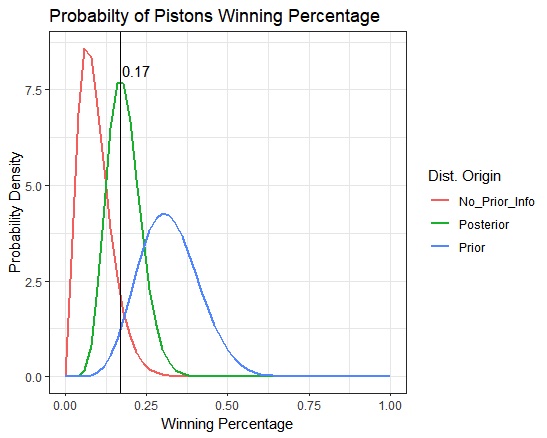
What’s striking here is that if we have just two pieces of information — a prior assumption of a .340 team, and the subsequent information of a .066 performance through thirty games — the combination of these two pieces of information yields a posterior prediction of a .170 winning percentage going forward, which remarkably enough is exactly what the current gambling odds predict!
In other words, it appears that the estimate being made by professional gamblers is that about two-thirds of Detroit’s worse than expected record is a product of an ex ante overestimate of the team’s quality, while the other third is assumed to be accounted for by bad luck.
Now a complicating factor here in predicting future performance is whether team quality could be thought of as a fixed variable going forward. I think it can, because any changes in team quality going forward this season — because of the improvement of young players as the season goes on, and/or because of better coaching decisions in terms of lineup composition, and/or because of changes to the composition of the roster because of management decisions — can be considered things that were inherent attributes of the players, coaches, and management at the beginning of the season, that gamblers can take into account at that time in terms of possible future changes to present team quality. Also if we don’t make this assumption then the math gets really hard and we’re not going to do that.
As for luck, that’s definitionally stochastic, as Alan Iverson once implied.
The Pistons had won 6.7% of their games so far that season; the bookmakers predicted they would win 17% of their remaining games; they actually won 23%, which allowed them to avoid the all-time NBA record for most losses, despite the incredible 28-game losing streak, but was still by far the worst single season in franchise history.
Now here’s an interesting subsequent development: The core talent group on that historically bad team still makes up the core talent of the present Detroit team, exactly two years later: Cade Cunningham, Jalen Duren, Ausar Thompson, Jaden Ivy, and Isaiah Stewart. Except instead of a 2-28 record through 30 games, these players have gone 24-6, which is the second-best record in the league, and projects out to 65 wins over the course of the season, which would be a franchise record, on a franchise that has won three NBA titles.
How did this happen? The answer is that all these players were extremely young two years ago: Cunningham and Stewart were 22, Ivy and Thompson were 21, and Duren was 20. Each of them has taken a huge leap forward in the subsequent two years: Cunningham is now a no-question-about-it superstar, Thompson was first team all-defense last season, [correction: his twin brother Amen was first team because Ausar missed too many games to be eligible; he will probably make it this season though] Ivy is also progressing toward stardom despite a serious injury last year, Duren is now one of the best big men in the league, and Stewart is right behind him in his own developmental arc.
Which just goes to show it’s darkest before the dawn, at least sometimes, at least if you drafted really well and are patient about it. This applies to a bunch of other things in life besides basketball, or at least I hope so (peers at 2026 and 2028 election calendars).