
Grading college papers in Jesusland
 By
By 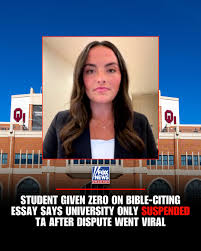
Samantha Fulnecky is doing Christofascism the Right Way:
In November, a University of Oklahoma student named Samantha Fulnecky received a zero for a psychology paper. The assignment was a 650-word response to a study of middle school students, which found that students that were “high in gender typicality” — think, athletic boys and well-dressed, attractive girls — were described as more popular by their peers, and that this effect was particularly pronounced for boys. Students, the study revealed, who were less gender typical tended to be teased and bullied more.
If she had just complained to her professor about the grade — which she did almost immediately — we would never have known about this. But according to Alexia Aston in The Oklahoman, just hours after the instructor refused to raise her grade, Fulnecky emailed the governor of Oklahoma, “O.U. President Joe Harroz Jr., her college’s dean, news outlets and the Teacher Freedom Alliance, led by former state schools Superintendent Ryan Walters, asking for help.” Fulnecky’s paper, which was published in full on the X account of the O.U. chapter of the conservative student group Turning Point USA, cited the Bible as her only source and did not seem to grapple much with the content of the original material.
The original study assigned to Fulnecky is not specifically about transgender youth, but a sample passage of her paper reads: “My prayer for the world and specifically for American society and youth is that they would not believe the lies being spread from Satan that make them believe they are better off as another gender than what God made them.”
The graduate student teaching assistant who graded the paper wrote that it “does not answer the questions for this assignment, contradicts itself, heavily uses personal ideology over empirical evidence in a scientific class, and is at times offensive.” The teaching assistant, who is reportedly transgender, had a second teaching assistant (who is not transgender) look at the paper, and that one concurred with the original grade.
You can probably guess where this went from here.
This kind of thing brings up two big problems with contemporary higher education in America:
(1) There is no such thing as a “neutral” perspective on whether God’s Infallible Word As Revealed in the Bible is a legitimate source of citation in a college classroom. At a secular institution it isn’t, any more than citing Dianetics by L. Ron Hubbard, or something published by that lizard people guy would be. Now at Bible Believing College a student would probably get a failing grade for arguing that religious fundamentalism of the sort presented by Ms. Fulnecky is a bunch of anti-scientific garbage, and that would be a predictable and in at least some sense appropriate grade in that particular sociological context. I don’t know if we have any explicitly Nazi colleges in the wonderfully diverse and inclusive world of American higher ed 2025, but if we do then a paper in a history class arguing that the Holocaust didn’t happen and also too the Jews deserved what they got would probably get a good grade in that class, but would still appropriately get a student an F at a non-Nazi college, aka a B- at Harvard.
(2) This leads me to Point 2, which is a much more pervasive problem than whatever’s going down in Jesusland:
Culture warriors like Fulnecky and the Oklahoma conservative politicians supporting her are merely taking advantage of a decades-long trend in higher education: Students think they are customers who deserve to be catered to, rather than curious humans who might have something to learn. With the Trump administration going to war with universities, and Oklahoma’s freedom caucus, a group of right-wing state legislators, decrying “O.U.’s descent into radical activism” and demanding a public apology to Fulnecky while threatening a funding cut, you can see how hard it is for even the most stalwart college presidents to stand up for the principles of academic freedom.Inside Higher Ed does an annual student voice survey that polls thousands of current college students from across the country, and this year’s results showed that 65 percent of college students “consider themselves customers of their institution in some capacity, defined in the survey as expecting to have their needs met and be empathized with because they are paying tuition and fees.” I.H.E.’s Colleen Flaherty explains that this thinking can undermine the teacher-student relationship. For example, it can lead to bad outcomes like grade inflation, which is rampant at even the most elite institutions, because administrators want satisfied students, and bad grades make very unhappy customers.
Flaherty cites a 2010 paper called, “The customer isn’t always right: Limitations of ‘customer service’ approaches to education or why Higher Ed is not Burger King,” which has an elegant explanation of the difference between education and a typical consumer transaction. “An education can not be had unless the person being educated is engaged in the process. Lessons can be given, but learning remains the responsibility of the learner. The practice of education is, then, necessarily cooperative; it is not a simple exchange of services for pay.”
The line about rampant grade inflation “even” at elite institutions is good for a mordant chuckle, since grade inflation is far more prevalent at your local HYPS outlet than it is at pretty much any community college to be found anywhere across this fair land of ours. But the general point is sound: if students think of themselves as customers paying for a product, then naturally they are going to want to Speak to the Manager whenever they have a less than satisfactory experience. (Remember the organic chemistry professor at NYU who got fired because he gave too many students bad grades?)
Samantha Fulnecky will probably go to law school and eventually end up on the 11th Circuit if not the SCOTUS, so I’m just glad my time horizons in the academic rackets are fairly short at this point. I swear if I were 35 I’d be looking for an honest line of work.