
Erik Visits an American Grave, Part 2,040
 By
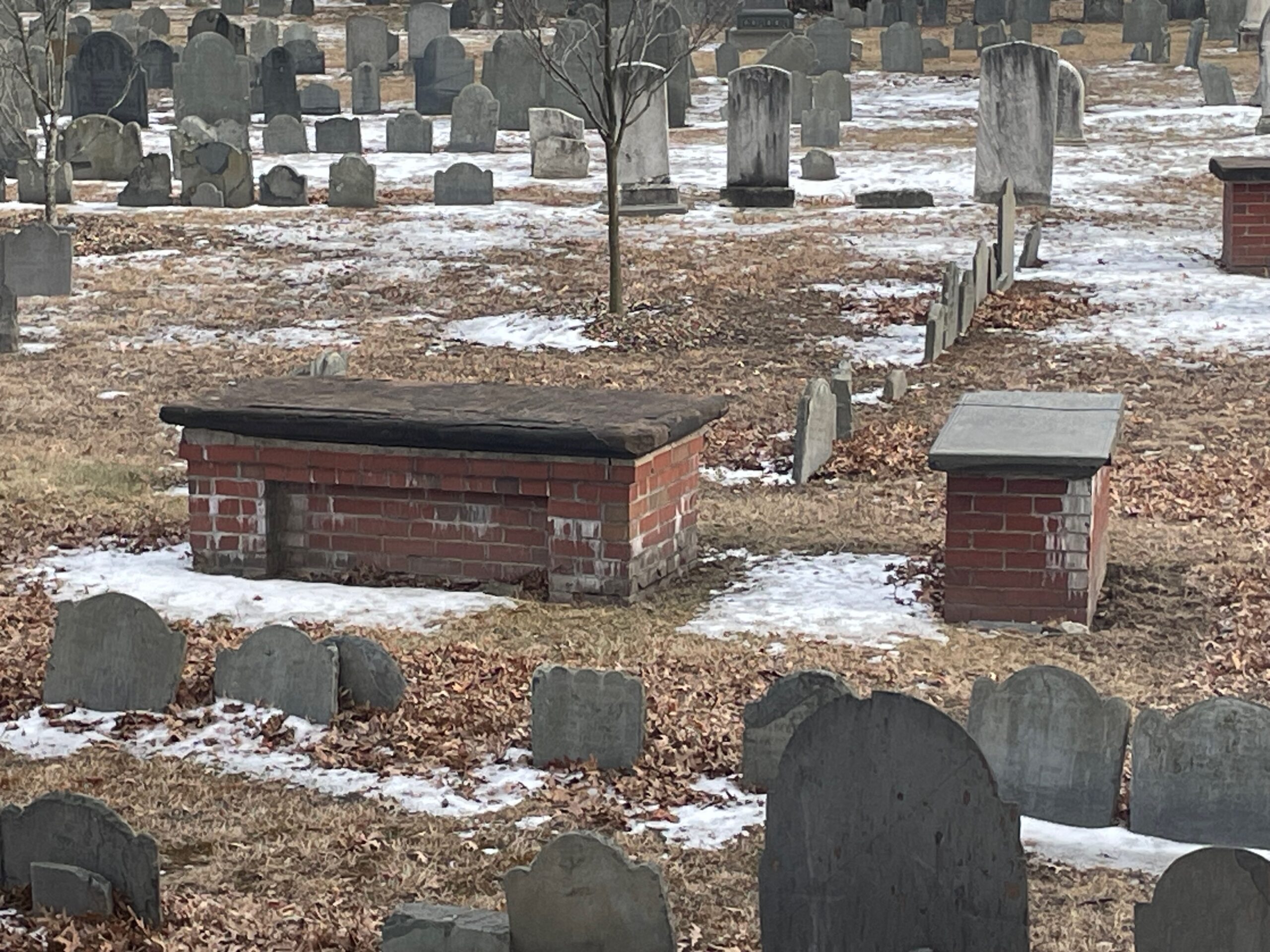
By This is the grave of Richard Mather. Or I think it is, the cemetery gate was locked. but I am pretty sure the large grave with the flat top is the grave.
Born in 1596 in Lowton, Winwick, Lancashire, England, Mather grew up in a downwardly mobile family that wasn’t too far from poverty, but had a past that allowed them a coat of arms. I don’t think the family itself was super inclined toward the new Puritanism. There doesn’t seem to be much evidence that this was a thing for them in those early days. He went to grammar school, did pretty well, went to Oxford a little bit, and became a minister. Meanwhile, the separatist Puritans that became known as the Pilgrims in the United States were off to the Netherlands and then America in 1620 and the more mainline Puritans decided to move to Massachusetts in 1630. At this time, it doesn’t seem Mather was particularly connected with either sect.
It’s not until 1633 that Mather starts showing up as a problem minister for the Church of England. Probably this had gone on for some time before, but in that year, Mather was suspended from his post for nonconformity. He was reinstated but then suspended for the same reason the next year, when he angered the Archbishop of York, who had friends who were in the congregation one day. Evidently, Mather refused to wear a surplice and hadn’t ever, so probably he always had these Puritan tendencies and simply hadn’t been caught. In any case, he sure was caught now.
Unsurprisingly, at this point Mather decided to join the Massachusetts Bay colony and went across the Atlantic in 1635. They nearly died as their ship got caught up in a hurricane. When a hurricane is that far north, it is usually moving very fast and that saved them, but it was a harrowing experience, without a doubt. I can’t even imagine riding through a hurricane on a 17th century boat. Somehow, everyone survived.
Mather thrived in Massachusetts. There was a shortage of ministers of the first rate and so there was something of a battle for Mather’s services. He chose the town of Dorchester. It was a struggling church, as a bunch of the settlers in that area had decided to move onto the new colony of Connecticut. Mather stabilized it.
Mather already had a pretty good sized family, but he and his wife had at least one more child in America, in 1639. They named him Increase. Puritan names did then toward the ridiculous and this is certainly no exception, but that’s now why I discuss him. It’s because the Mathers would become the first family of Puritan ministers, first with Increase and then with Richard’s grandson and Increase’s son Cotton Mather, probably the single most important Puritan minister in the Americas. The name Increase came from Mather’s great love for his new home. He stated it was because “of the never-to-be-forgotten Increase, of every sort, wherewith GOD favored the Country, about the time of his Nativity.” In related news, it’s exciting that the president of the United States in 2025 has adopted the capitalization standards of the 17th century.
Mather was also involved in translating the Psalms into metrical English from Hebrew. How well a man like this would know Hebrew is something I question, but it was common enough as a basic study at the time and I guess it would be useful for a literate society like the Puritans to go to the original sources the best they could. Evidently though, the Psalms he translated were notably bad. Mather was also known for his long sermons and frequent orations on most days of the week. This however was not unique to him. It was an era where the people wanted to hear very long sermons all the time. Sounds horrible to me, but then I am not a 17th century Puritan. I wouldn’t really want to sit through a 6 hour Fidel Castro rant either though.
Ministers like Mather also had tremendous power. The idea was that unlike the Catholics or the mainline Anglicanism that was delivered through The Book of Common Prayer, these ministers, thanks to their conversion experiences, were delivering the Word of God directly to the people everyday. Interestingly, Mather was somewhat less stern than you might think. While Puritans believed in a rigid predestination, in truth that was harder to live with on a daily basis. Add to that the relationship between religion and social control and you need to give people some way to feel that living a righteous life matters. The idea that works mattered at all was Arminianism, a hated term to these people, but a lot of ministers preached some form of this. Could each man control his own fate? He would never, ever admit to that, but it was a fine line when it came to ministering to real life people, even fanatics like these early Puritans. But what Mather offered–and not everyone did–was that all of his parishioners might in fact be among the elect, whereas the more common Puritan way was assuming that most of the people you are speaking to are in fact going to Hell and quite deservedly so. Hard to keep things up with that kind of lovely theology.
Interestingly, on his death bed, he was trying to convince Increase that the Haflway Covenant was worth supporting. This was the Puritan compromise. The problem of the Puritans is that the visible conversion was necessary for acceptance into church membership and thus full political and social rights. The issue here is pretty obvious when you think about it–as the first Puritan generation aged and got even crankier than Puritans usually were, the olds refused to agree that anything the kids said (which could be men and women in their 40s and 50s; Puritan families were strictly hierarchical up until the point of the father’s death, no matter the age of the children) was a real conversion. So the official church was shrinking. The Halfway Covenant was a compromise that allowed the baptism of children whose parents had a conversion experience, which would give them at least some church membership. This was already adopted by the time that Mather died, but remained highly controversial by those who thought it was an ungodly sellout. Interesting that in the Mather family, the generations were reversed on this.
Mather ministered in Dorchester for the rest of his life, dying there in 1669. We are not sure of his precise birthday, so he was 72 or 73 years old.
Richard Mather is buried in Dorchester North Burying Ground, Dorchester, Massachusetts. It’s not a super great area and thus the cemetery gates were locked, but I did the best I could to see his grave and I am pretty sure I got it right.
If you would like this series to visit other American ministers, you can donate to cover the required expenses here. Billy Graham is in Charlotte, North Carolina and Fred Shuttlesworth is in Birmingham, Alabama. Previous posts in this series are archived here and here.