
Drone Damage to Chernobyl Confinement Structure
 By
By 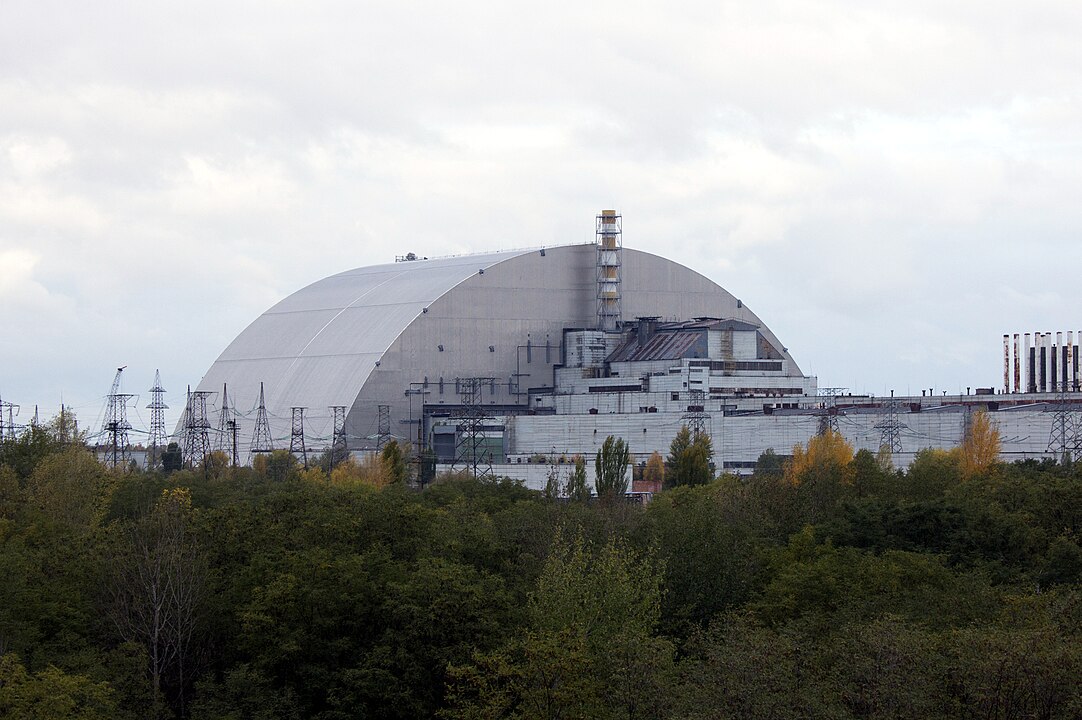
A number of news outlets have led with sensational headlines about Chernobyl, like
Bombed Chornobyl shelter no longer blocks radiation and needs major repair – IAEA (Guardian)
They are wrong. But first, a word from your sixth-grade science class.
Radiation comes from the breakdown of atoms. Because of this, it is always associated with matter. It is not a slippery ether-like fluid waiting to sneak up on you at night. We see a bit of this in the CNN headline above.
The New Safe Confinement Structure at Chernobyl is a double-layered metal structure outside of the sarcophagus that was built around the ruined reactor to confine the radioactive materials. (I said radioactive materials, rather than radiation, because of what I just said in the paragraph above.)
In February, a Russian drone blew a hole about 10 feet across in both layers of the NSC. The IAEA recently sent a mission to Chernobyl to investigate the extent of the damage and the repairs needed.
The hole allows dust that may be stirred up within the confinement to escape. Work to remediate the reactor and its surroundings cannot proceed until the hole is fixed. It also allows rain to get into the confinement and cause a variety of problems, although in both these cases, the amounts are small.
The space between the two metal layers must be ventilated to prevent moisture accumulation and corrosion. The hole interferes with this ventilation. Negative pressure within the confinement has also been mentioned, meaning that the pressure within the confinement is maintained so that air comes in, but not out. I’ve been able to find only one reference to negative pressure, and that one is from a prospective look at the NSC in 2015. I am wondering if this feature was implemented. It would require an enormous amount of blower power. If it is a current feature, it too will be disrupted by the hole, making it easier for material to escape.
[My search was relatively quick. If anyone has ACTUAL information about negative pressure under the NSC, I’ll be happy to update. ACTUAL information means a statement from a reliable source, not your vague memories.]
The poor reporting seems to come from an attempt to use this Director-General’s statement. It is number 331 in a series on Chernobyl. If you go to the News Release page of the IAEA, you can find the others. Here’s the meat of it:
Last week, another IAEA team completed a comprehensive safety assessment of the New Safe Confinement (NSC) at the Chornobyl site, which was severely damaged in a drone strike in February. This event also caused a major fire in the outer cladding of the massive steel structure built to prevent any radioactive release from the reactor destroyed in the 1986 accident.
The mission confirmed that the NSC had lost its primary safety functions, including the confinement capability, but also found that there was no permanent damage to its load-bearing structures or monitoring systems.
“Limited temporary repairs have been carried out on the roof, but timely and comprehensive restoration remains essential to prevent further degradation and ensure long-term nuclear safety,” Director General Grossi said.
Based on the mission findings, the IAEA recommends further restoration and protective work of the NSC structure, including humidity control measures and an updated corrosion monitoring programme, as well as an upgrade of an integrated automatic monitoring system for the shelter object structure built on top of the reactor immediately after the accident.
It’s that second paragraph that reporters seized for sensational value. To be fair, the IAEA wrote it so that was easy to do. I suspect that the phrasing has to do with IAEA formalities. The IAEA can be stodgy and not always easy to understand. This is well known to those of us who have worked with the agency.
Nothing is said about negative pressure, but that may be part of “the confinement capability.” Again, terminology strikes, and I am not fully familiar with the terminology around Chernobyl and the NSC.
The statement is also part of a campaign to get more money to do the repairs.
The bottom line is that confinement is marginally less effective than it was before the drone strike, and that damage to the structure will increase if the hole isn’t fixed as soon as possible. I’d like to see radiation measurements around the NSC, which I suspect haven’t changed.