Subscribe via RSS Feed

Author Page for Erik Loomis

rss feed

Visit Erik Loomis's Website

Plan B

[ 27 ] December 7, 2011 | Erik Loomis

Fantastic little oral history of Plan B on the day that the FDA decides whether to transition the pill to over-the-counter status, which I very much hope it does.


Total Health and Human Services Secretary Kathleen Sebelius fail
. Outrageous. Overriding her own staff. This one falls on Obama.

Changing Times in Springfield, Oregon

[ 11 ] December 7, 2011 | Erik Loomis

In 1992, I was a senior in high school. That spring, my town of Springfield, Oregon passed a notorious anti-gay ordinance that barred the city from taking any steps against discrimination. It was one of the 2 or 3 real radicalizing experiences of my life. I don’t know that the town was torn exactly, in the sense that most people clearly supported it or didn’t have any big problem with it. At least the people I knew. I was an exception. It was a hot topic throughout my senior year. In January, I turned 18 and registered to vote. I was always kind of interested in politics but it wasn’t the kind of conversation I had with my friends and acquaintances. I must have registered at lunch because I remember walking into my biology class in the afternoon and telling people I had registered. They asked what party. I said Democratic and then was harassed for the next 10 minutes about killing babies and loving the faggots and whatnot. I was pretty shocked by this. My best friends supported the anti-gay ordinance and even held signs on the streets to support it. It was pretty disgusting but probably was the first event that turned me toward the person I am today.

So I am extremely pleased to note that Springfield has now passed an anti-discrimination ordinance by a unanimous city council vote with very little controversy. The 1992 law never went into effect because it was thrown out by the courts and the Oregon Equality Act of 2007 made it moot anyway, but Springfield did not have to so directly reverse its past of hate. It is a sign of the changing times that a town like Springfield would do this. While just outside of liberal Eugene, Springfield has long defined itself as a conservative, blue-collar logging town against the Eugene hippie-anarchists-communists-homosexuals, etc. But we see discrimination against gays beaten back at every turn in 2011. The rising tide of gay rights is probably the best thing happening in this country over the last 10 years and I’m glad my town finally got its act together and repudiated the past.

Takedown

[ 77 ] December 6, 2011 | Erik Loomis

In one of the best blog posts of the year, Charles Pierce just destroys Jon Meachem’s analysis of Newt Gingrich. In part, beginning with quoting Meachem:

But by the September-October debates, Newt had grown impressive “by standing back and offering a Wise Man’s view of the political shenanigans onstage and in Washington generally. “Gingrich is the only person — if you watch the dial groups [voters recruited by pollsters to turn up a dial to express enthusiasm while watching a debate] and you look at the polling and you look at the focus groups and you look at the audience analysis that’s out there after the debates, Gingrich is the only guy up there who looks like a president other than Mitt,” said a Romney adviser. “The rest of them look like comedians.”

Forgive me, but if we’re talking “dial groups” made up of likely Republican primary voters, you’re talking about 20 or 30 mouthbreathers locked in a room and waiting for someone to send the cheese platter around again. If they think that Newt looks more like a president than Michele Bachmann, that’s only evidence of the fact that they can be allowed to walk around in public without a keeper. Jesus H. Christ bareback on a wildebeest, that’s the standard these days? Seriously, Jon, that really should tell you something.

Here’s a tip, Jon. Newt Gingrich is not going to turn into FDR just because people hate him, too. People hate Bill Buckner. He’s not going to be president, either.

Remind me never to make Pierce mad at me.

Our Very Serious Media

[ 29 ] December 6, 2011 | Erik Loomis

Tonight, Politico hands Paul Ryan its award for Health Care Policymaker of the Year.

Because inside the Beltway, actually crafting useful policy that helps people is meaningless. No doubt it’s only matter of time before James Inhofe wins Environmental Policymaker of the Year and Michelle Bachmann walks home with a prize for GLBT Issues Policymaker of the Year!

…..Link fixed!

Whoops!

[ 28 ] December 6, 2011 | Erik Loomis

Evidently Mexico has its own version of Rick Perry!

Mexican presidential candidate Enrique Peña Nieto hit a book fair this weekend in what should have been an easy public relations stop. Too bad he got stumped when somebody asked him to name three books that influenced him. Over several minutes, he didn’t manage to name a single book, outside of “some passages” of the Bible.

Place and Occupy Oakland

[ 5 ] December 6, 2011 | Erik Loomis

Aaron Bady makes an interesting and pretty convincing argument that Occupy Oakland and the Occupy movement as a whole outside of Wall Street is best understood by grounding it in place. He argues that unlike Occupy Wall Street, Oakland and other movements around the country were specific reactions to problems within cities rather than strictly to national economic issues.

After all, the police who dispersed occupiers with tear gas were only doing the sort of thing they had long been accustomed to doing to the poor, transient, and/or communities of color that make up a great majority of Oakland’s humanity. They used inhuman means of regulating human bodies—the declaration of “unlawful assembly”—because the city is accustomed to having the power to do so, the effective right to assemble and disassemble Oakland as they see fit. It’s that power that’s being contested. When a body calling itself the Oakland Commune renames the front yard of city hall after a police shooting victim, sets out to feed and house anyone who stands in line, and refuses to allow the state’s purveyors of violence to police them, the challenge is quite direct and legible, a peaceful revolution.

This point is worth lingering on, because it has generally been neglected. You will struggle in vain to find the words “Oscar Grant Plaza” or “The Oakland Commune” in most national news reports on Occupy Oakland; even in local Bay Area reporting, those words tend to appear, at most, in quotes made by occupiers. Instead, “Occupy Oakland” gets made legible by reference, first and foremost, to other occupations, mainly the one in New York. It will be described as more violent, perhaps, or more radical, or the way the police crackdown has been more intense will be noted (and, in some cases, found to be wanting by the guardians of the true spirit of the movement). It is like Occupy Wall Street, but different.

I’m not saying this is right or wrong, or even making a media critique (though there is much to critique). My point is that using a comparative lens—that mode of analysis by which “Occupy” is a category, a series of variations on a theme that first emerged in Zuccotti Park—will almost inevitably lead us to overlook the ways that an autochthonic Oakland Commune rises up and makes sense of itself, in resolutely local terms, by reference to nothing other than itself. There’s a crucial way, in other words, in which Occupying Oakland (or Atlanta, or Philly, or San Jose, or Huntington, WV, etc.) is not the same thing as to be a part of the “Occupy Wall Street” movement: while the former is a reclamation of a very particular shared space, community, and history, the latter not only implies that “Occupy Wall Street” is the original thing—the important thing—but it places and understands all the other occupations by reference to that original, like local franchises or copycats who have been inspired by it.

I don’t necessarily agree with everything Aaron says. I do see the homeless problem as a real problem–but at the same time, not only are the homeless certainly part of any construction of the 99%, but they were already living in these spaces when the protestors arrived. Still, thought-provoking throughout.

A New Grand Bargain?

[ 11 ] December 5, 2011 | Erik Loomis

Steven Greenhouse has a thought-provoking piece in the Times detailing how and why Boeing came to a labor agreement with its workers and wondering whether this is not the beginning a new “Grand Bargain.” The original Grand Bargain was the deal postwar workers made with companies (specifically General Motors workers but it grew far beyond that single contract) that provided for high wages in exchange for labor peace, creating the middle class of the second half of the twentieth century. I would argue that the Grand Bargain ultimately cost workers in the end because it lulled workers and unions into complacency, making them completely unable to adjust and regain militancy when corporations began moving jobs abroad in the 1960s. But there’s no question that the Grand Bargain also created 2 generations of rising prosperity.

So is Boeing setting a trend that could lead to a return of middle-class industrial jobs? Labor historian Nelson Lichtenstein disagrees and, unfortunately, so do I.

Professor Lichtenstein, a labor historian at the University of California, Santa Barbara, sees the Boeing deal as far different from the G.M. deal in one important respect. He does not believe other companies are going to rush to copy the Boeing deal. Indeed, Boeing signed its generous contract in an era when many companies are reluctant to deal with labor unions, and those that do often seem to be demanding concessions.

Professor Lichtenstein said, “This kind of successful private-sector bargaining is so unusual today — and the Boeing situation is so different from the rest of the economy — that it will set no ‘pattern.’”

Indeed, Boeing occupies a unique place in American life because of its monopoly, the fact that it still largely employs Americans, and its centrality in the defense industry. There are few monopolies that have not outsourced the majority of work. Combining that with Boeing’s very public government contracts and it is very difficult for them to go global from a public relations standpoint. Is Boeing really going to use Chinese labor to make American military aircraft? That would be very difficult for many reasons.

Of course, Boeing’s contract creates thousands of middle-class jobs and helps undermine its attempt to maximize profits by moving its unionized jobs in Washington to non-union positions in South Carolina. Those well-paying jobs will benefit the entire economy, as would similar jobs if corporations returned production to the United States. But we all know that’s not going to happen.

Watch the Ruthenian Threat!

[ 26 ] December 5, 2011 | Erik Loomis

Chris Bertram lists the 46 races, circa 1914:

African (black), Armenian, Bohemian, Bosnian, Bulgarian, Chinese, Croatian, Cuban, Dalmatian, Dutch, East Indian, English, Finnish, Flemish, French, German, Greek, Hebrew, Herzogovinian, Irish, Italian (North), Italian (South), Japanese, Korean, Lithuanian, Magyar, Mexican, Montenegrin, Moravian, Pacific Islander, Polish, Portuguese, Roumanian, Russian, Ruthenian (Russniak), Scandinavian (Norwegians, Danes, and Swedes), Scotch, Servian, Slovak, Slovenian, Spanish, Spanish-American, Syrian, Turkish, Welsh, West Indian.

This Day in Labor History: December 5, 1955

[ 11 ] December 5, 2011 | Erik Loomis

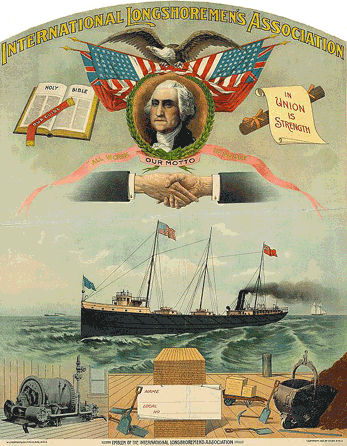
On this day in 1955, the American Federation of Labor and the Congress of Industrial Organizations merged into the AFL-CIO.

During the 1930s, dissatisfaction over the AFL’s conservatism and its unwillingness to organize industrial workers led to the creation of the CIO in 1935 under the leadership of United Mine Workers president John L. Lewis. The CIO revitalized the labor movement, organizing 4 million workers in the next 3 years and 6 million by 1945. It also forced the AFL to put huge resources into organizing in order to keep up. On one level, this situation became suboptimal for labor as many industries had competing AFL and CIO unions that spent as much time attacking the other the companies. But it also revitalized the labor movement, turning it into a central player within the New Deal Coalition and leading to labor’s greatest victoires.

But after World War II, the CIO’s reason for existing began disappearing. First, the AFL’s response to the CIO meant that it had begun organizing industrial workers into huge unions like the Machinists that had the same kind of bargaining power as the United Auto Workers. Second, the CIO’s purge of its left-leaning leaders destroyed the organization’s spirit. Communists had played a central role in CIO organizing from its beginning through World War II. Some unions were openly communist. The Taft-Hartley Act of 1947, the most labor-crushing law in American history, sought to crack down on the lefties, penalizing unions whose leadership did not repudiate communism. The increased anti-communist attitude in the nation was reflected in CIO head Philip Murray, who was a strong anticommunist. John Lewis had always tolerated the communists because he knew how well they could serve the larger cause, but Murray was distinctly uncomfortable with them. When in 1948, the left-leaning unions supported Henry Wallace for the presidency and opposed the Marshall Plan, Murray no longer felt he could tolerate having communists in the CIO.

Over the next few years, the CIO expelled not only communists from its leadership, but entire left-leaning unions, including Mine Mill, the Food and Tobacco Workers, and most significantly, the Longshoremen led by legendary leftist Harry Bridges. Philip Murray died in 1952. He was succeeded by UAW head Walter Reuther. I will talk more about Reuther in this series. He was a good man who did a lot of great things, but he could also redbait and had supported Murray’s expulsion of the communists.

With the communists gone, the CIO became not so different from the AFL. Moreover, the expelled unions were some of the strongest in the federation. Many of the remaining CIO unions were struggling and dependent upon subsidies from the CIO itself. Moreover, with Murray’s death, Reuther and Steelworkers president David McDonald were at each other’s throat. The CIO was rife with internal division. It made no sense for them to stay apart and in 1955 they merged together. From the perspective of what was smart for the big labor federations in 1955, it was an acceptable decision. From the perspective of the vitality of American labor, the expulsion of the communists after Taft-Hartley was the first step in labor’s long decline and the merger of the AFL and CIO is the second.

This series has also discussed the Homestead Strike of 1892 and the Everett Massacre of 1916.

The Future

[ 41 ] December 4, 2011 | Erik Loomis

Before I retire from teaching, I wonder if I’ll be able to teach a course called “Lost Environments,” where I tell students about what were once coastal ecosystems that are now under water because of our headlong rush into climate change? I can show lots of pictures of the Everglades and Bangladesh and Louisiana and Pacific Islands. I can talk about all the extinctions that are taking place. Everyone can share stories of how their parents and grandparents homes are now underwater and how their drinking water is now saline. We can tour the multi-trillion dollar seawalls keeping New York dry, seawalls that will inevitably collapse and inundate America’s greatest city. Because this is the future.

Ben Franklin, Environmentalist?

[ 23 ] December 4, 2011 | Erik Loomis

Americans’ have shaped narratives to make the Founding Fathers fit any number of political ideologies since at least the 1830s. It is a national passion to build connections between one’s own political beliefs and what some guys thought 200 years ago. So when I read a piece like Lauren Simenauer claiming that Benjamin Franklin is America’s first environmentalist, I am more interested in the national psychic need for such assertions more than its actual veracity. That said, while Franklin might have use his rational mind to create technologies that use energy more efficiently and improve public health, calling Franklin an environmentalism is a major stretch. I can understand the claim for Jefferson a bit more because he was consciously interested in the American landscape, but I don’t think Franklin ever showed such interests. It’s far more realistic to call Henry David Thoreau the first American environmentalist, with some antecedents like Jefferson, William and John Bartram, John James Audubon, and others. Maybe Franklin. But you have to think consciously about the natural world as such to be an environmentalist and I don’t see any evidence Franklin did so. Moreover, statements like this just don’t make any sense:

Given his commitment to environmental issues and sustainable business practices, it may be prudent to say that Franklin would have opposed some of the House cuts that stand to strip the public of food safety and farming innovation grants. He certainly would have taken no pleasure in the “Drill, Baby, Drill” chants, and not just because he would have found them lacking in wit.

Who knows what Franklin would have thought? We cannot possibly know this and I don’t see much value in trying to figure it out. Because, not surprisingly, the answer is always going to be the exact political opinion of the researcher!

Americans’ obsession with tying everything to the founders is second only to doing the same thing with Christianity for tortured logic in this country.

Default

[ 81 ] December 4, 2011 | Erik Loomis

Natalia Antonova (who in full disclosure is a former editor of mine) on making the decision to default on her student loan debt, even though it will screw her over for life. Essentially, it became a choice between the health of her child and paying Sallie Mae. Great system we have here.

  • Switch to our mobile site