Subscribe via RSS Feed

Author Page for Scott Lemieux

rss feed

It’s the Outcomes

[ 0 ] October 17, 2005 | Scott Lemieux

It is rare indeed that a favorite blogger will use the phrase “The best commentary I’ve yet seen comes from Mickey Kaus.” But that’s nothing; via Edroso, I present my first and last installment of “Hugh Hewitt is making sense”:

When Bush said “like Scalia or Thomas” many people heard many things. I think it is very safe to say that the vast majority of American voters did not hear “justices committed to a particular theory…of textualism or originalism.” I think they heard “justices who aren’t making stuff up,” or “justices who aren’t full of themselves,” or “justices who will not impose same sex marriage or overturn every juvenille death penalty in the land or import EEC law on a whim.”

This is, of course, quite correct (except for the attribution of modesty to Scalia.) The giveaway is that Bush doesn’t talk about “originalism,” a real theory of constitutional interpretation, but “strict construction,” a theory that not even Scalia himself claims can serve as a general theory of constitutional interpretation; it’s a codeword. Bush’s invocation of Thomas and Scalia was a promise of conservative results.

But there’s a broader error in these arguments, which seem to be a background implication of a lot of arguments about Miers. The assumption seems to be that the Court’s legitimacy is tied to the quality of its reasoning. One example of this is the oft-cited argument that Ruth Bader Ginsburg made about Roe v. Wade. Ginsburg argued that it would have been better had the court waited for its gender equality doctrine to develop further, as this would have provided a sounder basis for Roe. Similarly, when I have brought up my findings that R. v. Morgentaler–the decision that struck down Canada’s abortion statute–produced much less of a backlash, several people suggested that this may be because the Canadian decision was more persuasive. Now, I certainly don’t question the doctrinal arguments being made here. I will post about this sometime, but Morgentaler indeed represents what I consider the best arguments for striking down abortion bans: the plurality opinions emphasized the vague wording and arbitrary enforcement of abortion statutes, and a concurrence made a Ginsburgian argument emphasizing the effects of abortion bans on women’s equality. Roe, conversely, is a poor opinion, and the substantive due process doctrine is not a very convincing basis for striking abortion statutes even if one accepts its general validity. That’s all true. The problem is, as an explanation for the greater backlash to Roe it’s transparently wrong. The most obvious difficulty is that, as many empirical studies have demonstrated, virtually nobody outside of a small cadre of professionals reads Supreme Court opinions. Only a vanishingly small percentage of citizens could tell you the doctrinal differences between Roe and Morgentaler. And there’s a more specific problem, which is that the American public supports Roe by a 2-to-1 margin. To accept the received wisdom, you have to assume that substantial numbers of strong pro-lifers would embrace Roe if it had been better crafted; I trust that the implausibility of this goes without saying.

Or, to borrow a point from Jack Balkin, take Brown. Nobody, for good reason, could get appointed to the Supreme Court if they thought that Brown v. Board was wrong, or if Dred Scott was correct; there is widespread, cross-ideological agreement on both points. But does this have anything to do with legal reasoning? Of course not. Earl Warren is nobody’s idea of a brilliant constitutional theorist, and Brown was not intended to be great jurisprudence; it was meant to be simple, non-accusatory, and short enough to print in major newspapers. On strictly craftsmanship grounds, I don’t think anybody could claim that it’s a superior opinion to Dred Scott. The difference is that simply that the Warren Court was right about the defining issue of the era, while the Taney Court endorsed an ideology that was profoundly immoral and was to soon represent the losing ideology in the Civil War. That’s it; there’s no second verse here.

There is a tendency among people who study law–and I certainly plead guilty on all counts–to project their interest in legal theory onto the public. But the public evaluates Supreme Court decisions in terms of outcomes–concerns about legal craftsmanship are the domain of specialists. In the long run, the Supreme Court’s legitimacy is based on results, period.

iocaste makes a useful qualification with respect to the substantive point. I agree that the less high-profile the case, the more legal reasoning matters because the greater the influence of the specialists who care about legal reasoning will be. (I should emphasize as well that I’m talking purely about public perceptions of the court; the quality of the legal arguments made by lawyers certainly matters.) On the other hand, I’m not sure I entirely agree about the importance of craftsmanship in Kelo and Raich. It’s true that the Stevens opinions on both cases are solid enough pieces of work. On the other hand, I can’t really say that the reasoning per se is of a higher quality than the Thomas dissents in either case; while I disagree with both, Thomas’ arguments are not inept or unprincipled or implausible. I just disagree with his conclusions. I don’t think that iocaste’s ability to persuade people about the correctness of either case is dependent on what Stevens wrote; a good lawyer can make her own case effectively even if the court doesn’t, and most people will never read the opinion.

Unilateral Disarmament Is Not A Plan

[ 0 ] October 16, 2005 | Scott Lemieux

I was planning to start the week discussing this baffling post by Kos, but fortunately The Editors save me the trouble:

I agree that this is a great proposition, and I urge the voters of Texas to pass it. Oh, wait. The problem with this proposition, and the reason it was proposed by Republicans and opposed by Democrats, is that it asks the largest Democratic state not to redistrict for partisan gain while Republican states redistrict away, with help from the Republican Congress. Net result: a gain in reps for the Republicans on the national level, and endless headaches of the sort we’ve all come to know and love over the past decade. As far as I’m concerned, 77 and 75 are the two non-negotiable items on the agenda, as they are the most explicit attacks on Democratic political funding and leverage.

Exactly right. It’s like Kos went to sleep thinking Nelson Rockefeller was going to get the Republican nomination in 1964, woke up in 2005, and thinks that the Republicans will happily go along with a Democratic goo-goo initiative even if it’s against their self-interest. In other words, it’s just crazy. If there’s anything that could prevent the hyper-partisan redistricting that happened in Texas, it’s that the Democrats can threaten to do the same in the nation’s largest state. With that off the table, we can certainly expect to see even more mid-decade Republican gerrymandering, further solidifying GOP control of the House, and our ability to retaliate will be severely compromised. But David Broder will write a column praising the Democratic self-abnegation, which I’m sure will make it all worthwhile…

…and apparently it’s worse than that–Brad Plumer points out that “the judges drawing the boundaries will end up packing the majority of urban voters into a few concentrated, ultra-Democratic districts,” because they’re forced to draw the most compact districts possible. (Iowa, which has a similar system, has 1 Democratic district in a state that Gore won and Kerry got 49% of the vote.) Seriously, if you’re a Democrat and willing to vote “Yes” on 77, you’re welcome to any poker game I’m playing in anytime. But if the meeting is about Democratic strategy, please wait outside. (For further comedy, Kos touts the fact that the proposition has the endorsement of CalPIRG. Yep, if there’s anyone I trust to understand the electoral implications of institutional rules, it’s organizations founded by Ralph Nader!)

Balance and Shield Laws

[ 0 ] October 16, 2005 | Scott Lemieux

I think Kevin Drum’s post about shield laws is generally sensible–particularly the point that any such laws should protect activities, not professional identities–but I think there’s one point that’s worth adding to this:

At the same time, I agree with both Glenn and Atrios that it’s the activity of journalism that should be protected, not any particular medium. There’s an obvious objection to this, of course: if an activity as common as blogging provides protection against testifying in federal court, the Corleone family would just set up a blog and then sit back and happily thumb their noses at prosecutors forever.

This is unpersuasive. It’s perfectly possible to define “journalism” in a reasonable way, and judges are quite capable of distinguishing between genuine journalism and obvious ploys. It’s a matter of intent, and judges rule on stuff like that all the time. They won’t do it perfectly, but even a modest check on executive branch zeal is worth having.

This is right, as far as it goes, but there’s an additional point, which is that a privilege against testifying should be rebuttable from the other end as well. Any good shield law will presumably involve a balance between the reporter’s privelege and the state’s interest in the testimony. So it’s not just that a blog that exists to send coded messages about breaking the legs of the store owner who resisted a shakedown to hired goons wouldn’t qualify as “journalism.” It’s also that the state’s interest in preventing assault and battery is extremely high, and would obviously trump privileges created by a shield law. As I’ve mentioned before, this also applies to the case of Judith Miller. Even if federal law were to grant journalists privilege against testifying–which I think would be desirable–and we assume for the sake of argument that her conversations with Scooter Libby constitute journalism, privilege would pretty clearly not hold up in this case. The state has a very strong interest in not having its covert agents burned, and the public interest in this case (Miller didn’t even write a story based on what she learned, and her source was not providing useful information but was using her to pursue the interests of the administration) was negligible. So unless the privilege created by the shield law was absolute, which is obviously a terrible (and unworkable) idea, Miller would almost certainly be compelled to testify even if a shield law were in place. It is true that there will be much tougher cases than Miller’s, but as Kevin said, balancing individual rights (whether constitutional or statutory) and state interests is something courts do as a matter of course.

Meme the Second: Teh Funny

[ 0 ] October 15, 2005 | Scott Lemieux

Alright, I guess it falls to me to nominate some scenes that inevitably provoke peals of laughter from me after repeated viewings. This is even more top-of-my-head than most of my movie lists, so I’ll be leaving even more stuff than usual to our fine commenters:

  • The highway scene in Planes, Trains, and Automobiles. (“How does he know which way we’re going?”)
  • The entire baseball sequence in The Naked Gun. (“It’s Enrico Pollazzo!”)
  • Dr. Strangelove has too many to count, but I may be most partial to the sequence where the American soldier interrogates Mandrake (“You must be some kind of deviated pre-vert!”)
  • I’m not sure which Woody Allen moment I’d pick. Well, here’s two relatively less-cited ones: 1)the screening of the first cut of the documentary in Crimes and Misdemeanors. (“I’m not perfect, but I do not promote values that–let me get your quote exactly–deaden the values of a great democracy.”…”You’d think nobody was ever compared to Mussolini before.” ) 2)Fielding Mellish going magazine shopping in Bananas (“Hey Ralph! How much is a copy of Orgasm?”) There should be something from Love and Death here, but there are about thirty possibilities…
  • The contract-ripping bit in A Night at the Opera. (“It’s all right, that’s in every contract. That’s what they call a sanity clause.” “You can’t fool me! There ain’t no Sanity Clause.”)
  • Buck Swope pitching a top-end 8-track system in Boogie Nights. (“See this system here? This is Hi-Fi… high fidelity. What that means is that it’s the highest quality fidelity.”) Also, the Alfred Molina busted drug deal sequence should be the starting point of some other meme…
  • The scene in Lost In America where Albert Brooks tries to convince the casino manager that they’re the right kind of degenerate gambler (“You’re right, it was stupid to use an entertainer as a dividing point.”)
  • “Stonehenge” is the obvious choice from Spinal Tap, so instead I’ll cite the free-form jazz exploration (“This is our bass player! He wrote this!”)
  • The interview with the Canadian Ambassador in South Park: Bigger, Longer, & Uncut (“Our government has apologized for Bryan Adams on several occasions!”)

All right–I’ve already exceeded my quota. Your turn!

Miers: Compared to What?

[ 0 ] October 14, 2005 | Scott Lemieux

A couple of very smart people argue that–contrary to the argument I made last week–progressives should unequivocally reject Miers. I continue to disagree.

The first argument comes from Mark Kleiman, who argues that the Miers nomination is not a typical zero-sum political game. The argument is a little confusing, because he switches between the substantive and political implications of rejecting Miers. On the latter point, I agree that the Democrats wouldn’t pay any political price for rejecting Miers, although I’m not sure what the benefits will be. I’m not really concerned about the short-term political impact of the Miers confirmation in any case. On substantive terms, I don’t find his argument convincing. He argues:

Miers has two characteristics — lack of intellectual distinction and subservience to the interests of the Bush clan — that are undesirable from both conservative and liberal perspectives. It’s easy to imagine that the person nominated to replace her should she fail of confirmation would be more intelligent and more independent.

As I argued before, from a progressive perspective, Miers’ lack of distinction and the fact that her most salient characteristic is loyalty to Bush are features rather than bugs. Again, it is important to remember that 1)anybody that Bush appoints will be a conservative, and will almost certainly be a conservative who is a strong proponent of executive power, and 2)Bush leaves office after 2008. It strikes me that a Bush hack is rather preferable to someone whose conservatism is lodged in the belief that Griswold should be overturned and the power of the federal government severely curtailed, not least because her subservience to Bush affects a small percentage of issues when Bush is in office and virtually none after he’s left. (It’s worth remembering, too, that she can only serve the interests of Bush if 4 other justices go along with her, and if she can get 4 current justices to join it’s highly likely her replacement will go along too.) And, again, I would rather have conservative constitutional opinions be written less than more persuasively. I also continue to think the idea that putting Harriet Miers on the Supreme Court will somehow threaten its public legitimacy is frankly absurd. Leaving aside the fact that the public doesn’t really pay attention to the Court on a day-to-day basis, if the legitimacy of the Supreme Court can survive Bush v. Gore, another mediocrity on top of the many mediocrities who have already served on the Court is nothing.

Again, I think the crucial question is exactly what tangible harms come from having someone who may not write brilliantly crafted opinions on the court and is not a sophisticated legal theorist. These tangible harms are, I think, negligible, and pale in comparison to the votes a justice casts. Put it this way: Antonin Scalia is a more sophisticated legal craftsman than Earl Warren (who, in fact, was not a particularly skilled crafter of legal doctrine at all.) Would you rather have a court of 9 Scalias or 9 Warrens?

Prof. B prefers the devil we know:

If you’ve got someone who, as Miers is reported to have done, will generously agree to meet with people she disagrees with, listen to their arguments, and then simply dismiss them by saying that she doesn’t agree–without giving you anything to go on about why she doesn’t agree, or how to address the premises she uses to form judgments with–then there’s nowhere to go. I very much fear that, as a judge, Miers will play the role of the fundamentalist you argue with about evolution or feminism or the ACLU, someone who no matter what evidence you present them with, simply says, “no, those things are wrong and evil because I believe they are.”

Respectfully, I have to demur. If you compare a pragmatist like O’Connor to Thomas, the most principled conservative on the Court, I don’t think there’s any question who is more likely to dismiss the ACLU’s arguments out of hand. And I think the same is true of most of the viable alternatives to Miers. There’s just no way that Miers can be any worse than, say, Owen. Even if you take a more palatable choice like McConnell: who is more likely to overturn Roe: somebody with no public record on the question, or someone who has argued publicly that Roe is an abomination? The question, I think answers itself. We know that McConnell will almost certainly vote to overturn Roe, and to uphold virtually all entanglements with the state. (He would probably be better on executive power issues, which is one reason I don’t think he has any significant chance of being nominated, but that’s still not a great tradeoff on balance.) Miers can’t really be worse than most of these nominees, and she could be better. I’m going with the devil I don’t know.

Pinter

[ 0 ] October 14, 2005 | Scott Lemieux

Like Roy, I think it’s always nice when the Nobel Prize is granted to someone whose work I’ve actually read, although I’m less familiar with Pinter’s work than with recent winners Coetzee or Grass. (I haven’t read any of the novels of the much-criticized Elfriede Jelinek, although I think the film made of her novel The Piano Teacher is one of the best of the decade so far.) I read some Pinter as an undergraduate because of my admiration for his American son, David Mamet. Unfortunately, I’ve never seen one of Pinter’s plays performed live, which is regrettable; I don’t think his minimalism comes across as well on the page (although I also wouldn’t trust any aesthetic judgment I made when I was 20, so go with Roy’s evaluations.) The closest I’ve come is watching two of the Losey/Pinter/Bograde collaborations, The Servant and Accident. Both are quite entertaining, although the former flags a bit in the second half. Hopefully the Nobel will lead to some of his landmarks being staged here.

In the interests of fairness, I should note that Roger Simon refuses to go along with the political reductionism of so many other conservative bloggers; nice to know that the hack has not completely swallowed the artist.

This Settles Nothing

[ 0 ] October 13, 2005 | Scott Lemieux

As regular readers will know, I generally agree with Bob Somerby‘s point that it doesn’t really make sense to assume that Bush places a high priority on overturning Roe v. Wade. But I think this point about John Roberts is wrong:

If Karl Rove is involved in the selection of Court nominees, this sort of Machiavellian political calculation would surely be part of the stew.

In this calculation, Bush/Rove would be looking for nominees with a general conservative profile who wouldn’t be likely to overturn Roe. With Rehnquist’s death, the GOP is down to two anti-Roe votes. Who knows—maybe Roberts and Miers were selected to help keep the count right there.

For the record, Roberts told the Senate, in 2003, that he considered Roe to be “settled law.” This summer, some observers downplayed that statement; they said Roberts only meant that, on the Court of Appeals, he’d follow Roe as Supreme Court precedent. But that just isn’t what it means to call Roe (or anything else) “settled law.” We don’t know if Roberts will vote to overturn Roe. But we’d guess that Buchanan may have it right—that these selections may be about fooling the rubes in Kansas for one more long stretch of years.

This claim about “settled law” is, I think, wrong. “Settled law” is not a technical legal term; you won’t find it Black’s Law Dictionary. Its meaning is vague. Certainly, the term could refer to a previous precedent of a court that one belives should not be reconsidered. But is can also refer to a higher court precedent that is clear, and therefore binding on lower courts (as opposed to a situation in which higher court precedents are ambiguous, or a case where one is dealing with conflicting precedents at equal or lower levels.) Given the context in which Roberts made the claim, it’s overwhelmingly likely that he meant the latter.

None of this means that Roberts is certain to overturn Roe; I have no idea how he would vote on the question. But his description of Roe as “settled law” does not provide meaningful information either way.

Touche!

[ 0 ] October 13, 2005 | Scott Lemieux

“Harriet Miers”:

LOL Nicolle said, “So Maureen Dowd is accusing you of being a superficial hack? Pot, Kettle, hello?”–get it, like a pot calling the kettle Black, their both black. Well at least Maureen Dowd is obv reading my blog.

You have to admit, whatever you think of the prose she has her dead to rights on that one…

Executive Power: The Ugly Side

[ 0 ] October 13, 2005 | Scott Lemieux

In my previous post, I highlighted some of the defensible aspects of conservative theories of executive power. Brad Plumer explains the really awful stuff in detail. (I’m not sure, however, how much this cuts against the Miers nomination per se; it’s pretty clear that the expansion of executive power is one issue that Bush considers non-negotiable.)

When Bush Said He Had a Mandate, He Said HE…

[ 0 ] October 13, 2005 | Scott Lemieux

I think this post over at Balkanization is a good follow-up to Amanda and Jesse’s ripostes to Glenn Reynolds:

One way of thinking about judicial nominations is that, while the court has a famous tendency to follow the election returns, the court and judicial nominations are also struggles over what election returns mean. Indeed, one might interpret the present debate over Harriet Miers as a debate over the meaning of 2004 (or a set of elections from 1994 to 2004).
For George Bush, the 2004 election was a personal triumph. Americans voted to put him in office. In particular, Americans trusted him to lead the country. It follows from this that the ideal judicial nominee to cement this electoral result is a nominee whose main qualification is personal loyalty to George Bush. If the rest of us are not 100% sure exactly what that means (well, we have a good idea what it means with respect to torture, but can debate whether it means overrule or narrow Roe), so what. Americans in 2004 voted to trust George Bush and we should trust him now.

For many conservatives, the series of elections from 1994 to 2004 were a triumph of a conservative constitutional vision. The precise content of this vision is subject to some dispute, compare the differences between Randy Barnett and Robert Bork, but what is crucial is that Americans have empowered this administration to make fundamental changes in the constitutional status quo, be that challenging principles of federal power dating from the New Deal, overruling Roe, providing greater protection for property rights, dismantling affirmative action and federal habeas corpus, or some other variation/combination. Harriet Miers is unacceptable because she does not embody any conservative constitutional vision. Edith Jones does, as do a host of other characters. Hence, but entrusting a crucial Supreme Court position to a personal loyalist, Bush betrays the revolution of 1994 to 2004.

I think this is right. Conservative bloggers and scholars seem to be under the impression that the election represented mandate #2, but Bush clearly thinks it’s mandate #1. And the thing is, given the way his supporters talked during the election campaign, Bush is in a way quite rational. For bloggers like Reynolds, the election was almost entirely about whether Bush or Kerry had a more appealing personality; it’s hardly surprising that a campaign that basically buried its domestic agenda would think that the election was about the Great Leadership of George W. Bush. (My favorite example was Roger Simon, whose mash notes to Bush could have been written by Harriet Miers herself. Check out this debate commentary; he doesn’t really understand any of the issues, but “There is no question that Bush is a better man than Kerry.” Awwww–Roger has a man-crush!) Moreover, with a few exceptions (like church-and-state issues), Republican strategists understand that Bush’s 51% triumph is not a “mandate” for Constitutional-In-Exile favorites like overturning Roe or rolling back the New Deal, at least in the sense that the Court doing these things would be anything but extremely unpopular. Miers’ nomination reflects the problems with trying to infer common policy goals from an election campaign that was strictly a personality cult.

In another good post, Balkin himself argues that the key antecedent isn’t so much Truman as the Gilded Age:

Following the Civil War, Republican Presidents placed a series of railroad lawyers on the Court with little or no judicial experience, but plenty of experience as counselors to business. That’s what Miers is essentially, a Texas lawyer with lots of business connections who advised corporate clients, including, most importantly, George W. Bush. He liked the advice she gave him, and so she followed him during his career.

Presidents don’t choose this kind of nominee because they want a revolution. They choose them because they will give the executive a free hand, and, perhaps most important, because the nominee will help ensure a pro-business climate.

I think this is right; Karl Rove’s admiration for Mark Hanna isn’t accidental. This again demonstrates the tension between being an ideological supporter of free markets and being pro-business. Bush is, and has always been, plainly in the latter camp, and where the two conflict the principles will get thrown under the train (that is now up and running again after the troops were sicked on Eugene Debs) every time. That many conservertarians seem only now to be figuring this out is really more embarrassing for them; Bush is doing what he’s always done.

Robbed

[ 0 ] October 12, 2005 | Scott Lemieux

I don’t really have a rooting interest in the series–if anything I’m cheering for the White Sox–but I really hoped the Angels would get out of the 9th. What a disgrace. At least the brutal Joe West call on Cano was within the letter of the law; it was more an argument against “strict constructionism.” This one was just a joke–a high school umpire has to get that call right. And after all the nice things I said about the umpires last year…

That’s My Derb!

[ 0 ] October 12, 2005 | Scott Lemieux

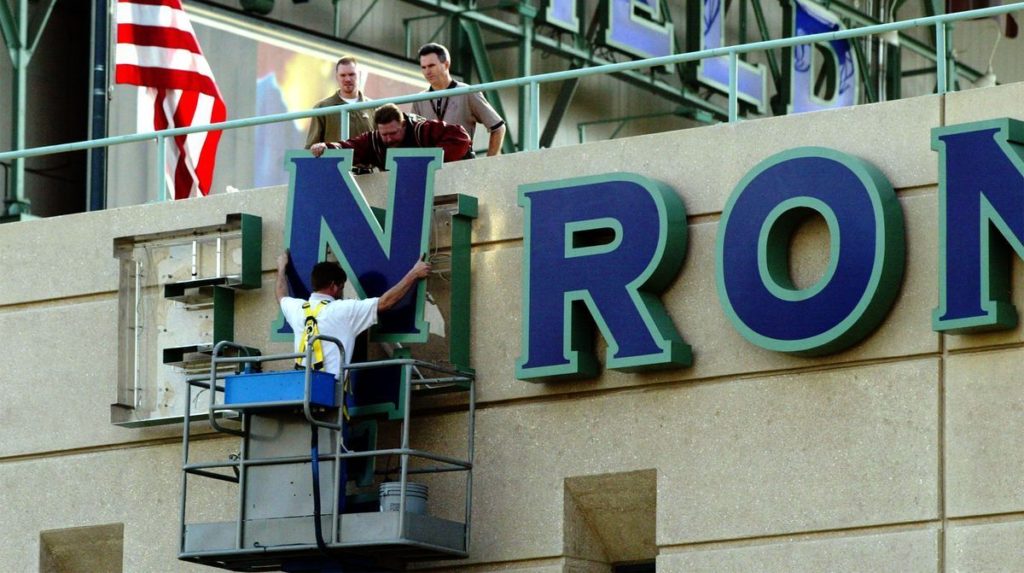
You see, Boy George’s house is robbed, and a sodomy-obsessed NRO writer reads his own projections into a headline, and…well, the joke writes itself. Unfortunately, the person in question wrote it too. And then followed it up with a joke about which the authors of “Hi and Lois” said “it was pretty lame when we used it 5 years ago.”

  • blogroll

  • Brad Delong
  • Crooked Timber
  • Daily Kos
  • Danger Room
  • Eschaton
  • Ezra Klein
  • Feministe
  • Talking Points Memo
  • Feministing
  • Glenn Greenwald
  • Juan Cole
  • Monkey Cage
  • Switch to our mobile site