
Emotional Labor and Working Women in Asia
 By
By 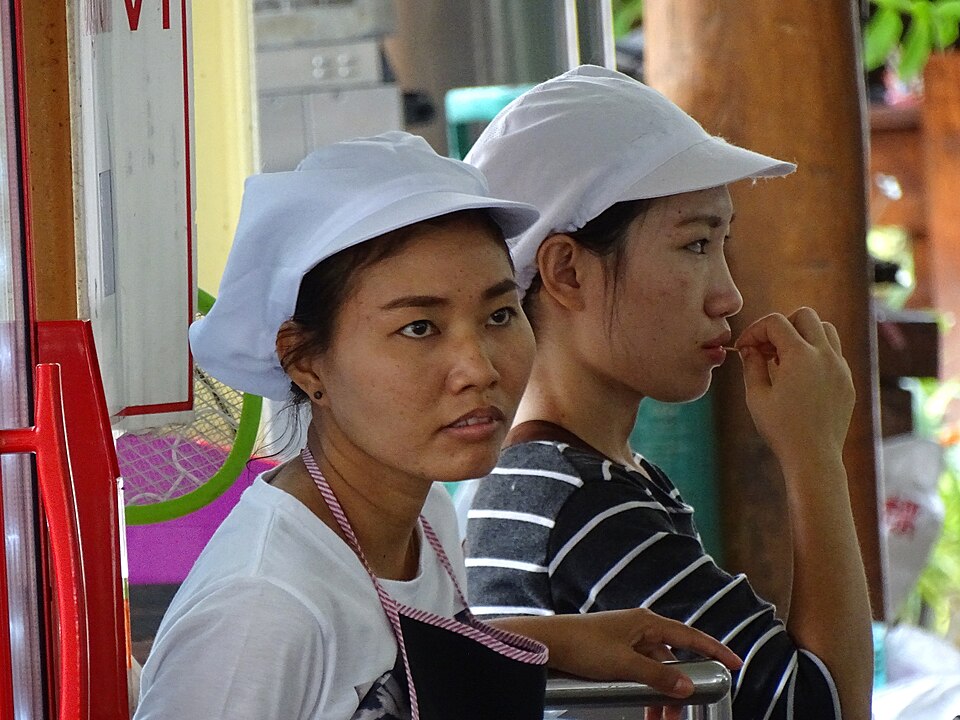
Emotional labor is one of the most useful ideas to come out of labor scholars in the last 25 years (it may have been articulated earlier, I’m not sure, but it’s gone mainstream since 2010 or so). It does such a great job explaining the gendered nature of labor in the world, the unpaid labor women are required to do based on gender roles and expectations for them and the types of jobs to which they are relegated. For example, a 1st grade teacher is more likely to be expected to engage in emotional labor than a high school science teacher. A flight attendant is expected to engage in emotional labor whereas a pilot is not. Etc. Here’s a good piece in the Asian Labour Review (you know I like it because I am willing to use that extra “u” in labor) about how women in Thailand are using these expectation to help in their organizing.
Desire for Freedom and the Cruel Optimism of Gig Work
Empirical data from field research in Thailand (2023–2025) demonstrate the severity of the social reproductive crisis. Riders who earned an average of 700 to 1,000 Baht per day during the pandemic saw their daily earnings slashed by over 50 percent, dropping to a precarious 300 to 400 Baht despite working longer hours. In Southern provinces like Krabi, Trang, and Phang Nga, a survey of 700 women riders revealed that 98% reported their earnings were insufficient to cover basic daily living expenses.
When a worker is classified as an “independent partner,” they lose access to state-mandated social safety nets—such as accident insurance, healthcare, and pension schemes under Thailand’s Labour Protection Act. Algorithmic management systems—including dynamic pricing models, rating penalties, and deactivation triggers—are explicitly engineered to compel riders to work at breakneck paces, routinely ignoring safety protocols and bodily needs. Crucially, the conditions that push workers to self-organise stem from the platforms’ own operational requisites, which demand labour far beyond the limits of physical and social survival.
To understand how workers survive this extraction, we can look through the lens of cruel optimism1 (Berlant 2011)—a condition that occurs when something we desire actually becomes an obstacle to our own flourishing. As riders from a Southern Province recall, the initial days felt like freedom: earning 700–1,000 Baht a day while driving leisurely and taking in the roadside views. However, as platforms systematically adjusted their parameters, this optimism turned cruel.
The platform economy hooks workers using the fantasy of entrepreneurial autonomy, flexibility, and “independent partnership.” In reality, it forces a “slow death”—the physical and psychological wear and tear of a population under late capitalism. The algorithm also functions as an anti-organising architecture, using gamified incentive structures, competitive mechanics, and surge pricing tied to personal acceptance rates to weaponize individual survival against collective solidarity.
Emotions as a Form of Collective Intelligence
Under traditional models, emotions are dismissed as interior, irrational, or counter-productive to hard-nosed labour organising. FPAR, however, approaches emotion as a form of collective intelligence. When women riders gather, their shared anxieties, frustrations, and grief are treated not as private liabilities, but as structural data.
As one single mother balancing a two-year-old child with fluctuating orders noted:
“Exchanging life problems with fellow riders was like releasing the suffering in my heart… it made me feel warm and no longer lonely.”
This affective alignment is the prerequisite for structural resistance; it turns atomized despair into shared analytical power. In a sense, FPAR transforms what Berlant calls an “intimate public sphere”—a space where a collective of strangers share common feelings toward specific issues—into an explicitly political sphere. Research becomes a venue where women workers realize that their personal structural distress is actually a widely shared, systemic condition. By organizing monthly focus groups across provinces, FPAR created an intimate sphere for over 230 female and 50 LGBTQ+ riders in Thailand.
A critical impediment to building a cohesive platform labour movement is that existing rider organisations are deeply fractured by divergent organizational structures, funding mechanisms, and ideological alignments. Our previous analysis of the Thai platform movement reveals that traditional organising approaches generally fall into institutional containment, with each model fragmenting the worker’s lived experience.
…..
An FPAR lens brings into sharp focus the highly gendered dimensions of social reproduction, illuminating the indispensable role of women in constructing collective care infrastructures. Women riders frequently serve as “network anchors,” performing emotional labour: the unpaid, invisible emotional, cognitive, and organizational work required to keep a decentralized network from breaking down.
This emotional labour operates across a triple burden: delivery work, domestic care labour, and community-building labour. Women bear the primary responsibility for managing households, cooking, and raising children under extreme financial constraints; notably, 95% of the FPAR study group have children. Yet, they simultaneously sustain these vital mutual-aid systems. Furthermore, this gendering manifests in heightened exposure to workplace harm: the FPAR survey revealed that 50% of female riders experienced sexual harassment from customers, yet 73% noted that the platform had zero policies or infrastructure to support victims of customer-perpetrated violence.
Platform algorithms explicitly exploit the forced separation of production and reproduction processes. The algorithm operates on an economistic logic that treats caregiving responsibilities as an individual burden. When a female rider goes offline to collect a child from school or cope with health shocks, the platform’s scoring system triggers automatic penalties—reducing her acceptance rates, blocking her access to high-paying shifts, or flagging her account for deactivation.
By reframing care not as a personal liability but as a collective right, FPAR projects allow women riders to challenge the platform’s anti-care logic. Women leaders systematically prioritize relational maintenance over top-down commands, recognizing that a movement’s sustainability depends on distributing leadership across a broad base. When women riders coordinate care-sharing protocols to cover each other’s offline periods, they replace corporate alienation with a feminist protocol of relational solidarity that honors the whole person.
Because FPAR refuses to separate production from social reproduction, it allows workers to turn intimate reproductive needs into systemic labour demands. This transition is clearly illustrated by how riders politicize basic biological needs.
For female riders in Bangkok and Chiang Mai, the lack of basic urban infrastructure—such as access to clean public restrooms and rest areas—manifested in high rates of urinary tract infections and physical exhaustion. Through FPAR focus groups, what was once endured as a private, isolated health issue was collectively reanalysed as a structural failure of the platform economy. By articulating demands for physical rest zones and safe urban infrastructure, the workers effectively argued that the platform’s workplace extends across the entire layout of the city. This claim links the welfare of the individual body directly to urban planning and corporate accountability.
This is pretty deep cut stuff, but these are important findings and worth a conversation here for the 3 people around here who care about such issues as the Thai working class.