
Jesse Jackson, RIP
 By
By 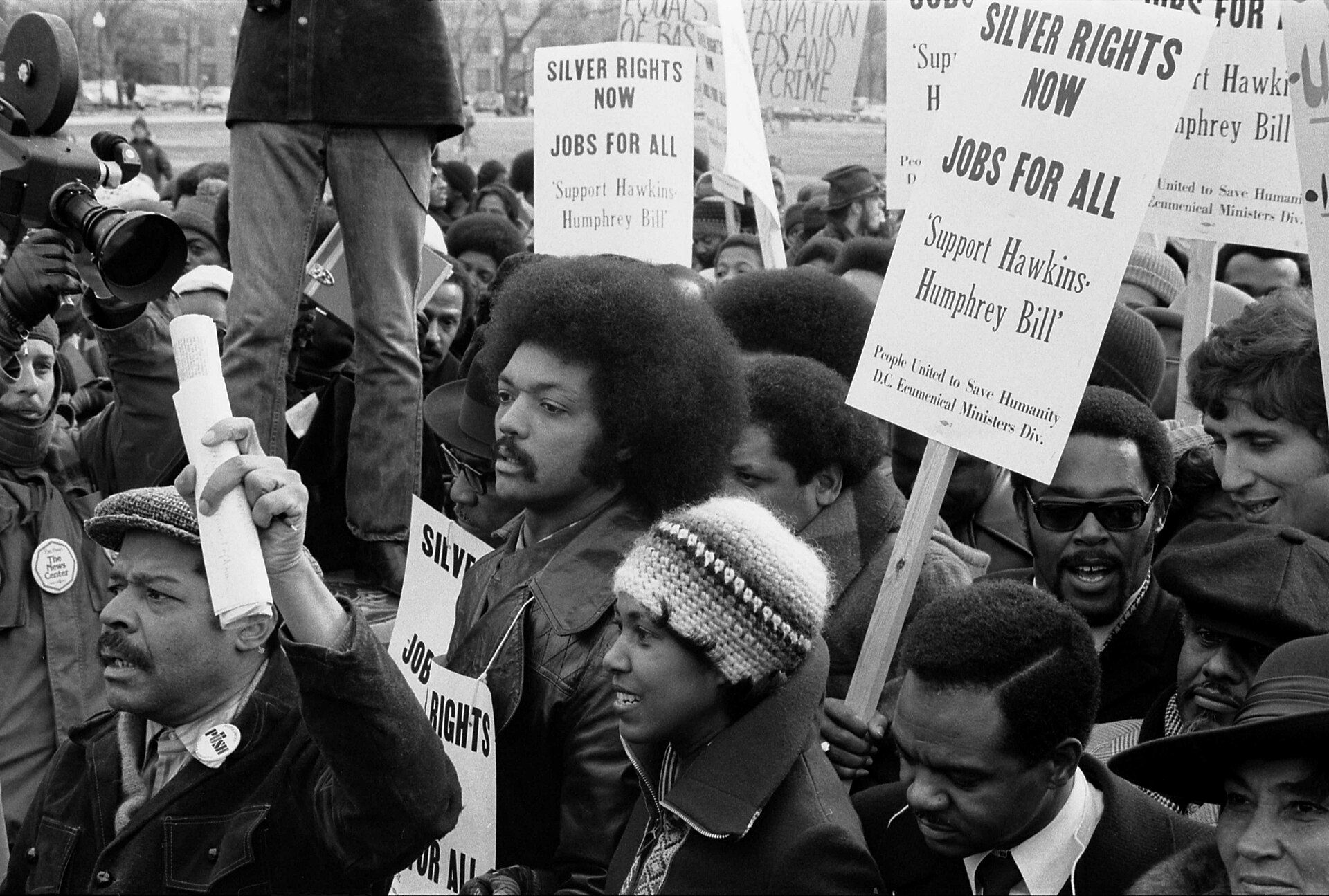
Jesse Jackson has died. One of the most important civil rights leaders in the post-King era, Jackson was a complicated man with a complex legacy. He had quite an ability to both promote himself endlessly and shapeshift into the Black politics of the moment, which kept him relevant for much longer than most of the core ministers of the 1950s and 1960s movement. That made him a critical voice in American politics when he channeled the frustrations of actual liberals with the Democratic Party and made two key campaigns for the presidency. While perhaps not all of Jackson’s legacy will hold up to readers today, he absolutely is one of the most important figures in the American history of the last six decades.
Born in 1941 in Greeneville, South Carolina, Jackson came about after an affair between an older married man and his teenage mom. His mother married later and the husband raised Jesse as his own, but Jackson faced a lot of teasing as a kid because of his background. He grew up in Jim Crow America and until he reached college, he didn’t really realize that a different way was possible. He certainly knew about the Montgomery Bus Boycott in 1955, and that definitely influenced him. But how does one just start something like that in your hometown? Who could know.
So in 1959, Jackson went to the University of Illinois. He was a good athlete and traveled north to play football. But he didn’t respond very well to rural Illinois (who can blame him) and he left after a year. He transferred to North Carolina A&T in Greensboro, a traditionally Black college. He played football there, as a quarterback. He was also student body president. Now, in 1960, the famous four students started the campaign to desegregate the lunch counters in Greensboro. Jackson was not one of them. But he got involved. This led to the creation of the Student Nonviolent Coordinating Committee, which would transform the civil rights movement, providing years of grassroots direct actions that would challenge white supremacy across the South. But Jackson kept his distance and he would not join SNCC. He would hew his own path.
However, Jackson was motivated for change and soon found himself in a leadership position. First, he decided to apply the Greensboro method to the lunch counters and other facilities back home in Greeneville. That summer, while home from campus, he and seven others sat in at the public library in Greeneville and were arrested. It was far from the last time Jackson would be arrested for his activism. Greeneville then decided to close all the libraries, but the threat of a lawsuit convinced the city to open them again and they were now desegregated. It was a real victory.
Jackson became a minister and was an ambitious, important leader within the Southern Christian Leadership Conference. He came to more prominence in 1965, when he was a fairly central figure in the Selma to Montgomery march that famously led to the beating of the protestors and Lyndon Johnson supporting the Voting Rights Act, the last great national victory of the movement. Jackson was then tasked with running Operation Breadbasket in Chicago, a boycott campaign against companies that refused to hire African-Americans. Operation Breadbasket was a national campaign from the SCLC and it had various levels of success, but Jackson went gangbusters. He proved quite adept at this, working with local Chicago leaders who had been involved in boycotts going back to the 1950s. He started by targeting five dairies. Three immediately caved. The other two followed after the picketing began. He then moved onto the soda industry and ran campaigns against both Coke and Pepsi. Then it was supermarket chains. King was thrilled and Jackson was on the rise, under King’s wing. Jackson and Operation Breadbasket created over 2,000 jobs in the black community in a short time. In 1967, Jackson became the national leader of Operation Breadbasket.
Jackson was with Martin Luther King when the latter was assassinated in Memphis. People long accused Jackson of taking advantage of this fact for his political career, washing himself in the blood of King to gain prominence. They had a point. Jackson always could see an angle to promote himself. Jackson was a floor below King when the shots rang out. He claimed that King died in his arms and that King spoke his last words to him. Might be true, might not be. The rest of King’s team were angered by these claims and openly disputed them. Jackson was excellent with the media and by 1969, the New York Times ran an article saying that many civil rights leaders saw Jackson as King’s true successor. This only infuriated the rest of King’s lieutenants even more, who were a disputatious bunch with large egos, to be fair to Jackson here. But then so was he.
Jackson definitely wanted to run SCLC. King’s chosen successor was his right-hand man, Ralph Abernathy. Jackson wanted to isolate Abernathy. In truth, Abernathy was no visionary and Jackson likely would have done a far better job. SCLC did run out its clock as the most important organization in the civil rights movement under Abernathy’s leadership in the 1970s. Moreover, Jackson chafed under Abernathy’s leadership going back to when the latter ran the national Operation Breadbasket. Abernathy wanted to consolidate control, pretty ineffectively. He also felt seriously threatened by Jackson’s rise.
In 1971, Abernathy demanded that Jackson move from Chicago to Atlanta so Operation Breadbasket could be run from SCLC offices. Jackson refused and quit his work with that organization. Instead, he built on his previous years and started his own organization–People United to Save Humanity. PUSH became the group that pushed Jackson into the national spotlight and his two presidential runs, while still working on economic justice issues. Operation Breadbasket died in 1972 after SCLC couldn’t keep it going without him. Among those who left SCLC due to Jackson’s treatment was the young Al Sharpton, who at the time ran the youth wing of the group. While Sharpton would prove a charlatan in many ways, this did demonstrate that SCLC leadership was pretty out of touch by the early 70s with the younger activists in the post-King era.
PUSH also built off Black Panther Party programs to feed and educate children in the ghetto. Jackson of course had a lot more resources than the Panthers could ever muster and so this got national attention and national grants, especially during the Carter administration. Jackson also had a strong ability to deal with corporate leaders. This made some question whether he was really a corporate ally cosplaying as an activist and there was perhaps some truth to that on occasion. But he also worked with corporate leaders for more active minority hiring programs. That included hiring up and down the line. He pushed for more Black CEOs and he pushed for more Black line workers and he pushed for more Black-owned businesses as contractors and subcontractors.
The push for Black capitalism was an interesting moment in the larger civil rights movement. It demonstrated that the revolutionary vision of a lot of the Black Power-era leaders really wasn’t that revolutionary. I have long wondered what King would have done with this moment, given his move to democratic socialism later in life. King was such a forward thinking, intellectually curious, and deeply committed individual and I think it’s unlikely he would have followed the line of people such as Jackson that the future was Black capitalism. But who can tell. But let’s also be clear–Black capitalism also has a very long history within Black political movements, including people such as Maggie Walker and Marcus Garvey.
Jackson got weird in other ways during the 70s, though so did America. He was the keynote speaker at a Republican National Committee meeting in 1976, arguing “We must pursue a strategy that prohibits one party from taking us for granted and the other party from writing us off. The only protection we have against political genocide is to remain necessary.” He then told the RNC that the way to gain Black support was to quit complaining about government subsidies when they helped Black Americans but shut up about them when they helped whites. He got a standing ovation. This however did not change Republicans’ position on race and welfare.[1]
In fact, Jackson kept trying to appeal to Republicans for years. The problem of course was that the Republican Party was rapidly sprinting right to become the White Man’s Party and so it remains today, though with rhetoric that is sadly now pulling in men from both the Black and Latino communities. Jackson stated in 1978, “Black people need the Republican Party to compete for us so we can have real alternatives … The Republican Party needs black people if it is ever to compete for national office.” Turns out that’s not quite true, as Donald Trump would demonstrate.
The 70s also became the era of Jesse Jackson, anti-abortion activist. Now, issues of abortion have often split traditionally liberal coalitions in the civil rights community. Among those opposed to abortion was Fannie Lou Hamer, who knew what it meant for the state to get involved in your body, having been forcibly sterilized. She thought this would lead to more Black women being forced to have unwanted abortions and repeatedly explained her position on this to white feminists, who didn’t really want to listen.
Jesse Jackson was also on this train. Shortly after the Roe decision, Jackson had Operation PUSH launch a campaign against abortion. He said that if there had been abortion back in the Biblical times, that Jesus and Moses might have been aborted. I am not sure whether Jackson knew that abortion has always existed and always will exist. He kept on this track for some time. He endorsed a constitutional amendment to ban abortion in 1975. He also was a big fan of the Hyde Amendment, one of the worst laws to come through Congress in the last several decades. He said in 1977 that the idea of the right to privacy made no sense to him, for it could also apply to the holding of slaves.
This is nonsense. But it is also worth noting that this was also Jackson’s Black Power era and that era was filled with men talking about Black manhood that often marginalized women. There was a lot of nostalgia in this era for a vaguely Back to Africa set of values that tended to replicate strong men having a lot of children and being little patriarchs. Of course Jackson later reneged on all of these positions and by the time of Dobbs, he was a firm supporter of Roe, but I wonder which side of this was more truly felt through his life.
One thing Jackson understood, despite his playing footsie with Republicans in the 70s, was the importance of influencing the Democratic Party. Thus, he always remained a good Democratic Party man, one who would also challenge the rightward trend of the party in these years. During the 1980 general election, he practically begged John Anderson to drop out of the race, accusing him of delivering the election to Reagan. Anderson was fine with that.
Jackson had his own national political ambitions, no question about that. As the 1970s went on, he began to wonder if there was space for Black presidential candidate. In 1983, he addressed a joint session of the Alabama legislature, the first Black man to do since Reconstruction, where he urged the legislature to put aside racial animus and instead focus on economics. Alabama whites were not so interested in this, but the speech was seen as successful and that began to move him toward a more formal announcement about running for the Democratic nomination the next year. He started speaking to a variety of minority groups—Native American and Latino, as well as Black—to build a coalition that he could work with for the presidential nomination in 1984.
By the 80s, PUSH mostly engaged in boycotts of companies that it didn’t see as promoting minority hiring. Going after Anheuser-Busch was the big one, which started in 1983. But PUSH started fading as Jackson’s presidential ambitions grew. He was the reason it was a thing and why people gave it money. With him pushing his donors to give to his political campaigns instead, PUSH went into debt, which by 1987, was noted by other Democrats who didn’t much care for Jackson. Jackson’s new Rainbow Coalition group took it over, and that was basically it for PUSH.
Jackson also spent these years building off his international reputation to promote himself as well as build bridges between the U.S. left and the international left naturally alienated from American foreign policy. For example, in 1983 he headed to Syria to work out the release of an American pilot shot down over Lebanon while bombing Syrian military positions in that country’s civil war. Jackson convinced Syrian leader Hafez el-Assad to release the guy and that certainly helped Jackson’s reputation. Even Ronald Reagan was impressed by this after initially opposing Jackson’s mission.
Jackson then headed to Cuba to convince Fidel Castro to release 22 American citizens held in prison there. Castro was happy to work with Jackson on this to boost both of their international reputations over the act. In fact, through the rest of the century, Jackson would engage in these kind of international missions. Before the Gulf War in 1991, he went to Iraq and convinced Saddam Hussein to release a bunch of international prisoners. Even during the American intervention in the Balkans in the 90s, Jackson got the vile Slobodan Milosevic to release three American POWs taken on the border between Serbia and Macedonia.
Jackson announced his presidential run in November 1983. The question immediately was whether he was a real candidate or a symbolic one. This in itself divided the leading Black political figures in this nation. In Atlanta alone, the sellout corporate hack mayor Maynard Jackson endorsed him, but Coretta Scott King refused to, noting that he had no chance to win. But that wasn’t going to stop Jackson, who by this time had a better sense of what was possible in politics than King.
Jackson didn’t bother competing in Iowa and walked into the New Hampshire televised debates way too confident. His campaign openly stated that he was Jesse Jackson and did not need to prepare to be on television, but then he flopped in the debate as he was unprepared on the specifics. He did not win New Hampshire, but managed to stay competitive. He then went on to win in his home state of South Carolina. By this point, the only real competitors were Walter Mondale, Gary Hart, and Jackson, maybe, if you squinted. And as time went on and he just stuck around, he seemed to become a real alternative. He won in Louisiana and Washington, D.C. and did the best in total votes in the Virginia caucus, though Mondale got more delegates thanks to the arcane rules of those awful ways of choosing a candidate. Obviously he was not going to win the nomination. But at a time when liberals were really frustrated with the Democratic Party’s trajectory, he became a voice for their anger. His Rainbow Coalition proved a pretty robust segment of the party at the very least.
Jackson came out of the 1984 election looking really good. He was now a star of the Democratic Party. When Mondale won the nomination, Jackson did what he could for the Minnesota liberal, but it was not a good year for Democrats, to say the least. He did have one big error though. In a discussion with a reporter, which he assumed was off the record, he referred to New York City as “Hymietown” because it had so many Jews. That was….not good and it was even worse that it made the story. That Louis Farrakhan then responded by threatening anyone who harmed Jackson over this really really did not help. Jackson did the work to repair his relationship with the Jewish community over the years, but he never completely lived this down.
Jackson prepared almost immediately for another run in 1988. On the day of Reagan’s second inauguration in 1985, he led a large rally in Washington ending at the Washington Monument to rally support for programs to help the poor. Reagan didn’t care and neither did most leading congressional Democrats, not to mention Republicans of course. He attempted to build credibility among farmers by taking up the cause of farm foreclosures, a major issue in the mid 80s that is largely forgotten today. When a farmer in Kansas was being foreclosed upon, the Rainbow Coalition chapter in Kansas City showed up with Jackson at the lead and had a rally at the county courthouse on the evils of foreclosure. This stuff wasn’t going to transform the white farming class into Jackson supporters, but it got the attention of some of them, which was important. Not to mention that Jackson was correct on the morals and on the politics.
Jackson remained a liberal, but what a liberal meant changed over time and when it made sense to his politics, he could support issues more associated with conservatism. His anti-abortion phase in the 70s is one example. He also wasn’t immune to the law and order politics of the 80s. He was especially concerned with the use of drugs among the Black community. That made a lot of sense of course, it was a terrible era, with drugs pouring into cities and no economic option for so many Black people other than selling drugs to those who responded to their lack of economic options by using drugs. Yet while Jackson of course supported programs for the poor, after the death of Len Bias from a cocaine overdose shortly after the Boston Celtics selected him in the NBA Draft, Jackson turned to support for an increased War on Drugs. Working closely with Chuck Rangel, his ally in Congress, he called on Reagan to do more on drugs, especially funding anti-drug education in the schools.
I get that of course, given the context, but the real problem was, among other things, that the schools in the inner cities were disasters because whites had all left the city so that little Jennifer and Michael could go to the “good schools” and thus poverty and decaying infrastructure and a lack of economic opportunities was the order of the day. Jackson knew this, yes, and I am not going to go too far in criticizing him for his response to the death of Bias. But it’s still frustrating to see how even a figure like Jackson could articulate these unhelpful politics, calling for busting drug users but not really making it clear that the reason for all this was structural, not about personal failings.
As Jackson moved toward 1988, he tried to build on his Rainbow Coalition from 1984, especially reaching out to rural Americans. This was in part because of the dominance of Iowa over the primary process. Jackson actually moved his office there from Des Moines to a rural county to press this point. He even met with George Wallace to talk about common ground and Jackson praised Wallace’s advances on race, which was true as far as it went, which wasn’t that far because Wallace was a cynic who wanted to win more than a deeply felt racist.
Hoping to sweep the South on Super Tuesday based on whites fleeing the Democrats for the Republican Party, Jackson announced his run in October 1987. Once again, he represented the liberal wing of the party, pushing for everything from Great Society-like economic programs to ratifying the Equal Rights Amendment. He got killed in Iowa and New Hampshire, but he always knew those states would be tough for a Black guy. He indeed did do well on Super Tuesday, winning five southern states that day. Pretty quickly, it was considered a 3-man race between Michael Dukakis, Al Gore, and Jackson. Jackson was even considered the frontrunner after his upset win in Michigan. But after losing Wisconsin and Colorado to Dukakis, it was over. Still, Jackson had significantly built on his 1984 totals.
Jackson desperately wanted to be the VP candidate, but Dukakis chose Lloyd Bentsen, once again showing that the mainstream Democratic Party was far more interested in appealing to fleeing conservatives than to energizing the party base. Dukakis had contempt for Jackson and the feeling got pretty mutual, to the point that Jimmy Carter was called on to mediate the conflict. They vaguely put down their hatchets to show a united front, but neither meant it and the infighting continued between campaign staffers through the general election.
After his failed presidential campaigns, Jackson was a superstar in politics and he could have a lot of gigs. First, he chose becoming the elected delegate to the Senate from Washington, D.C., which is an important role, even if one can’t vote. But given the control Congress has over the District and the sheer hostility to the residents of the city from so many politicians, having someone in there who could handle these guys certainly doesn’t hurt. He also decided to host a political show on CNN. Both Sides with Jesse Jackson ran from 1992 to 2000. I barely remember its existence, which is itself not a big deal, but it never was a huge hit from what I can tell. Still an eight-year run is pretty good.
Jackson and Bill Clinton were not close. Clinton feared Jackson would run again, but the latter chose not to do so. Jackson did not want Clinton to be the presidential candidate in 1992 and when it was clear that was going to happen, he pushed the Party to support ending the death penalty and fighting to repeal anti-union “right to work” legislation, which was outright seen by many Democrats as a shot at Clinton, since he was busy killing Ricky Ray Rector and of course didn’t give a damn about unions. The Party ignored Jackson and he was honestly pretty marginalized in the party during the Clinton years.
But Jackson was a good party man by this time. No vanity third party candidate here. I saw Jackson speak once, at a rally in Eugene for Clinton in 1992. Clinton was not there; in fact, he had a large rally later in the election campaign that I also attended where someone in the band tried to give him a saxophone to play like on Arsenio and Bill kinda freaked out about what was going on. I will say this about Jackson—one can see why he was such a popular speaker. Now, it was Oregon. I knew very few Black people in my life by the time I was 18. I went to a high school where there was one African-American in my class in my timber town. So I had zero experience with the style of Black ministers. Let’s just say it was a lot more riveting than the Lutheran church that I knew all too well.
Clinton continued to fear and distrust Jackson. He worried that Jackson would primary him in 1996. Jackson wasn’t going to do that though and they talked and they made their peace and Jackson was more concerned about setting his son up in the Democratic Party and so Jackson ended up doing a lot of work to get the Black vote to come up for Clinton that year. He was under consideration in the mid-90s to be ambassador to South Africa, but he declined in order to help Jesse Jr. run for Congress.
In truth, after the mid 90s, Jackson was kind of spent as a political force. He showed up here and there but a lot of it was kind of random. Occasionally, during one of the many, many acts of racial violence in this nation, Jackson would show and condemn it. He was a good interview. He had a famous name and so his endorsement could matter in some communities, but he didn’t get super involved in local politics. His leadership in the Black progressive community began to fade by the early 2000s, with new leaders such as Rev. William Barber taking the helm. There’s nothing really wrong with that, but I think I would have liked to see the later era Jackson be a bit more active, making those needed connections between the civil rights struggles of the present and the 1960s.
Still, Jacklson does deserve credit for when he did show up, such as in 2003, when he was arrested in a solidarity action supporting strikers at Yale, or in 2007, when he was arrested for blockading the entrance to a gun store in protest against the gun violence rampaging America.
Not surprisingly, Jackson and Barack Obama had a deeply complicated relationship. Basically Jackson thought Obama was too close to whites. He was perhaps jealous, yes, but he also had a point. Obama was very good at speaking in a way that made whites feel comfortable with him, even if of course once many whites realized a Black guy was president, they turned from Democrats to fascists by 2016. But their relationship grew. Jackson strongly supported the Affordable Care Act and attacked the right-wing Black Democrat Artur Davis for not supporting, basically accusing Davis of not being Black. When Obama came out in support of gay marriage, Jackson lent his support to that effort. He joined Trayvon Martin’s parents in 2012 to call for the arrest of George Zimmerman and involved himself in the protests over the murder of Michael Brown and other famous cases of cops slaughtering Black people. He’d show up here and there for years, mostly for good causes, but without having much of a political presence behind him. He was now simply a senior figure.
Jackson increasingly stepped away from the spotlight as he aged. He was diagnosed with Parkinson’s in 2017, had a severe enough case of Covid in 2021 that he was hospitalized, and then later that year fell and hit his head, leading to another hospitalization.
With Jackson now gone, very few of the major civil rights leaders remain. It’s sad but inevitable. Jackson was a complex figure, one who was mostly good, but who also had no small share of opportunism to promote himself that led to some bad ideas when they served his interest. In that, he’s hardly worse than any other politician and maybe that’s what Jackson really was all along, a politician. Was Jackson a great man? I don’t know, it’s not a very helpful question. Jackson was without question an important man, one who made the world better for all of his work. If he wasn’t perfect, who is? I wish he had been president instead of, uh everyone else who has been president in my lifetime, except maybe Obama.
[1] Perlstein, Nixonland, 220.