
Our Official Policy is “Let’s Blow Some Shit Up”
 By
By 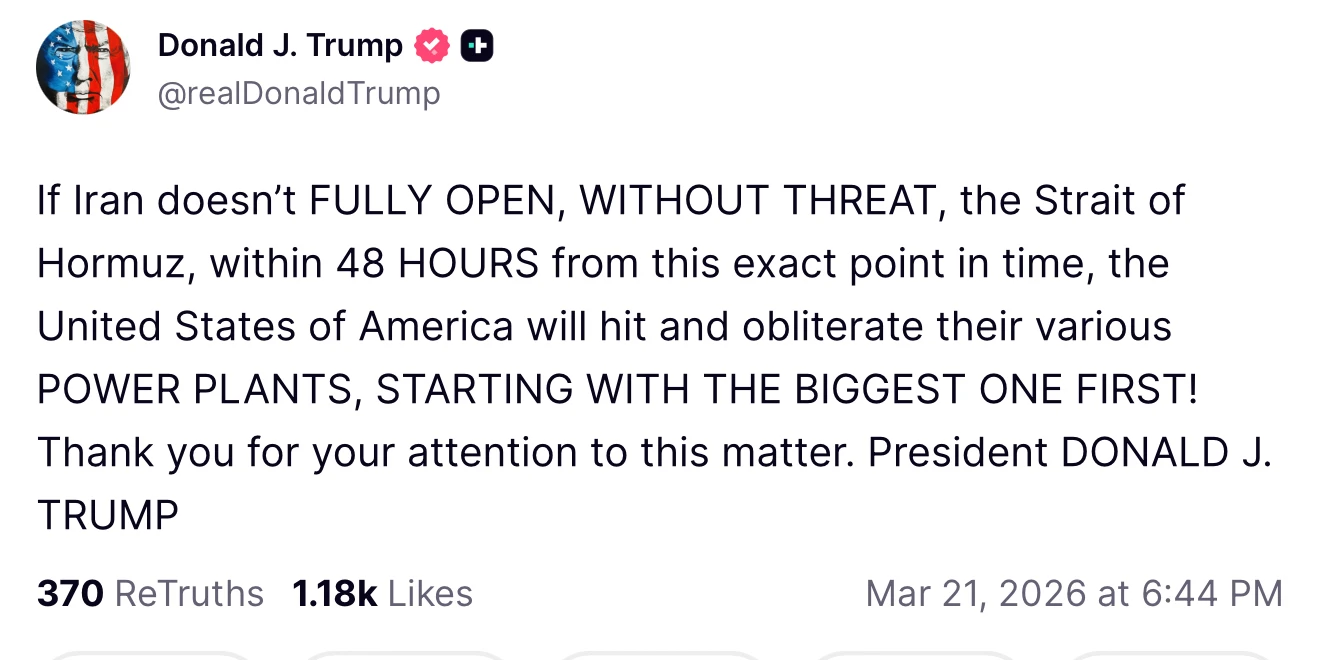
Iran and the United States traded threats over critical energy infrastructure in the Middle East, with Tehran vowing on Sunday to retaliate if President Trump followed through on a warning that he could target Iranian power plants.
Mr. Trump said late Saturday that the United States would “obliterate” the power plants — which millions of Iranians depend on — if Tehran did not fully open the Strait of Hormuz within 48 hours. The strait, a key oil shipping route, has been choked off by Iranian strikes.
Iran dismissed the ultimatum as it launched a new round of attacks on Israel and issued its own warning. Ebrahim Zolfaghari, an Iranian military spokesman, vowed on Sunday that if Iranian energy sites were attacked, it would strike more infrastructure in the region used by Israel, the United States and American allies, such as fuel depots and desalination plants.
Here’s a good discussion of how the Law of Armed Conflict treats attacks on energy targets, which is unsurprisingly complicated. Some preliminary conclusions on Russia’s campaign against Ukrainian energy infrastructure:
Although there is no prohibition on striking power infrastructure as such in IHL, only that which qualifies as a military objective is lawfully subject to attack. Almost certainly, some of the targets Russia is hitting do not. And even with respect to those targets that are military objectives, Russian forces are obligated to consider alternative weapons, tactics, and targets to achieve the desired effect if the alternative would result in less death, injury, or destruction for the civilian population. Without knowing more facts, compliance with this requirement is difficult to assess. But an attempt to avoid civilian harm has not characterized Russian operations.
Russian attacks must also comply with the rule of proportionality, which prohibits an attack when the expected collateral damage is excessive relative to the anticipated concrete and direct military advantage. An effect on civilian morale does not qualify as a military advantage, and almost certainly, some of the expected harm being suffered by the Ukrainian population is excessive to any potential Russian military advantage. Furthermore, in my opinion, the constant care requirement obligates Russian forces to try to avoid adverse consequences for Ukrainian civilians, even if those consequences do not qualify as collateral damage in the sense of the proportionality rule.
It would seem clear that at least some of the Russian power infrastructure attacks violate IHL. Sadly, this comes as little surprise in light of the rampant (and tragic) Russian practice of ignoring this body of law.
My reading is that it would be extremely difficult to justify attacks on Iranian power plants as deriving military advantage proportionate to the civilian damage inflicted. Even the Russians are primarily attacking power distribution rather than power generation, and their campaign is quite sketchy from a legal point of view. The US and Israel have more precise means of analyzing the Iranian energy grid and attacking the specific components that supply Iranian military forces than Russia, and are unlikely to suffer military disadvantage from a campaign plan that hits those targets specifically. So the devil is in the details… but it looks to me that the President is openly calling for violations of the Law of Armed Conflict, which is to say… war crimes.