Subscribe via RSS Feed

Category: movies

Inter-Inception

[ 90 ] July 26, 2010 | SEK

It appears as if my wife and I are the only two people on the face of the planet who hated Inception.  She walked out about an hour and change into it—immediately before the tedious exposition that made the rest of the film thuddingly predictable—and I followed shortly thereafter.  Spoilers follow under the fold.

Read more…

Eye of the Tiger!

[ 0 ] October 8, 2007 | Robert Farley

I’m in the midst of a five film long Rocky marathon on Spike. My thoughts…

  • The first film is an immortal classic, as long as one can accept melodrama. If you try to approach Rocky with any sense of irony, you’ve already given away the game; there’s nothing to like. But if you’re open to it, there really are some outstanding scenes. My favorite is when Balboa meets Apollo Creed’s promoter, with the expectation that he’ll be asked to be a sparring partner. Stallone demonstrates with his response to the invitation to fight Creed that he can really act; it’s unfortunate that he’s so rarely displayed that acumen since the first film.
  • I have little use for the second movie, as it seems not much more than a recapitulation of the first. There are some interesting things going on, I suppose, and in some sense the second film may be better than the third and fourth, but it simply fails to capture my interest.
  • The third film is perhaps the single best “white guy fears for his manhood when threatened by aggressive black guy” document on record.
  • SPOILER!!! Ivan Drago killed Apollo. Therefore, he deserves to die. There’s so much interesting going on in the fourth film that it deserves an entire post. Ivan Drago is a magnificent creation, and I find it endlessly fascinating that the Klitschko brothers essentially became Drago in the late 1990s and 2000s. By this point Rocky is nothing more than caricature, but since he wasn’t much more than that in the first film it’s not as if anything has been lost. I love the Gorbachev caricature at the end, and I also love the vision of industrial Soviet athletics. Frequent commenter MJD once said to me that the Olympics have lost interest since the end of the Cold War because they no longer represent the confrontation of Eastern methods against Western, and I think that the Western interpretation of that conflict is nowhere on better display than in this film.
  • … I have to add that the James Brown sequence in the fourth movie is such a magnificent distillation of the right-wing conception of foreign policy. All of America’s cultural achievement are significant, except when we have to fight the Russians. Drago simply ignores the pageant and proceeds to kill the unprepared Creed, just as the Russians will mess us up if we devote too much attention to trivial pursuits such as art and music instead of preparing ourselves for the inevitable confrontation…

McCarthy on Film

[ 0 ] September 20, 2007 | Robert Farley

Erik points out that John Hillcoat of The Proposition is set to direct Cormac McCarthy’s The Road, with Viggo Mortensen starring as the father character. Like Erik, I have mixed feelings. I didn’t really care for The Proposition, so I can’t say that Hillcoat’s participation has me enthused. On the other hand, I think Mortensen is an inspired choice (based largely on his outstanding work in History of Violence), and I don’t think that The Road is unfilmable in the same way that I think Blood Meridian is unfilmable. Speaking of the latter, I’m extremely skeptical of this Ridley Scott project.

I’m psyched, however, about No Country for Old Men. It’s a weak novel, but weak novels can make fantastic movies, and there’s something weirdly appropriate to my mind about the mating of McCarthy with the Coen brothers. McCarthy’s Anton Chigurh was just strange and not terribly appropriate, but the Coens’ films often drop a strangely violent and alien character into the middle of an otherwise conventional narrative. I’m very optimistic.

Must-See Movie Pick of the day (week? month?)

[ 0 ] September 16, 2007 | admin

I saw Charles Ferguson‘s documentary “No End in Sight” last night. Here’s a clip:

The film, unlike many other documentaries that have been made about Iraq, focuses not on the days between 9/11 and the decision to send troops to Afghanistan, nor on the day-to-day experience of soldiers and civilians on the ground in Iraq, nor even on the crimes that took place at Abu Ghraib. The film zooms in on the time between the Bush administration’s decision to invade Iraq and the end of the first year (or so) of the war, and exposes the mammoth failures in planning and execution on the part of the Bush Administration and the officials it placed in Iraq. And all through the eyes and words of former Bush Administration officials in Iraq. It’s damning stuff. And it’s not more of the same stuff we already know. Of course, the depths of the Bush Administration’s incompetence are no longer shocking. But the details that emerge about its inability to create or implement a plan for “post-war” Iraq are shocking and enraging, even for those of us who have kept pretty close tabs on the action there. And it makes clear why the movie’s title is a reference not only to the seemingly interminable quagmire we have created in Iraq, but also to the Bush Administration’s inability to envision anything beyond their bombs and oil.

Mainstream Movie Report: Apatow Edition

[ 0 ] September 4, 2007 | Scott Lemieux

I’m way behind on my movie blogging, so the two Apatow movies seem like a good place to start. Asthetically, they’re evidently both extremely funny. The first two-thirds of Knocked Up are more consistently funny as any Hollywood movie in a long, long time. Perhaps even more relevant than Freaks and Geeks (and the underrated Undeclared) is Apatow’s involvement in the best television comedy of my lifetime; it’s nice to see the art of the multiple good one-liners come back. It does sag a bit towards the end. I wasn’t surprised that, having systematically recycled the most exhausted sitcom cliches for his clever ploy to demonstrate the ineptitude of most television critics Studio 60 on the Sunset Strip Aaron Sorkin climaxed with a childbirth plot — highly appropriate because whereas most cliches are cliches because they used to be good hooks as far as I can tell a childbirth plot has never led to a comedically or dramatically good episode of television ever. The last part of Knocked Up isn’t nearly as bad, of course, but it does tail off noticeably as things move to the hospital. Even with that, it produces so many more laughs than the typical comedy that it seems churlish to complain. Superbad doesn’t peak as high and is more consistent, although it does overdo the sitcommy reaction shots and as many people have noted the cop subplot gets too much screentime. Obviously, the evolution of the teen sex comedy is unusually rapid: Porky’s-American Pie-Road Trip-Superbad is a lot of progress.

One potential complaint about both, which bleeds into the quality of the films, is that Apatow & co. haven’t created enough movement with the gender paradigm. Enjoying Knocked Up as much as the quality of the comedy merits does require getting over the utter implausibility of virtually every aspect of the central relationship. (This isn’t to say that any aesthetically mismatched relationship will be implausible, but this one isn’t convincing in its details.) Interestingly, Ezra tries to salvage Superbad from similar charges with a charitable reading of the conclusion. I would like to agree but while I’m open to change my mind on a second viewing I don’t really buy it. IIRC Jules carefully avoids giving Seth even a sub silento permanent rejection at the party and the conclusion does nothing to negate the possibility of a mutual pairing-off rather than Jules strictly running interference.

Admittedly, it must be said that tensions derived from mismatches are a fruitful source of comedy, as both of these movies ultimately prove. Still, it would be nice to see some fruitful tensions other than the “shlubby guy scores with smart, nice, extremely hot woman for no obvious reason” relationship. At least Superbad avoids the “girl who looks like a model portrayed as ugly because she wears glasses and inevitably looks better before the makeover than after” routine…

Happily Repressed Memories

[ 0 ] July 23, 2007 | Scott Lemieux

Huh, until I found it scrolling through a list of the year’s worst films so far I had completely forgotten a picture about some kind of numerology horseshit starring Jim Carrey and directed by Joel Schumacher was released earlier this year. It would seem like a mortal lock for worst movie of the year even with the Tim Allen motorcycle thing and the Robin Williams priest thing, but then there was that Torture Porn For Nice Guys (TM) thing. Gawd, there’s been some horrible, horrible-looking movies this year; I can imagine Bay not even making the top 5. I assume that later in the year Kevin Smith will be directing a sequel to Jersey Girl

On the other hand, as I will get to writing about eventually, I can now unequivocally recommend two mainstream movies that have come out in recent months! Plus conceivably the worst movie I’ve seen in the theater since The Rock

On Sex(ism) and Ratatouille

[ 0 ] July 9, 2007 | admin

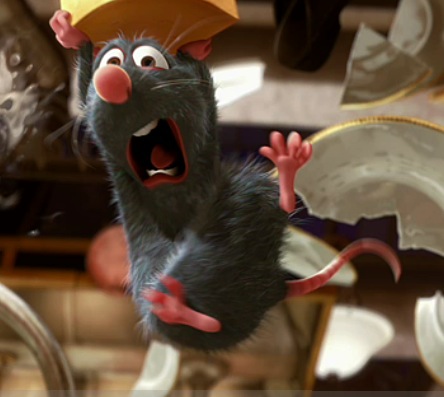
Wow, busy times around these parts this weekend. In no thanks to me. But I had a busy weekend of movie-watching, sun-enjoying relaxation. Part of this included going to see Ratatouille yesterday at a matinee showing (read: most of the audience had a single-digit bedtime and a single-digit age). As critic after critic has pronounced, the film is pretty fantastic. The animation is incredible, the humor better for adults than for kids.

There’s a minor but not major spoiler alert here…..

OK, so being the always-(hyper)alert feminist that I am, I was particularly struck by a scene in which Colette, a female assistant chef in the kithen of Gusteau’s, the restaurant where the action takes place, gives the protagonist (Linguini) a stiff talking to. She angrily tells him that she is the toughest cook in the kitchen. Her monologue comes complete with knife trick to prove her toughness. She’s had to be tough, she says, because haute cuisine is and has long been patriarchal and very very male. There’s no doubt that Colette is right. Fancy kitchens have long been the realm of men, in stark contrast to the kitchens of the home, (too) long thought to be the domain of women. And while I cheered internally at her “I am woman breaking down walls, hear me roar” approach, I couldn’t help but be a little disappointed at her tacit acceptance of the strcuture even as she tried to find a place within it.

As Margot Magawan wrote in a recent WIMN’s Voices post on the film:

In “Ratatouille,” the movie acknowledges this imbalance when Colette, a female human sous chef, gives a speech about how hard it was to succeed in male dominated kitchens. But this brief monolgue is simply an acceptance of sexism instead of a challenge to it.

When I complained to my mom and sister: “Why couldn’t Ratatouille have been female? Why no girls – again?” They said, “Didn’t you hear Colette’s talk? That’s how it is in the real world.” OK, let me get this straight: It’s just fine to stretch our imaginations to believe in a talking rat who can cook, but when it comes to gender roles, we
admire realism and authenticity?

Sure, sure, I know what you’re thinking. It’s a cartoon. Get over it. But that’s the thing. It’s a cartoon. Which means it’s got a huge audience of kids (even though the hardest laughs — by far — came from adults at yesterday’s showing). And time and again, these kids are presented with an image of boys as leads, adventurers, magicians, even cooks, while girls are the princesses in need of rescue (even Colette, here, turns out to be a tough girl with a soft feminine center) or sidekicks. And the roles seem to be continuing into adulthood.

So while I was bowled over by much of Ratatouille (not least of which the precision and beauty with which they recreated a fancy french kitchen), when it came to gender representation, I couldn’t help but smell a rat.

Bad pun intended.

John McClane

[ 0 ] July 4, 2007 | Robert Farley

Against my best judgment, saw Live Free or Die Hard last week. It’s…. action packed.

I’m a big fan of the first and third films in the Die Hard series, especially the first. Willis’ McClane is an accidental action hero, which is a bit different than the reluctant action hero that dominates most other films; McClane ends up at One Nakatomi Plaza for random reasons, and ends up saving the day through luck and accident as much as skill. In the third film McClane is similarly thrown into a situation not of his own choosing, and Willis does a fine job of depicting, for the first half of the movie, a guy who would love nothing more than to simply go home and sleep off his hangover. Moroever, the first movie has, as Eric Lichtenfeld has ably noted, the single greatest one-liner in the history of action cinema. Finally, both the first and the third films have appropriately classy, sinister Euro-trash villains, and some genuinely surprising plot twists.

Live Free or Die Hard really isn’t a sequel to those movies. Rather, it’s a movie in which Bruce Willis plays a character named John McClane, a character loosely based on a character also named John McClane that Bruce Willis has played in previous films. This is quite fitting, because Live Free or Die Hard is, unashamedly, a Frankenstein’s monster of action films. The villain is lifted from a combination of Swordfish and Charlie’s Angels. The F-35 sequence is borrowed directly from True Lies. The “damsel in distress” is lifted from the first Die Hard, as well as any number of other action films from Commando on down. The annoying sidekick is so familiar that I began to wonder how Vincent Chase would have done in the role, and then started to think about where I could find a place in the movie for Johnny Drama (maybe replacing Kevin Smith?) Oh yeah, Kevin Smith is in the movie, for some reason. The villainess is borrowed from the second X-Men movie. The plot has something to do with the internet (“Hey, let’s make an action movie!” “What about?” “I don’t know; the internet? Lots of people talking about the internet these days.”) and proceeds in an utterly predictable manner. Willis and the script writers have abandoned any effort to make McClane human, and we actually get a “man’s gotta do what a man’s gotta do” type speech.

Here’s the kicker, though; they actually manage to pull it off, or better than could be reasonably expected, anyway. The derivativeness doesn’t matter, because the film works on two levels. First, the action sequences are genuinely impressive. Utterly unbelievable, but genuinely impressive. The unbelievability is a feature, though, not a bug, because the film works best as parody. Parody demands liberal borrowing from other films, and LFODH works well as a respectful parody of the action-hero genre.

Anyway, while I can’t bring myself to actually recommend it to anyone (especially given how much I liked the previous films), it was certainly better than I expected.

Happy Fourth of July!

Thirteen (Spoilers)

[ 0 ] June 14, 2007 | Robert Farley

First things first, Ocean’s Thirteen is better than its predecessor, yet not as good as the first film. Given the characteristics of the first two, it would have been deeply surprising if this had not been the case. Spoilers aplenty ahead.

I was very surprised by Ocean’s Thirteen most fundamental weakness. Who would have thought that the combination of Pacino and Barkin would prove so toothless, both on camera and as part of the structure of the story? Andy Garcia received insufficient credit for his work in the first two films. His Terry Benedict, a channelling of Michael Corleone without the conflicted soul, was at the same time sophisticated and genuinely menacing. It becomes clear enough early in the first that Benedict wouldn’t hesitate to wipe out the entire crew, and indeed this menace drives the entire second film. Moroever, the heist in the first film works by playing off Benedict’s sophistication and brutality. Danny and the boys don’t so much outsmart Benedict as turn his brilliance and ruthlessness against him. It’s also clear, even in the first, that Benedict does not consider the fight over. If Danny and the boys are to be judged by quality of victim, Benedict proved an appropriate foil in the first two films.

Furthermore, it’s not surprising that the only watchable scenes in Ocean’s Twelve come when either Garcia or Vincent Cassel are on screen. That time out, Benedict proved so menacing that the gang decided to submit rather than try to fight. They manage to defeat Toulour, but win by redefining the game rather than outperforming him. The method ended up being cinematically unsatisfying (wholly apart from the horrificaly indulgent Julia Robert’s arc), but the viewer nevertheless comes away with an understanding that, by defeating Toulour, the gang has achieved something. Toulour’s menace survives the second film just as Benedict’s survived the first.

So, given that a faux-Michael Corleone was so great in the first, what could be better than bringing in Don Coreleone himself for the third? Giving Pacino Barkin as a lieutenant also seemed inspired on paper. But what do we get? Nothing. Pacino’s Bank ends up being a mildly charismatic thug, quickly overtaken by events and hanged by his own ineptitude. He’s supposed to be a brilliant and ruthless operator, even more so than Benedict, but he falls for a series of pathetically transparent scams, from Pitt’s earthquake machine to Reiner’s (weak) impersonation of a hotel reviewer to the Bernie Mac-Andy Garcia kabuki with the domino machine. Sure, Terry Benedict fell for the Lyman Zerger con, but it was in part his distrust of the situation that made the con work. Barkin proves ridiculously easy to deal with. Simply put, Willy Bank would not have survived long enough in a world of Terry Benedict’s to prove a threat to Ocean and the crew. The competition ended up being as one sided as this year’s NBA Finals.

That said, there are plenty of cheerfully interesting moments, and Soderbergh has a way with Las Vegas. The Godfather quips were amusing enough, and Gould was an inspired catatonic. The Mexico stuff was kind of funny. Overall, I think I have to concur with Matt Duss:

I kind of saw it as the movie that Ocean’s Eleven might have been, had that movie not been so much better than it should have been.

Spiderman III (spoilers aplenty)

[ 1 ] May 8, 2007 | Robert Farley

Saw Spiderman III on Saturday. Although I’m as incredulous as Scott regarding Matt’s self-assessment as “usually a relatively harsh judge of films”, I do think Yglesias is more or less correct on the merits of the film. It’s a decent summer popcorn flick, flawed, and not the disaster that some have argued.

SPOILERS AHEAD

I suspect that much of the negativity about the third film stems from how poorly it stands up to the second. I think that we have an “Empire Strikes Back” problem. Thinking people everywhere understand that Empire was, by far, the best of the original Star Wars trilogy. Jedi appears to be a weak entry in large part because of the strength of Empire, but Empire, and not Jedi, is the real outlier. Similarly, Spiderman III really isn’t any worse than the first Spiderman flick. The problem is that Spiderman II was much, much better than it had any right being. One of my favorite scenes from the second movie comes when Ursula (Parker’s next door neighbor) brings him some milk and cake. He accepts, and they sit down and eat the cake. It’s a complex, interesting, understated, and generally outstanding scene, but what struck me as most notable is that it had no business whatsoever appearing in a summer popcorn blockbuster. For whatever reason, Spiderman II, like Empire, transcended the form. A repeat performance was too much to expect. Nevertheless, there were some genuine problems with the execution of Spiderman III.

The structural problem in the film is the Flint Marko character. Long story short, he doesn’t add anything, and should have been cut entirely. There was ample plot to be had in the continuing rivalry between Parker and Harry Osborn, and the developing rivarly between Parker and Topher Grace’s Eddie Brock. Excising Marko would have given Raimi more time to develop Venom, and potentially to create a relationship between Venom and Osborn’s Goblin. The tension with Mary Jane’s work situation (which I thought was well done) could have remained, as could her potential rapproachment with Harry. There was also the potential for an evil Alfred-Bruce Wayne relationship between Osborn and his butler, but this was hardly explored. Marko did nothing but re-open a plot line that was settled in the first two films, and on which there was little productive left to say. I like Thomas Haden Church as much as the next guy, and perhaps Raimi was seduced by the Sandman special effects, but it was a character and plotline for some other movie.

The ending of Spiderman III has also been justly criticized. As noted above, I think that the fundamental problem arises from the inclusion of the Flint Marko character, as an interesting three way duel could easily have been developed between Spidey, Venom, and Goblin, and would even have allowed the deathbed conversion of Osborn. Instead, we get an extraordinarily predictable and hackneyed fight (sound hurts the symbiote, for some reason that’s completely unclear) that doesn’t really cap off the narrative (since Spidey doesn’t even really know who Venom is before the fight starts). Most annoying, however, is how Raimi uses the crowd and the media to help pace the fight. To go against my own advice in the previous paragraph, let’s compare the use of the crowd in the train fight sequence of S2 with that of the final sequence of S3. In S2, the train passengers are an integral part of the plot; they’re the reason Spidey and Ock are there, and they affect (and are affected by) the behavior of both. In S3, the crowd is simply there; its presence has no impact on the fight, and there’s no investment on the part of the crowd above the excitement of the battle itself. Now, surely it would have been implausible to stage a giant fight in the middle of Manhattan with no one watching, but that fact doesn’t determine how the crowd was to be used. Even spectators would have been better than cheerleaders; we don’t need the gasps and applause of the crowd to tell us when Spidey is doing poorly or well.

On this last point, my filmgoing companion noted that it’s still a bit uncomfortable to watch scenes of falling buildings and debris in New York City. I think that’s right, and I think it’s quite interesting that the Spiderman trilogy has almost entirely avoided any reference to 9/11. The finale of the first film, of course, was supposed to occur between the Twin Towers. Events made that finale impossible, although I do remember a early film poster at a Seattle poster shop that showed a reflection of the Towers in Spidey’s eyes. Instead of a price, the post simply had a note saying “Inquire Within”. The second and third films don’t touch on 9/11 at all. Now, this wouldn’t be notable (it’s a popcorn movie, after all) except for the fact that the other recent New York superhero movie did deal with the September 11 attacks. No one mentioned 9/11 explicitly in Superman Returns, but they didn’t have to; September 11 infused the film. The early scene of Superman rescuing a crashing jetliner and landing it in a baseball stadium could not but evoke memories of 9/11. More important, the film was structured around the questions “Where did you go?”, and “How did we manage to get along without you?” The first carries with it an implicit rebuke of Superman for abandoning Metropolis to the depredations of evil-doers, while the answer to the second is, again implictly, “Not very well.” Superman Returns is a sad film, and part of that sadness comes from the recognition that something horrible that only happens to New York in comic books happened to New York in real life, and that Superman wasn’t around to stop it.

Each approach has its merits, and Spiderman’s focus on smaller problems (street crime, saving babies from fires, etc.) is probably more true to the ethos of the character than some grand fight against ideologically driven supervillains. It’s Superman (who I believe is an illegal alien) who has always been burdened with the ideological baggage. Of Batman I have little to say. Anyway, the critics are correct to say that Spiderman III is overlong and has some serious structural flaws. Nevertheless, I found the film entertaining, and I think that there’s still some value in exploring the Spiderman character.

Cross-posted to the attractive new TAPPED.

Critical Ineptitude

[ 0 ] April 15, 2007 | davenoon

Among my numerous intellectual deficits, I’m not a very articulate film-and-TV-talking-guy like Scott, Rob, or DJW. I haven’t watched television since August, and I’ve seen exactly two films in the theater since my daughter was born almost a year ago. Both of those latter excursions (Nacho Libre and 300) were wretched, and both were seen with a colleague who will never be able to speak the words, “I was thinking of going to see [X] this weekend — do you have any interest in–” without being swatted atop his balding pate with the nearest blunt object.

Notwithstanding my bad luck and recent distance from most things cultural, I like to think I have a pretty good sense of what sucks and does not suck, even if my ability to explain why more closely resembles the idiom of Beavis and Butthead than that of my co-bloggers.

Having said that, I hope I’ll not find much disagreement that Glenn Reynolds’ favorite new film blogger must be some sort of clown:

Here’s part of his review of Little Miss Sunshine, a review the Ole Perfesser seems to find insightful in some way:

What is billed as a charming and quirky comedy is actually a painful exercise in “let’s make fun of the dysfunctional family.” If you get the impression I didn’t much like the picture, you may be right.

This one hour and 43 minute study in misery and seat squirming is the story of a truly sad family and their odyssey to make it to the youngest daughter’s “Little Miss Sunshine” beauty pageant. “Sunshine” is actually reminiscent of funnier movies, like National Lampoon’s Vacation, even down to certain plot points that I won’t give away here. But while the latter actually amused, Little Miss Sunshine simply made me want to hide my face in my hands and pray for the end credits.

As the cliche has it, reasonable people can disagree over the merits of LMS. I loved it — nine months after everyone else did, apparently — but could imagine that someone else might not. I happen to enjoy films about people coming to grips with their own limitations.

On the other hand, I don’t think any reasonable person could have this to say about West Wing:

Once every so often, you find a TV show that transcends the standard fare, and that achieves the extraordinary. For me and many others the first four seasons of The West Wing did just that. I remember one commentator being astounded that policy wonk issues could form the basis of a successful hour-long drama. But that observation misses the point. It wasn’t so much the stories that grabbed the viewer, it was the incredible pacing and dialogue. Watching a West Wing episode was not only a pleasure for those who thrive on snappy repartee, it was also a challenge. Creator-writer Aaron Sorkin paces his stories along so fast, you better pay close attention, or you’ll miss something good.

Or this:

The Shawshank Redemption would have been the best movie of the year any year. Except 1994, when it was released. That was also the year of Forrest Gump. Talk about an embarassment of riches!

“Embarrassment” strikes me as the appropriate term, but perhaps not in the way it was intended.

In Defense of Iwo

[ 0 ] March 30, 2007 | Robert Farley

In a March 3 American Prospect article, Charles Taylor did a fine job of debunking the myth of Clint Eastwood. As Scott has noted, while Eastwood is a talented filmmaker, his catalogue is uneven, and the worst work nearly unwatchable. Unfortunately, in the process of criticizing Eastwood, Taylor gets his latest work, Letters from Iwo Jima, badly wrong.

Taylor and Stephanie Zacharek have argued that Eastwood presents a picture of the Imperial Japanese Army that takes insufficient account of its brutality. In World War II, the Japanese Army operated with barbarity against both civilian and military foes. The IJA committed many atrocities in its eight year was against China, including most notably the Rape of Nanking. After capturing the Chinese capital, the IJA ran wild, raping and beheading civilians without any apparent purpose other than terror. In Manila in 1945, a retreating and isolated Japanese army turned its frustration on the local population, massacring thousands before American forces could retake the city. The Imperial Japanese Army’s treatment of prisoners was similarly brutal. After defeating a combined Filipino-American force at Bataan, the IJA marched 75000 American and Filipino troops nine days in horrific conditions, killing thousands. Similarly, 16000 surrendered Allied troops died in slave-labor conditions during the construction of the Burma-Thailand Railway. The issue of Japanese use of “comfort women”, or forced sex slaves, has again come to the fore as a consequence of the unfortunate comments of Prime Minister Shinzo Abe. Indeed, the depredations of the Imperial Japanese Army had effects beyond the murder of its victims. As Christopher Bayly and Tim Harper detail in Forgotten Armies, the brutality of the Japanese Army in China, Burma, Malaya, and elsewhere helped undercut support from anti-colonial groups that might otherwise have been sympathetic with, or at least neutral toward, Japan’s pan-Asian propaganda.

Taylor and Zacharek contend that because Eastwood doesn’t depict the Japanese Army massacring civilians or killing very many American prisoners, Letters from Iwo Jima amounts to a whitewash. Of course, there were few civilians on Iwo Jima for the Japanese Army to massacre, and because of the tactical situation it had very few opportunities to brutalize and kill American prisoners. This left Eastwood with several options. He could refrain from making a movie depicting the Japanese view of the Battle of Iwo Jima. He could demonstrate Japanese brutality through flashbacks, an effective if clumsy device. Finally, Eastwood could, instead of giving us obvious examples of Japanese brutality, show us an Army that would, given the opportunity, commit atrocities. Eastwood chose the last, and did his job with uncharacteristic subtlety. He told the story so well, in fact, that some critics seem to have missed it entirely.

Taylor saw a stylized, honorable Japanese Army that bore no relationship to the real Japanese Army. Eastwood showed me, on the other hand, an army capable of committing the atrocities of Manila and Nanking. Eastwood ably demonstrated the character of the Imperial Japanese Army, both how it understood itself and how that understanding could break down into an orgy of unrestrained, irrational violence. Early in the film, as the Americans take control of Mount Suribachi, a group of Japanese soldiers is ordered to abandon their position and retreat to a more defensible point. Infused with “warrior ethos” several in this group decide to commit suicide (using hand grenades) instead of obeying orders and retreating. The rest of the group, less enthusiastic about detonating themselves, nevertheless complies because of both overwhelming social pressure and the very real threat of battlefield execution. This scene is key to Eastwood’s understanding of the Imperial Japanese Army, but neither Taylor nor Zacharek mention it. Along with a few others, this scene demonstrates that Eastwood understands the internal problems that helped lead the IJA to commit atrocities.

Armies do not, by and large, commit atrocities because they’re full of horrible people. Instead, they engage in horrific behavior because of institutional and situational factors. Military units that display extreme ideological commitment easily dehumanize the enemy, leaving just a few short steps to atrocity. Even then, committing atrocity doesn’t often appeal to a lot of soldiers. Social cohesion and pressure to conform, especially in a culture that puts a particularly high value on conformity, can lead soldiers to temporarily forget their own values in favor of group togetherness. Terror also pushes soldiers to commit atrocities, both in response to threats from their own comrades and as a reaction to fear of the enemy. Finally, while some armies commit atrocities in response to direct orders from superiors, many don’t. Military units that respond poorly and erratically to central orders tend to take matters into their own hands, including relations with civilians and prisoners of war. The political imperative to treat conquered civilians and captured prisoners humanely requires tight discipline at the unit level, as the urge for vengeance and rampage can easily take over a group of soldiers.

Eastwood gives us an army designed for atrocity. He depicts the Japanese Army as enthusiastic to the point of irrationality, deeply invested in social cohesion and group conformity, terrified both of itself and of the overwhelming American power, yet with extremely poor chain of command discipline. This is an army that would, given the opportunity, do terrible things. That it lacked the opportunity on Iwo doesn’t change the fundamental nature of the organization. Eastwood reminds us that the men of such an army, in spite of all the evil that they could do, still clutch pictures of their loved ones when they die. Moreover, he shows us the limits of what professional soldiers can do within such an organization. While Taylor saw the depictions of General Kuribayashi and Baron Nishi as a mixture of archetypes borrowed from war and samurai movies, I saw a couple of officers trying to win a battle, hindered not just by the Americans but also by the limits of their own organization. Perhaps unsurprisingly, the characteristics that make an army likely to commit atrocities also make it ineffective on the battlefield. The Japanese Army performed unevenly during World War II, combining occasional brilliance with consistent problems of discipline, supply, and organization. The suicidal tendencies that Kuribayashi has to deal with make it harder to defend Iwo, not easier.

Eastwood doesn’t literally show us the Rape of Nanking. Instead, he does something far more important; he shows us the army capable of committing the Rape of Nanking, and the Bataan Death March, the Burma-Thailand Railroad, and the atrocities in Manila. Both Flags of Our Fathers and Letters from Iwo Jima attempt to understand the battlefront in terms of the home front. In the former, Eastwood is at his clumsiest and most obvious. In the latter, he’s at his most subtle. Letters from Iwo Jima should be understood as part of a family of films, along with Breaker Morant, Battle of Algiers, or The Grand Illusion, that conceptualize the practice of war as distinct from but embedded within a larger social universe. It’s among Eastwood’s best work, and critical over-appreciation of Eastwood’s other films shouldn’t obscure its quality.

Cross-posted to TAPPED.

Page 1 of 212
  • blogroll

  • Brad Delong
  • Crooked Timber
  • Daily Kos
  • Danger Room
  • Eschaton
  • Ezra Klein
  • Feministe
  • Talking Points Memo
  • Feministing
  • Glenn Greenwald
  • Juan Cole
  • Monkey Cage
  • Switch to our mobile site