Subscribe via RSS Feed

Author Page for Robert Farley

rss feed

What About That Lawyer?

[ 0 ] May 3, 2005 | Robert Farley

This excellent post on Rosemary’s Baby reminded me of some thoughts I’ve had about another peripheral character in an outstanding film. In this case, the character does not actually make an appearance, but nonetheless plays an important role. I’m thinking about the defense attorney in Twelve Angry Men.

A spoiler alert on a fifty year old movie is pointless, but proceed at your own risk. Recall that Twelve Angry Men concerns a jury deciding the fate of a young defendant accused of murdering his father. The first vote in the jury room goes 11-1, with only Henry Fonda dissenting. Fonda’s only reason for dissenting is that insufficient time has been given for deliberation. Slowly but surely, the jury reconsiders apparently damning evidence and finds that it doesn’t hold together. The film ends, of course, with an acquittal.

Among the most damning pieces of evidence considered by the jury is the attitude of the defense attorney, who was apparently unable to demonstrate even the faintest enthusiasm on behalf of his client. One juror remarked that the defendant must be guilty, as even his own attorney didn’t believe him. The defense attorney failed to impeach even the weakest of the prosecution witnesses. Fonda opined that the lawyer had little reason to be enthusiastic; the case carried no money or prestige, thus the attorney had no incentive to work hard for his client.

So. . .

Whenever I watch the movie, I like to think about what the defense attorney is doing. I imagine that he expects a quick conviction, after which he’ll make a brief reassuring comment to his client before going home, getting drunk, and forgetting about the whole experience. I wonder if he thinks the defendant is guilty, or just doesn’t care; I suspect it is the former. The jury deliberates for longer than he expects, and, as the second hour begins, he may begin to wonder what’s taking them so long. At about two hours, they announce the return of the verdict, and his fears are allayed; no jury, given this evidence, given the race of his client, would return a not guilty verdict so quickly. He feels safe, because his own inept half-assed performance won’t matter, and a guilty man will receive the punishment he deserves.

Then, the jury returns a not guilty. The prosecutor is surprised, no doubt, but also probably understands that several elements of his case are weak. The defense attorney, unable and, really, unwilling to find the holes in the prosecutor’s case, is shocked. He looks to his client, to the prosecutor, and to the jury in an effort to confirm the unbelievable verdict. The defendant is concerned; he feels he should be happy, but his lawyer looks almost sick.

Eventually hands are shaken, and the defense attorney leaves the courthouse. Where does he go? I think he heads to the closest bar, and starts hitting the scotch. How does he explain what just happened? Does he appreciate that his own ineptitude almost sent a young man to prison for thirty years? Does he believe that the jury made a mistake, and that a guilty man has gone free? Or does he manage to convince himself that his defense was actually brilliant, and that the defendant owes him his life?

My guess is a little #1, followed up by a lot of #3 as the empty glasses accumulate. But what happens then? Does he use the experience to become a better attorney? In bitterness, does he quit the law altogether? Or does he simply become a bitter, angry, pathetic alcoholic?

I think he becomes Frank Galvin.

Fog of War Wrap-Up

[ 0 ] May 2, 2005 | Robert Farley

Last Tuesday, I sat on a panel following a screening of Errol Morris’ Fog of War. The panel went very well; the speakers all had interesting things to say, the questions were good, and a fair percentage of the audience stayed after the film ended. My co-panelists were Lance Bennett, UW political science and communication professor, and Roger Morris, who worked in both the Johnson and Nixon administrations on Vietnam policy.

The latest viewing of Fog of War crystallized some of my disquiet about the project. Sure, McNamara should be commended for not taking the Henry Kissinger route and explaining how Vietnam was critical to the larger strategy of containing the Soviet Union, etc. But, that only goes so far, and Morris really doesn’t try to push McNamara any farther than he wants to go. Morris gets what he wants from McNamara, which is an admission that Vietnam was a costly, unnecessary mistake. That’s fine, but it’s not the whole story. What McNamara’s account lacks is a genuinely reflective account of how the mistake was made, who was responsible, and why so many people went along with it. Morris could have pressed McNamara, but he doesn’t.

Most irritating, Morris doesn’t try to challenge McNamara even when Stay-Comb Bob is clearly lying. “In a sense,” McNamara didn’t know about the attempts to assassinate Castro, and “in a sense” he and Kennedy weren’t aware of the plot to kill Diem. What the hell does that mean, exactly? How can you know something like that in one sense, but not in another? Perhaps Morris’ challenges didn’t make the cut, but there would be a certain value in uncovering McNamara’s project. It’s wrong to think McNamara is coming clean, because he’s not. He’s painting a picture, and he wants us to see some things and not others. Challenging him on camera would at least give some indication that he’s giving a performance as much as a confession.

The most interesting parts of the film come not in the semi-confessional Vietnam segments, but rather in McNamara’s discussion of World War II. The firestorming of most of urban Japan remains less politically controversial than most anything associated with Vietnam, despite the fact that the criminality is, if anything, greater. Because of this, McNamara’s discussion of WWII is more genuine than his discussion of Vietnam. We get the sense that he both admires and is horrified by Lemay. Unfortunately, the admiration strikes me as genuine, while it seems that he is horrified because he ought to be horrified, which is a different thing. McNamara describes himself as being critical to the March 10 firestorming of Tokyo, which incinerated 100000 Japanese civilians. He relates his role in a matter-of-fact style, without all the confessional nonsense that we see in the Vietnam scenes. It is here, I think, that we see the real Bob McNamara; the arrogant son-of-a-bitch capable of making awful decisions (and I mean awful in every sense of the word), without consideration for their moral and ethical consequences.

Professor Morris pointed out one of the film’s biggest shortcomings, which is its depiction of the relationship between McNamara and LBJ. Johnson is depicted as a bully in the film, driving the hapless McNamara into an ever deeper commitment to Vietnam. This is a half-truth. Yes, LBJ was a bully, but he respected those who would stand against him. The problem was that McNamara never made an effort to do so. McNamara never tried to steer Vietnam policy in the direction he now tells us he wanted it to go. Rather than standing up to power, he went with the flow. Some indication of this in the film would have been nice, because it transforms our understanding of the critical conversation between LBJ and McNamara. In McNamara’s version of events, LBJ indeed seems the bully, willing to walk all over Kennedy’s memory and his preferred policy in a mad drive to deepen the commitment to Vietnam. McNamara is unable to stand against his President so, loyal to the end, he does his best to make that policy a reality. This is, of course, exactly how McNamara wants us to think about his relationship with Johnson. A more nuanced account, one that took into consideration Johnson’s dependence on his advisors, his intelligence, and his personal style, makes this encounter come across much differently. Rather than the troubled but loyal servant that McNamara likes to think of himself as, we would see a flexible reed, bending in whichever direction the wind blew.

Morris could have shown that, but he didn’t. Fog of War is a good film, but also an important missed opportunity.

Capabilities

[ 0 ] April 29, 2005 | Robert Farley

North Korean ballistic missiles armed with nuclear weapons are terrifying things, no doubt. The possibility of their existence makes me just a bit happier to be moving to Lexington, where I only need worry about Russian, British, and French ballistic missiles.

However, I can’t give our Dear Leader a pass on this one:

At a White House news conference on Thursday, President Bush said that given the uncertainties, he was worried about the progress North Korea had made on its nuclear program under its leader, Kim Jong Il. “There is concern about his capacity to deliver,” he said. “We don’t know if he can or not, but I think it’s best when dealing with a tyrant like Kim Jong Il to assume that he can.”

That sounds reasonable, and we almost don’t notice that we’ve been bait-and-switched. What the President is doing, ladies and gentlemen, is deriving capabilities from intentions. Instead of referring to any actual intelligence, he derives from the expected intentions of Kim Jong Il the capabilities that North Korea has at its disposal. Again, this sounds almost reasonable until we remember that assessing intentions is actually much, much more difficult than assessing capabilities, and that trying to derive the latter from the former is an exercise in futility.

Because the Soviet Union hates freedom and wants to destroy us, it must be spending three times as much on defense as any evidence we have suggests. Because Saddam Hussein hates freedom and wants to destroy us, he must be hiding the stockpiles of WMD that we can’t find. Because Hugo Chavez hates freedom and wants to destroy us, he must be assembling a vast army to assail us.

Works every time. Try it at home!

In other news, I must apologize for the relative paucity of posts over the last week; life intrudes. Likely no posts this weekend, either.

[ 0 ] April 29, 2005 | Robert Farley


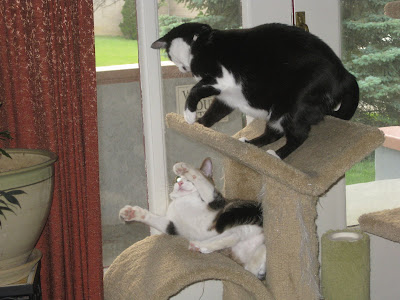
Friday Cat Blogging. . . Stromboli Posted by Hello

In Chile, Pensions Grow on Trees

[ 0 ] April 28, 2005 | Robert Farley

Dave and Erik do the necessary work of flushing John Tierney’s latest tripe on the Chilean privatized pension system.

The only thing that surprised me about Tierney’s column was how far behind he is on the Republican message. The Chilean “success” was trashed several months ago, but perhaps John didn’t receive the memo. In the future, he should try a bit harder; it can’t be that difficult to find a single relatively representative Chilean who has derived some benefit from the pension system. Also, I thought that the boys at Tech Central Station had moved beyond the unrepresentative supporting anecdote and toward the poorly manufactured supporting statistic.

Kristof?

[ 0 ] April 25, 2005 | Robert Farley

When he’s not buying Thai prostitutes, Nick Kristof occasionally gets one right.

But if the Bush administration had just adopted the policies that Colin Powell initially pushed for – and that Mr. Bush largely came to accept several years later – then this mess could probably have been averted.

You don’t have to take it from me. Charles Pritchard, the ambassador and special envoy who was the point man for North Korea in the first Bush administration, says of this administration’s decision-makers: “They blew it.” Another expert still involved in North Korea policy puts it this way: “Their A.B.C. approach – ‘Anything but Clinton’ – led to these problems.”

A bit of background: North Korea made one or two nuclear weapons around 1989, during the first Bush administration, but froze its plutonium program under the 1994 “Agreed Framework” with the Clinton administration. North Korea adhered to the freeze on plutonium production, but about 1999, it secretly started on a second nuclear route involving uranium.

That was much less worrisome than the plutonium program (it still seems to be years from producing a single uranium weapon), and it probably could have been resolved through negotiation, as past crises had been.

Instead, Mr. Bush refused to negotiate bilaterally, so now we have the worst of both worlds: that uranium program is still in place, and the plutonium program is churning out weapons material as well.

I’m uncertain of some of Kristof’s data. In particular, there’s not a ton of really good evidence regarding how many nukes North Korea has, and while Kristof probably knows more people that I do, he doesn’t really provide a basis for his assertions. On the whole, however, he’s right on target. The “anything but Clinton” policy pursued by the Bush administration in 2001 and 2002 has led to a situation in which there are no good options other than the Clinton policy, on worse terms than we could have achieved three years ago.

Unsurprisingly, John Bolton is right in the middle of the whole mess. Indeed, he has pursued, rhetorically at least, a hard line against North Korea even after the rest of the administration gave it up.

Seattle Event: Fog of War

[ 0 ] April 25, 2005 | Robert Farley

Seattle area readers,

There will be a free screening of the Fog of War tomorrow from 6-9pm at the HUB Auditorium, under the auspices of Pi Sigma Alpha, UW’s Political Science Honor Society. Dr. Lance Bennett, Professor Roger Morris, and myself will apparently answer questions about the film and about American foreign policy more generally following the screening.

Come one, come all.

Take the Quiz

[ 0 ] April 25, 2005 | Robert Farley

Final exam questions at Jim Evans Academy of Professional Umpiring.

I scored 7/10 on the True-False, 3/4 on the Make the Call, and 3/4 on the Fair or Foul.

UPDATE: Fair or Foul is here, and answers are here.

Challenge Standings: Week 3

[ 0 ] April 25, 2005 | Robert Farley

Dave Noon takes the lead!

Axis of Evel Knievel, Dave Noon: 803
Discipline and Punish, Scott Lemieux: 795
Swinging at Space, Kirk Jepsen: 765
The Spot, Dave Watkins: 762
New Mexico Alterdestiny, Erik Loomis: 746
Oregon Bearded Duck, Rob Farley: 570

I wonder how my team got quite this bad. . .

What She Said

[ 0 ] April 24, 2005 | Robert Farley

From Belle Waring:

Look, my country is better than this. Or this. Just. Stop.

I know I’ve related this before on my own blog, but my grandfather was an OSS spy in WWII. In one of the letters he sent home to my grandmother he describes how he met up with US ground troops who had just taken a French village controlled by a particularly awful German captain. He relates how his first impluse was to beat the shit out of the guy, knowing what he did about what the man had done. But he just gave him a cigarette instead. I don’t remember exactly what he said in the letter, but it was basically that the German was surprised at his mild reception, and my grandfather told him that was what happened when you were taken prisoner by Americans, and that we were better than them, better by a long shot. Anyone who thinks Osama bin Laden is more of a threat to the US than the Axis is welcome to come to East Hampton to get hit on the head with a lead pipe by my grandpa. He’s still pretty spry. Also, just stop.

That’s Kind of Cool. . .

[ 0 ] April 23, 2005 | Robert Farley

Via Wolcott.

The Venezuelan government has printed one million free copies of Don Quixote to mark the book’s 400th anniversary.

Venezuelan President Hugo Chavez urged everyone to read Miguel de Cervantes’ Spanish classic.

He called on everyone to “feed ourselves once again with that spirit of a fighter who went out to undo injustices and fix the world”.

“To some extent, we are followers of Quixote,” he told viewers of his Hello President TV show.

The Venezuelan edition contains a prologue written by Portuguese Nobel literature laureate Jose Saramago.

The free copies will be handed out in public squares this weekend, said Mr Chavez.

The Case Against Humanity

[ 0 ] April 22, 2005 | Robert Farley

Erik at Alterdestiny has an interesting post on the subject of “ecofascism.” In short, Erik is troubled by what he believes are some anti-humanist tendencies in the American environmental movement. I’m not sure I agree, but the steady invocation of Teddy Roosevelt and the recent difficulties of the Sierra Club with a virulent anti-immigrant faction lend support to his argument.

Could environmentalism be taken over by right-wing thugs who tie environmentalism up with reprehensible ideas. I believe the answer to be yes. The major point that I worry about is the anti-humanism that is so wrapped up in American environmentalism. I believe this problem to be worse in America than in Europe. In Europe the lack the wilderness and the sheer population density of the place has generally led to an environmentalism that focuses on the problems of people, particularly pollution, nuclear power, urban environmentalism, etc. In America, environmentalism is, and has been for most of its history, specifically aimed to separate most people from the environment. The emphasis on wilderness and wildlife protection, while worthy projects, has demonized people as bad and wolves as good, let’s say. People are only supposed to enter nature in very specific circumstances. Work is separated from the environment. Hunting and fishing are often demonized. We only are supposed to interact with the environment in very specific ways. Access should be limited to those who deserve to go into the wilderness, says many environmentalists.

It’s pretty interesting, read the whole thing.

  • Switch to our mobile site